A GDPR-compliant document sharing workflow is the structured process by which organizations exchange documents containing personal data with external parties (clients, partners, investors, auditors) while meeting EU General Data Protection Regulation requirements. It covers data minimization at the source, secure transmission, controlled access, transparent monitoring, and lifecycle management. Doing this correctly is not optional: GDPR fines reach 4% of global revenue or €20 million, whichever is higher. Papermark ships GDPR-aligned defaults across its document-sharing and data-room products, with EU/Frankfurt hosting, a signed DPA, and a public sub-processor list.
Quick recap
GDPR (EU Regulation 2016/679) regulates how organizations collect, process, store, and protect personal data of EU residents - effective May 2018.
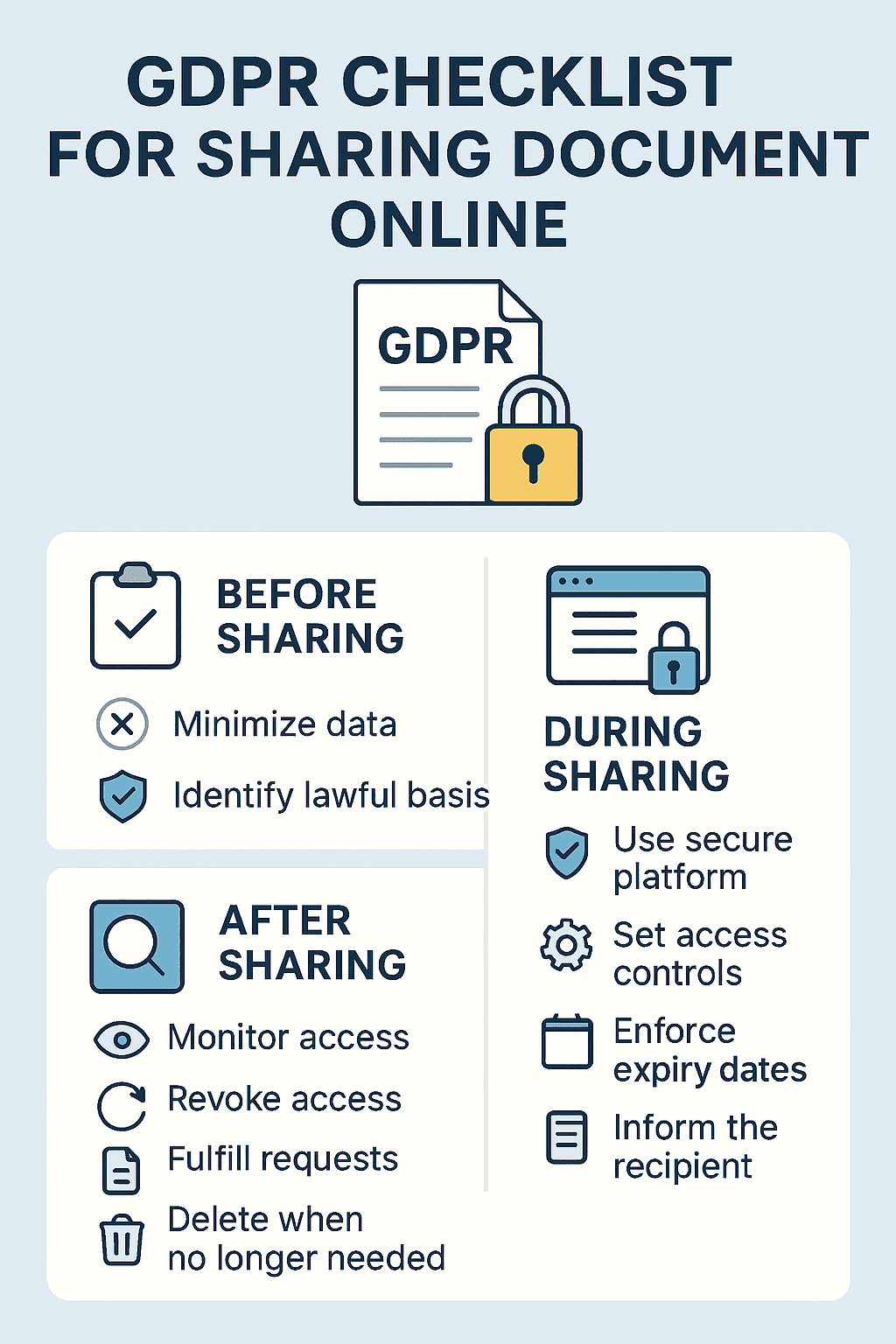
A compliant document sharing workflow runs across five stages: data minimization, secure setup, controlled distribution, transparent monitoring, and lifecycle management.
GDPR principles that apply to document sharing: lawful processing (Art. 5(1)(a)), purpose limitation (5(1)(b)), data minimization (5(1)(c)), accuracy (5(1)(d)), storage limitation (5(1)(e)), integrity and confidentiality (5(1)(f)), and accountability (5(2)).
Email attachments fail GDPR for sensitive personal data: no access control, no audit trail, no revocation, no encryption beyond TLS in transit.
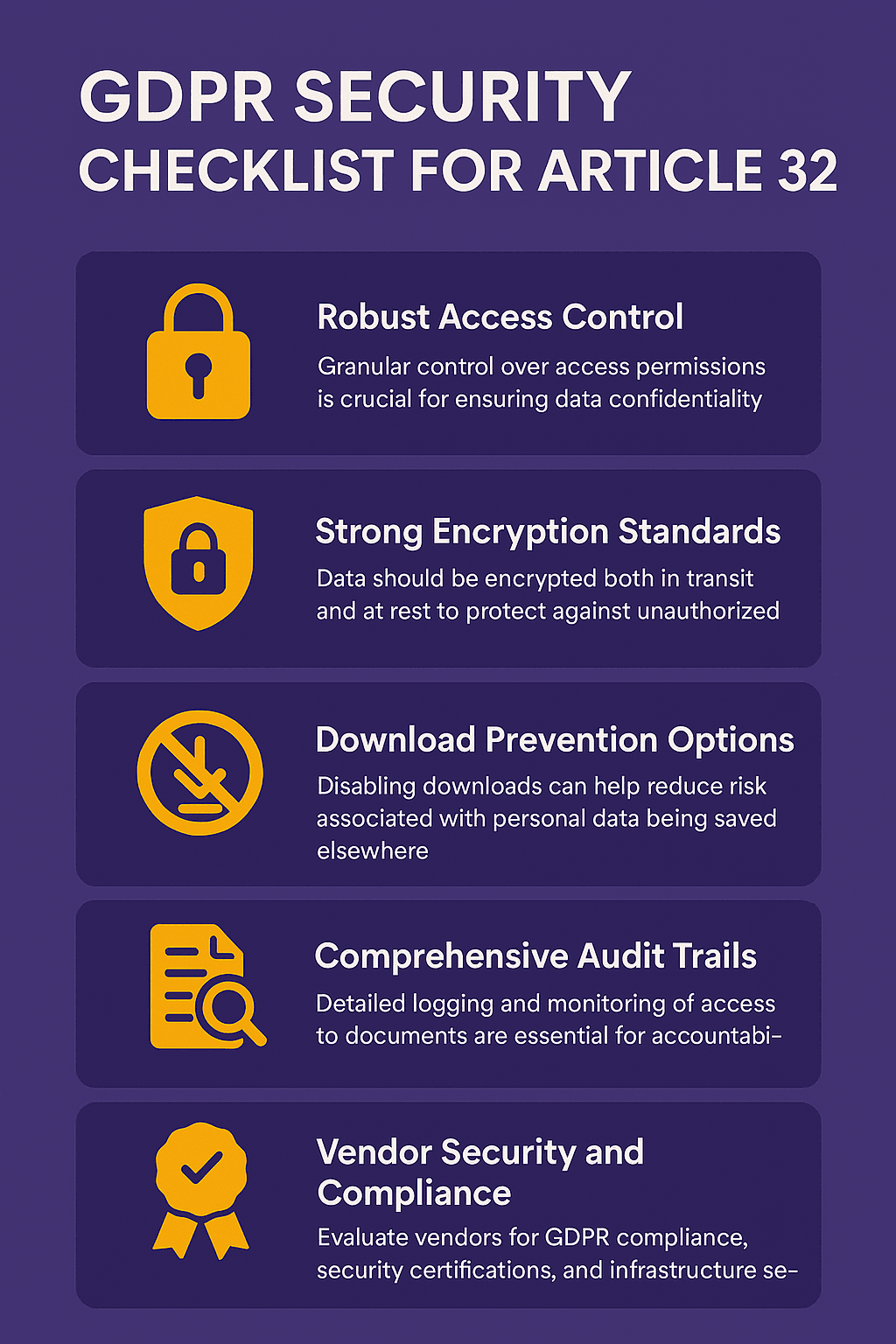
Required platform features: secure link generation, NDA/email verification gate, granular permissions, download blocking, link expiration, audit log export, dynamic watermarking.
Cross-border transfers post-Schrems II require Standard Contractual Clauses (SCCs) and / or EU data residency for sensitive workflows.
Papermark GDPR posture: data processor under signed DPA, public sub-processor list, EU/Frankfurt hosting available, AES-256 at rest, TLS 1.3 in transit, 72-hour breach notification, full data subject rights support.
Non-compliance penalties: up to 4% global revenue or €20M, whichever is higher.
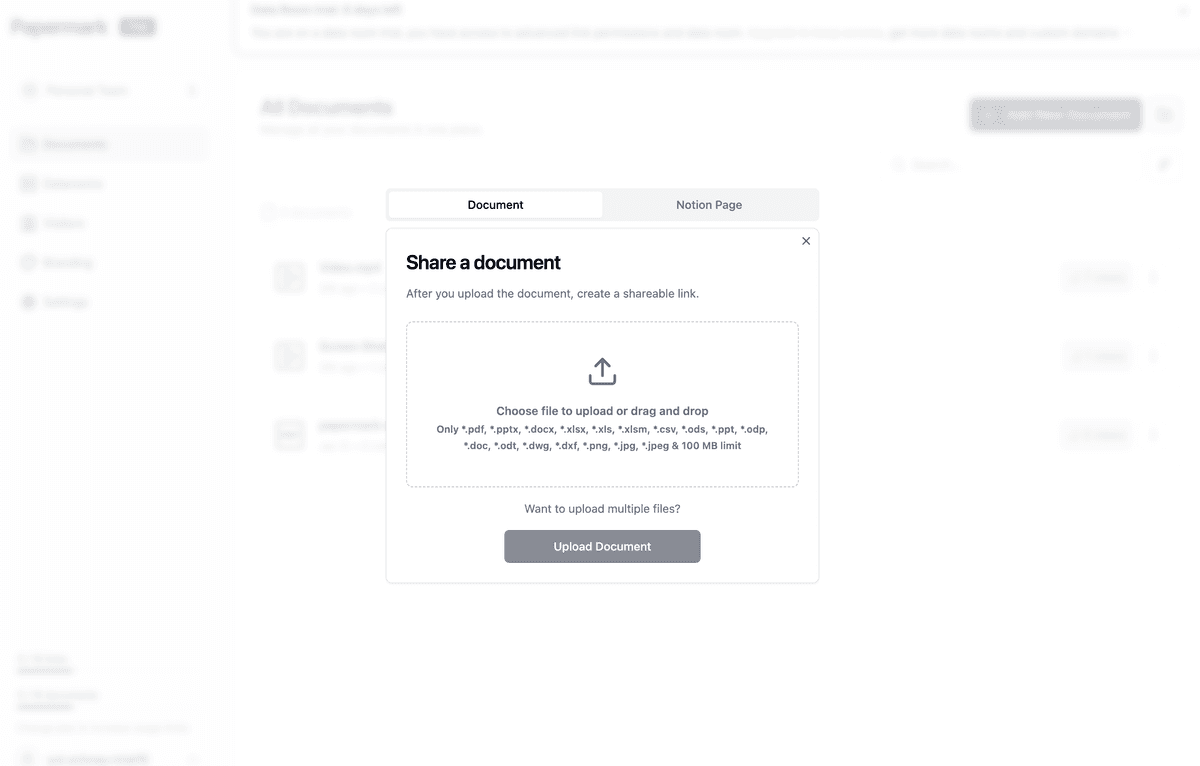
Share secure documents
No credit card required
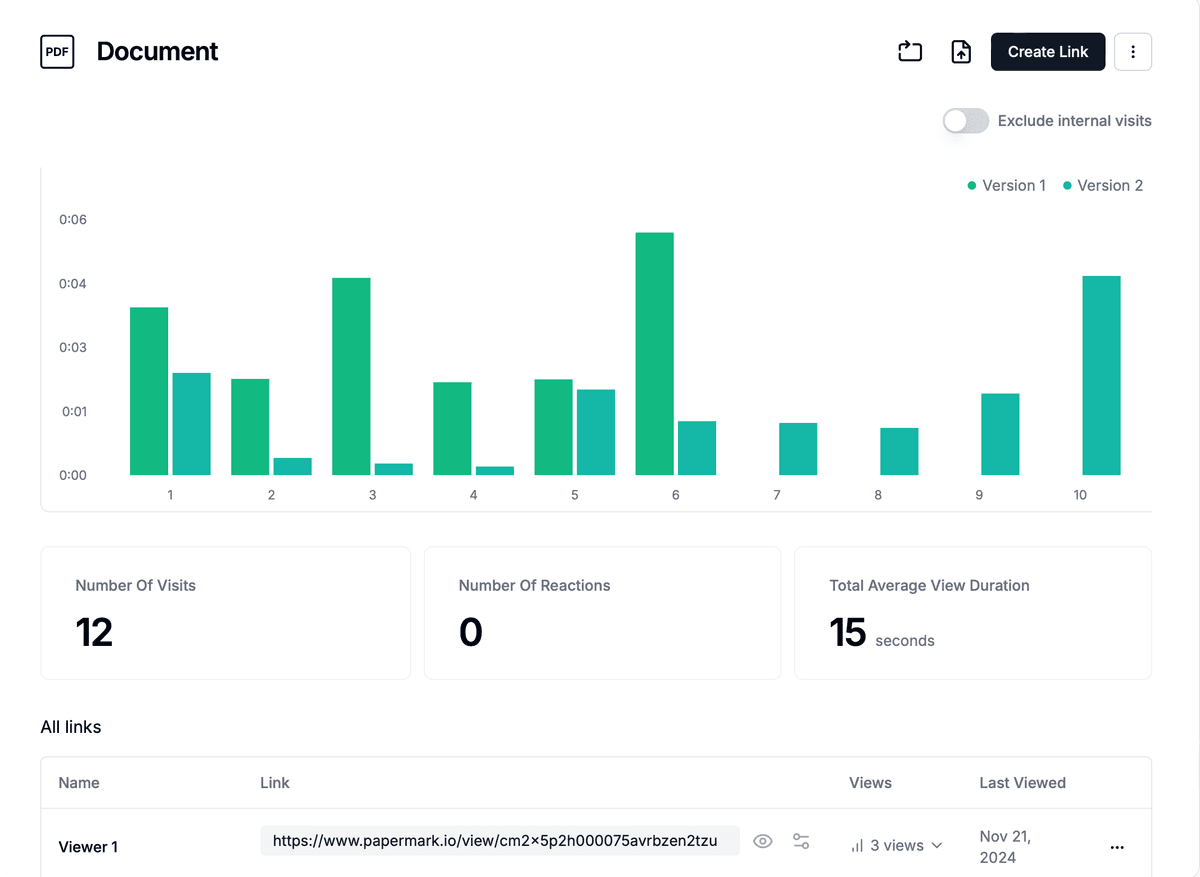
Page by page analytics
Require email verification
Require password to view
Allow/Block specified viewers
Apply Watermark
Require NDA to view
Custom Welcome Message
Why a compliant workflow matters in 2026
Sharing documents like proposals, contracts, client reports, board materials, or M&A diligence is fundamental to business operations. Doing it without a structured GDPR-compliant workflow exposes the organization to four concrete risks: regulatory fines, lost client trust, vendor-due-diligence failures, and Schrems II cross-border transfer violations. For more context, see What is GDPR? and the Papermark GDPR compliance overview.
A well-defined workflow is not just about avoiding the 4%-of-revenue fines. It is about building trust with European clients, passing vendor risk assessments from EU enterprises, and meeting the procurement bar that institutional buyers routinely apply. The five-stage workflow below translates GDPR principles into concrete platform configuration.
Stage 1: Document finalization and data minimization
Before sharing, ensure the document is final and contains only the personal data necessary for its purpose. GDPR's Data Minimization principle (Article 5(1)(c)) is the operating rule.
Consideration: Does this proposal really need the recipient's home address, or just their business contact details? Review every document to remove superfluous personal information before it leaves the building.
Best practice: Establish internal guidelines for minimizing personal data inclusion in standard document types (proposals, contracts, reports). Train staff annually on the principle, with documented sign-off.
Tool features needed: Version control to ensure the correctly minimized version is the one shared. Document templates that are pre-screened for unnecessary personal data fields. Optional automated PII detection at upload time (modern VDRs apply this with LLMs).
Stage 2: Secure sharing setup
This is where technical controls become non-negotiable. Email attachments and unsecured cloud links fail GDPR's Integrity and Confidentiality principle (Article 5(1)(f)) the moment any personal data is involved.
Consideration: How do you ensure only the intended recipient accesses the document, prevent unauthorized copying or downloading, and produce an evidentiary record if something goes wrong?
Best practice: Use a secure document sharing platform with deal-grade controls. Avoid direct email attachments for any document containing personal data of EU residents.
Tool features needed:
Secure link generation - a unique URL to access the document online, not the file itself.
NDA gate and email verification - require the recipient to confirm identity before viewing.
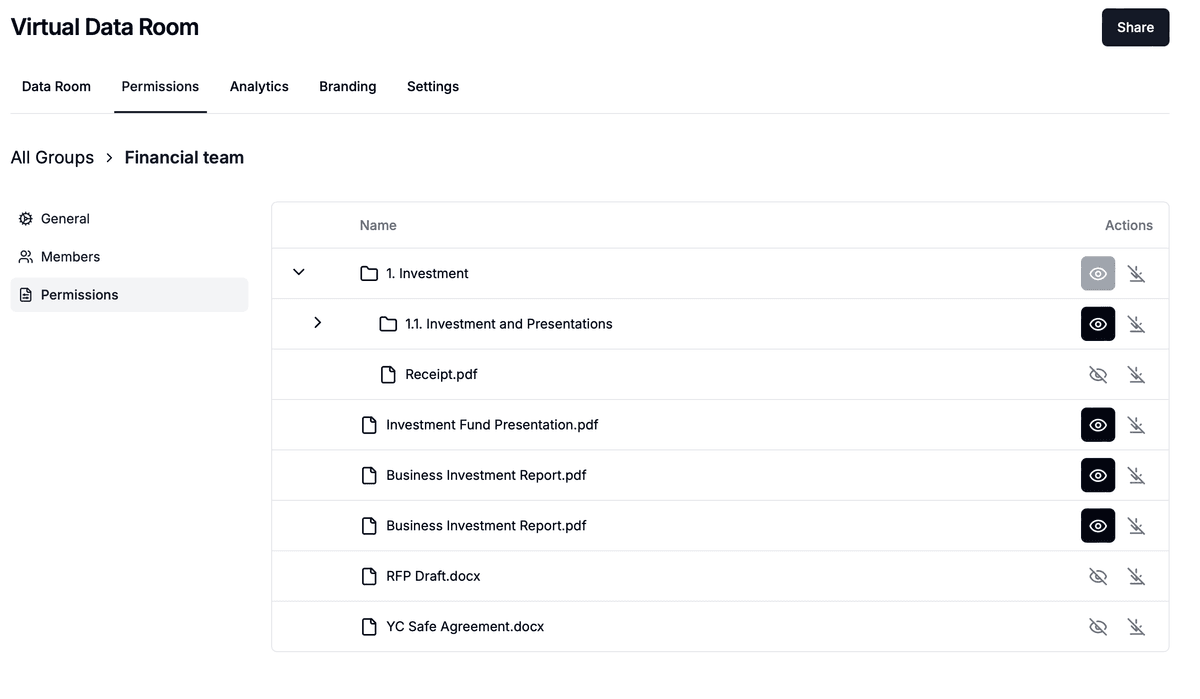
Allow / block lists by email or domain for closed audiences.
Password protection on top of email verification for sensitive workflows.
Download prevention - keep the document centralized and reduce uncontrolled copies.
Link expiration to enforce storage limitation by default.
Dynamic watermarks rendering viewer email, IP, and timestamp on every page (deters leakage and supports the audit trail).
AES-256 encryption at rest, TLS 1.3 in transit as the underlying cryptographic baseline.
Papermark applies all of these by default. See the Papermark security page for the technical details.
Stage 3: Controlled distribution
Sending the secure link still requires care. Make sure you are sending it to the correct, verified recipient address, and that the recipient understands how to access the document.
Consideration: Are you certain the recipient's email address is correct and secure? Have you verified that the recipient is the intended counterparty and not a forward from someone with limited authorization?
Best practice: Double-check recipient details before sending. Send via the platform itself (with audit logging) rather than copy-pasting links into email. Inform recipients briefly about how to access the document (for example, "click the secure link below, verify your email, and enter the password").
Tool features needed: Platforms like Papermark integrate link generation, recipient verification, and delivery tracking so you have a record of what was sent, to whom, and when.
Stage 4: Engagement monitoring and transparency
Knowing if and when a document was accessed is vital for Accountability (Article 5(2)). At the same time, monitoring must be transparent under the Lawfulness and Transparency principle (Article 5(1)(a)) - data subjects must be informed about tracking practices in your privacy notice.
Consideration: What level of tracking is necessary and proportionate to the legitimate purpose? How will you inform the recipient that engagement is tracked?
Best practice: Use tracking for confirming receipt, security monitoring (anomalous access attempts), and basic engagement insights (viewed / not viewed, time spent). Avoid intrusive monitoring beyond what serves the legitimate purpose. Reflect tracking practices in your privacy notice and DPA.
Tool features needed:
Viewer analytics with an audit trail showing who accessed the document (with email verification), when, and for how long. See why audit trails matter.
Real-time notifications for new viewer access events.
Page-by-page engagement for documents where dwell-time signals matter (pitch decks, contracts, financial models).
Exportable audit log for DPIA, vendor reviews, and post-incident investigation.
Stage 5: Post-engagement actions and lifecycle management
Once the purpose of sharing is fulfilled (proposal accepted or rejected, contract signed, deal closed), access should be reviewed and either revoked or transitioned to the next phase. This is the Storage Limitation principle (Article 5(1)(e)) in practice.
Consideration: Does the recipient still need access to this document? How long must the document be retained for legal, regulatory, or contractual purposes?
Best practice: Define retention periods for different document types in a documented policy. Regularly review active links and revoke access when no longer necessary or after the retention period expires. Use link expiration features set in Stage 2 for set-and-forget enforcement.
Tool features needed:
Manual access revocation - ability to disable specific links immediately, even after a viewer has downloaded.
Automatic link expiration with no further action required.
Centralized dashboard showing all shared documents, viewer status, and expiry timing.
Three GDPR-specific procurement items routinely come up in EU customer vendor reviews. A workflow that does not address all three will fail enterprise GDPR audits.
Data Processing Agreement (DPA)
Under GDPR Article 28, the data controller (customer) and data processor (Papermark) sign a Data Processing Agreement that documents:
The subject matter and duration of processing
The nature and purpose of processing
The type of personal data processed and categories of data subjects
Obligations and rights of the controller
Sub-processor management terms
Audit rights, breach notification timing, and end-of-contract data return / deletion
Papermark provides a standard DPA available under signature for all enterprise customers, with customer-specific amendments for regulated workflows.
Public sub-processor list
Papermark maintains a public list of every third party that processes customer data as part of service delivery (infrastructure providers, email delivery, analytics). Each sub-processor entry documents the service provided, the data processed, and the jurisdiction of operation. Customers receive advance notice of any material sub-processor changes.
EU and Frankfurt data residency
For workflows that need data to remain inside the EU (cross-border transfer restrictions post-Schrems II, regulated industries, sovereign data requirements):
EU-region cloud deployment on Papermark's hosted product, available for enterprise contracts with Frankfurt as the default EU region.
Self-hosted deployment using Papermark's open-source code on customer-owned infrastructure in any jurisdiction.
Hybrid setups where high-sensitivity rooms are self-hosted while general workflows use the cloud.
A complete document-sharing posture in 2026 covers more than GDPR alone. The frameworks below routinely apply to EU document workflows.
Framework
Scope
When it applies
GDPR (EU 2016/679)
Personal data protection
Any processing of EU resident data
ePrivacy Directive
Electronic communications and cookies
Marketing, tracking, analytics on EU users
NIS2 Directive
Cybersecurity baseline for essential / important entities
Energy, finance, healthcare, transport
DORA (Digital Operational Resilience Act)
ICT risk management for financial sector
Banks, insurance, asset managers from Jan 2025
EU AI Act
High-risk AI systems
AI-assisted document analysis on regulated workflows
ISO 27001
Information security management system
Vendor procurement gate at most EU enterprises
SOC 2 Type II
AICPA Trust Services Criteria
Vendor procurement gate (US-style, increasingly used in EU)
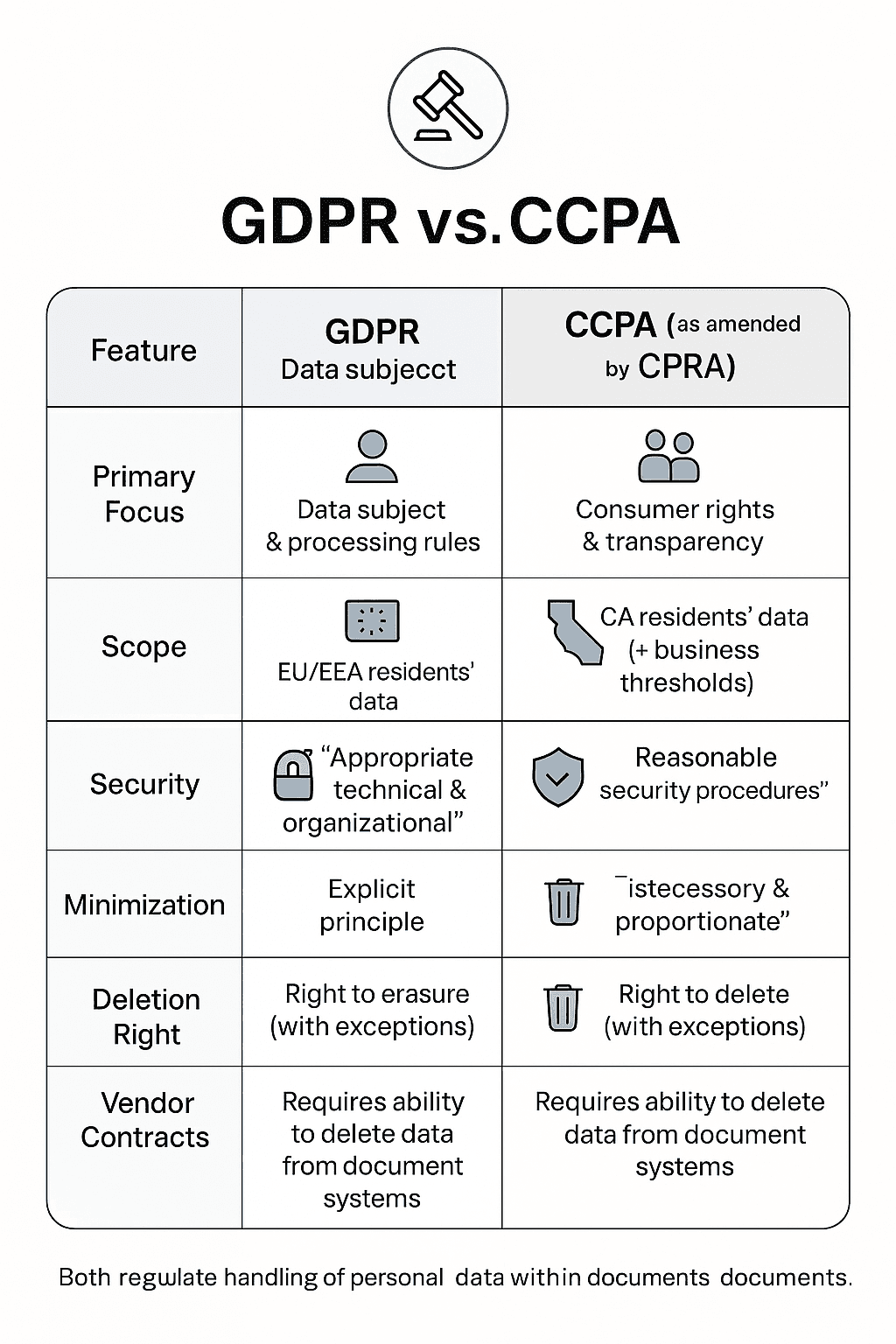
CCPA / CPRA
California consumer privacy
Any business processing California resident data
Papermark maintains SOC 2 Type II audit, GDPR alignment with DPA, and supports ISO 27001 alignment via self-hosted deployment on customer infrastructure. NIS2 and DORA workflow support is available on Enterprise plans for in-scope sectors.
Cross-border transfers and Schrems II context
The 2020 Schrems II ruling invalidated the EU-US Privacy Shield and tightened requirements for cross-border transfers of EU personal data. In 2026 the practical implications for document-sharing workflows:
Transfers to non-EU countries require Standard Contractual Clauses (SCCs), with supplementary measures (encryption, data minimization, contractual restrictions) where the destination country's laws conflict with EU privacy standards.
EU-US Data Privacy Framework provides a path for certified US-based vendors to receive EU personal data. Papermark's EU-region deployment avoids this question entirely for EU customers.
Data residency clauses in customer contracts are increasingly common, requiring vendors to keep all customer data inside specific jurisdictions.
The simplest path through Schrems II for sensitive document workflows is to choose a vendor with EU data residency from the start. Papermark's EU/Frankfurt hosting handles this for the cloud product, and the self-hosted deployment moves the question entirely to the customer's own infrastructure.
A secure and GDPR-compliant document sharing workflow requires integrating procedural best practices (data minimization, recipient verification, retention policy) with the right technical controls at each stage. Individual point tools may cover specific aspects, but integrated platforms designed for secure document sharing - like Papermark - provide secure links, granular access controls, transparent analytics, and lifecycle management in one place. The integration matters because GDPR accountability lives in the consistent application of controls across the full document lifecycle, not in any single feature.
Adopting a compliant workflow is not just a regulatory hurdle. It is a strategic advantage that enhances security, builds client trust, passes EU vendor reviews, and protects the business from the 4%-of-revenue downside.