BlogDocument SharingData Security in 2026: 5 Threats, 5 Controls, and How Data Rooms Apply Them
Data Security in 2026: 5 Threats, 5 Controls, and How Data Rooms Apply Them
·11 min read
Marc Seitz
Data security in 2026 is the combined set of controls, processes, and architectural choices that protect organizational and personal data from unauthorized access, alteration, loss, and exfiltration. The threat surface has expanded with cloud-native workflows, AI-assisted attacks, and tightening cross-border regulation. The protection model has expanded too: encryption (AES-256 at rest, TLS 1.3 in transit), zero-trust architecture, granular access control, and audit-logged data sharing are now table stakes. This guide covers the principles, threats, controls, compliance frameworks, and the specific role of virtual data rooms (VDRs) like Papermark in applying data security to real document workflows.
Quick recap
Data security rests on three principles: confidentiality, integrity, and availability (the CIA triad).
Top threats in 2026: phishing and AI-generated social engineering, ransomware, insider threats, supply-chain compromise, and cross-border regulatory exposure.
Compliance frameworks: GDPR (EU), CCPA (California), HIPAA (US healthcare), SOC 2 Type II (B2B SaaS), ISO 27001 (global), FDA 21 CFR Part 11 (clinical), NIS2 (EU critical infrastructure).
Virtual data rooms apply data security to high-stakes document workflows (M&A, fundraising, IPO, regulated diligence) with NDA gating, dynamic watermarking, granular permissions, and tamper-proof audit logs.
Papermark security posture: SOC 2 Type II, GDPR-aligned, HIPAA-ready, AES-256 at rest, TLS 1.3 in transit, EU/Frankfurt hosting available, 38+ data residency regions, signed DPA, public sub-processor list, optional self-hosted open-source deployment.
Non-compliance penalties: GDPR fines up to 4% of global revenue or €20M, HIPAA fines up to $1.5M per violation per year, CCPA up to $7,500 per intentional violation.
Protect your documents with advanced security
No credit card required
Page by page analytics
Require email verification
Require password to view
Allow/Block specified viewers
Apply Watermark
Require NDA to view
Custom Welcome Message
What is data security?
Data security is the combined set of policies, controls, and technologies that protect data from unauthorized access, disclosure, alteration, destruction, or loss. It is broader than information security (which covers all information assets) and overlaps with privacy (which adds personal-data and consent dimensions). For organizations handling client data, financial records, regulated workflows, or M&A documents, data security is not optional: it is the baseline for trust, compliance, and operational resilience.
The three principles of data security (CIA triad)
The foundation of every data security program is built on three principles:
Confidentiality. Only authorized people and systems can access the data. Implemented via encryption, access control, multi-factor authentication, and need-to-know permissioning.
Integrity. The data is accurate, complete, and unchanged unless authorized. Implemented via hashing, version control, audit logging, and immutable storage.
Availability. Authorized users can access the data when they need it. Implemented via redundancy, disaster recovery, capacity planning, and DDoS protection.
A complete data security posture covers all three. A platform with strong encryption (confidentiality) but no audit log (integrity) and no redundancy (availability) is incomplete.
Why data security matters in 2026
Four pressures define the 2026 data security environment:
Regulatory exposure is real and rising. GDPR fines reach 4% of global revenue or €20M; CCPA, HIPAA, and SOC 2 attestation each carry their own enforcement consequences. EU's NIS2 Directive expanded the scope of cybersecurity requirements to most essential and important entities, and DORA (effective January 2025) tightened ICT risk management for the financial sector.
Cyber threats are AI-accelerated. Phishing emails generated by LLMs are harder to detect. Voice-clone scams target executives. Ransomware groups now use AI-assisted reconnaissance to identify high-value targets. The defender side benefits from AI too, but the asymmetry has shifted toward attackers in some categories.
Cross-border data transfers are constrained. Schrems II (2020) tightened EU-to-non-EU data flows, and the EU-US Data Privacy Framework provides only a partial path. Sensitive workflows increasingly require EU data residency from the start.
The procurement bar has risen. Enterprise customers routinely require SOC 2 Type II reports, signed DPAs, public sub-processor lists, and EU data residency before engaging any cloud vendor. Vendors without these fail procurement screens regardless of feature parity.
Common data security threats in 2026
Five threat categories account for the vast majority of real incidents.
1. Phishing and AI-generated social engineering
Phishing remains the most common entry vector. In 2026 the variants include:
Spear phishing with LLM-generated personalization at scale
Vishing (voice phishing) using cloned voices of executives
Smishing (SMS phishing) with shortened URLs and AI-tailored urgency
Business email compromise (BEC) with detailed knowledge of internal workflows scraped from LinkedIn and breach data
Prevention. Multi-factor authentication on every account that touches sensitive data, employee training with simulated phishing campaigns, anti-phishing email filters, and clear escalation paths for suspicious messages.
2. Ransomware
Ransomware encrypts data and demands payment for decryption. Variants include double-extortion (steal data, then encrypt) and triple-extortion (steal, encrypt, threaten DDoS). Median ransom payments now exceed $1M for mid-market victims.
Prevention. Air-gapped or immutable backups, network segmentation, endpoint detection and response (EDR), least-privilege access, and rapid patching cadence.
3. Insider threats
Insider threats come in two flavors: malicious (intentional theft, sabotage) and accidental (oversharing, misconfiguration, lost devices). Both are common; the accidental category is bigger by volume.
Prevention. Role-based access control with least-privilege defaults, audit logging of every data access, separation of duties on sensitive workflows, exit-process controls (immediate access revocation), and clear data-handling policies.
4. Supply-chain and third-party risk
Vendors and partners are an extended attack surface. The 2020 SolarWinds compromise, 2023 MOVEit breach, and ongoing attacks against managed service providers all show how third-party software becomes a vector into customer data.
Prevention. Vendor risk assessments before engagement, contractual data-protection terms (DPA), continuous monitoring of vendor security posture, software bill of materials (SBOM) tracking, and zero-trust architecture that does not assume vendor systems are safe.
5. Cross-border regulatory exposure
The fifth threat is regulatory rather than technical. A workflow that processes EU resident data on US infrastructure without proper Standard Contractual Clauses (SCCs) is itself a compliance incident, regardless of whether any data is "stolen."
Prevention. EU data residency for European customers, signed DPAs with all data processors, documented sub-processor lists, and architectural choices (self-hosted, sovereign cloud) for workflows where cross-border transfer is structurally undesirable.
Core data security controls
Five technical controls form the baseline of every modern data security architecture.
1. Encryption at rest and in transit
At rest: AES-256 encryption applied to stored documents, metadata, audit logs, and backups.
In transit: TLS 1.3 (or TLS 1.2+ as a minimum) for all client-server communication.
Key management: customer-managed keys or platform-managed keys with strict rotation policies. Bring-your-own-key (BYOK) and bring-your-own AWS bucket are increasingly required for highly sensitive workflows.
Client-side encryption for zero-knowledge architectures where even the platform vendor cannot decrypt customer files.
2. Multi-factor authentication and identity
MFA on every privileged account (admin, finance, HR, deal teams).
SSO via SAML or OIDC for enterprise users, integrated with the corporate identity provider (Okta, Azure AD, Google Workspace).
Email verification or magic-link auth for external viewers (saves account-creation friction without compromising verification).
Biometric authentication on mobile devices for executive workflows.
3. Role-based and granular access control
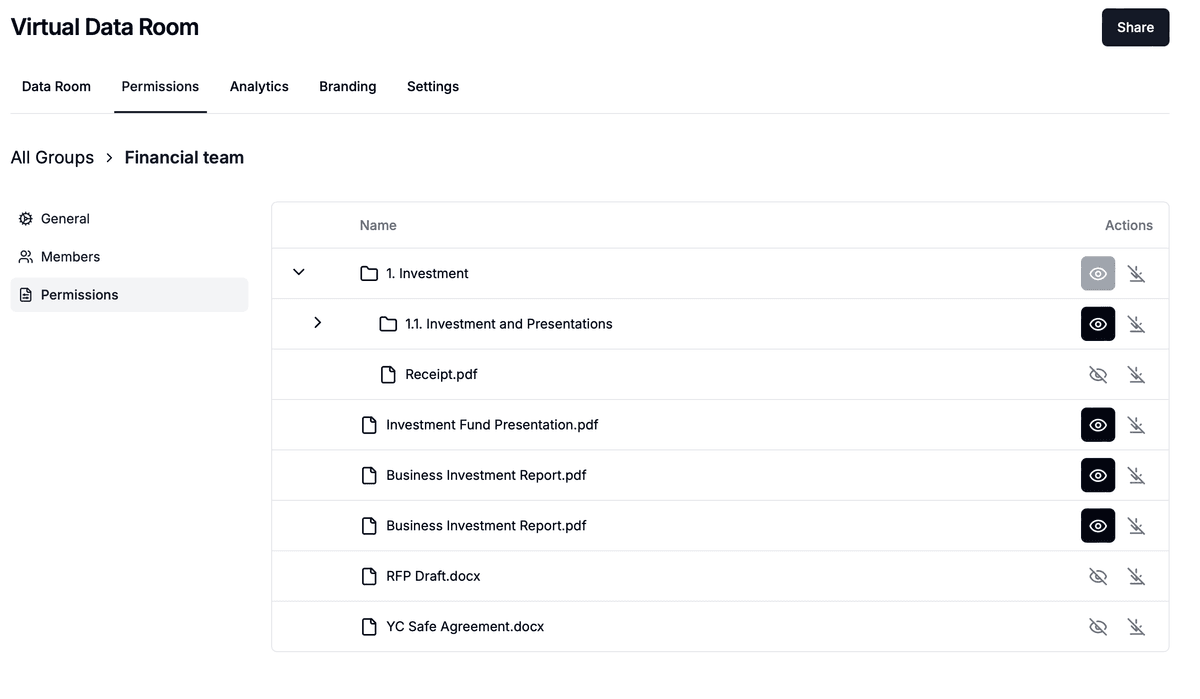
Folder-level and file-level permissions scoped per user or group.
Permission inheritance with explicit overrides for high-sensitivity items.
Allow lists and block lists by email or domain.
Time-bound access with link expiration and manual revocation.
4. Audit logging and monitoring
Append-only audit log of every authentication, access, and modification event.
Real-time alerts on anomalous behavior (geographic anomalies, off-hours access, mass downloads).
Exportable audit trail for compliance review, vendor assessment, and post-incident investigation.
5. Zero-trust architecture
Verify every request regardless of network origin.
Continuous authorization with re-authentication for sensitive actions.
Least-privilege defaults with explicit grants rather than blanket access.
Behavioral analytics to detect deviations from established access patterns.
How virtual data rooms apply data security in practice
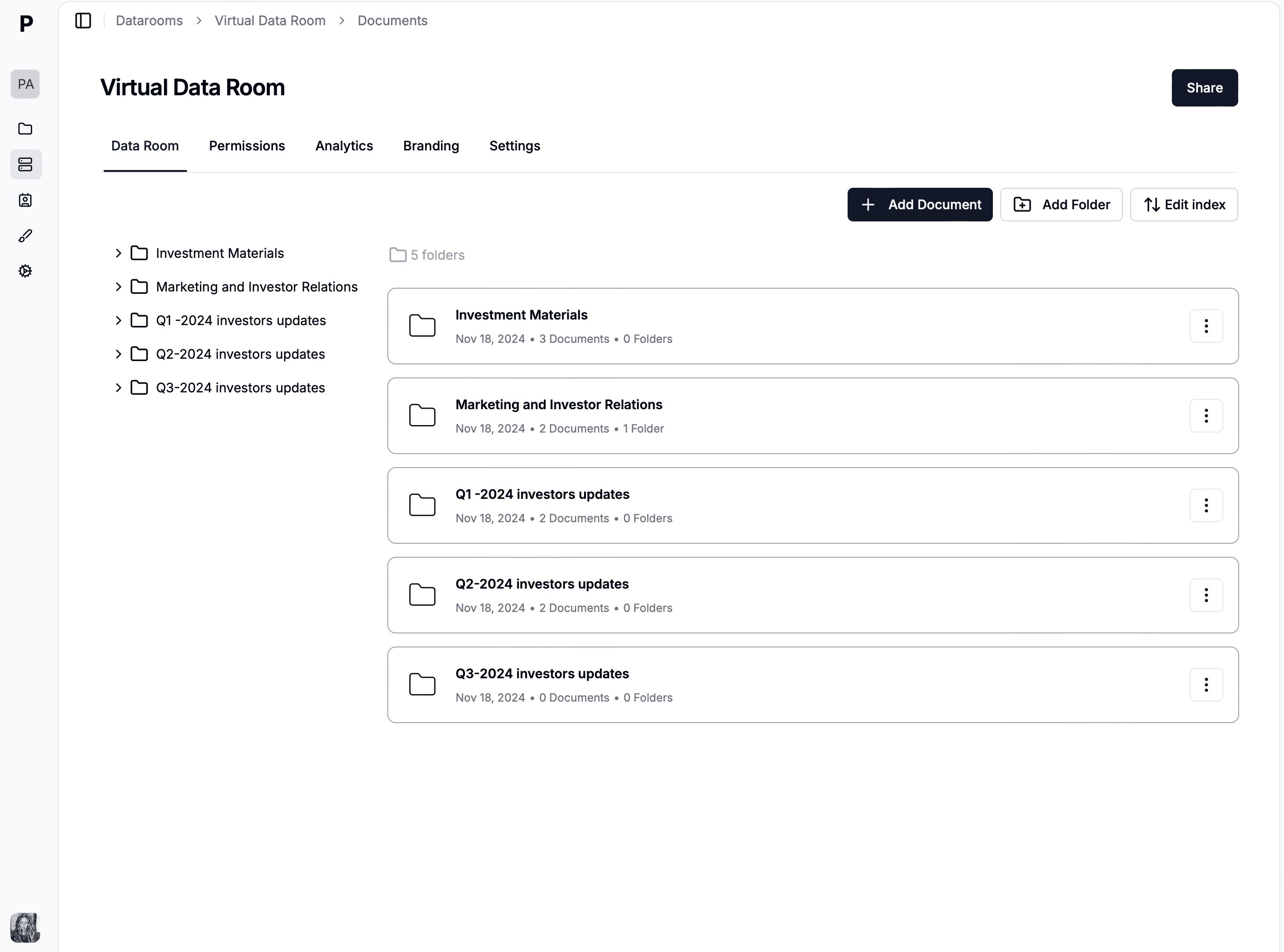
For high-stakes document workflows (M&A due diligence, fundraising, IPO readiness, regulated diligence in healthcare or finance), generic file sharing fails the data security bar. Virtual data rooms (VDRs) are purpose-built platforms that apply the controls above to deal documents specifically. For the deeper category overview, see What is a virtual data room?.
Eight VDR-specific data security controls
A modern VDR applies eight controls that generic cloud storage does not:
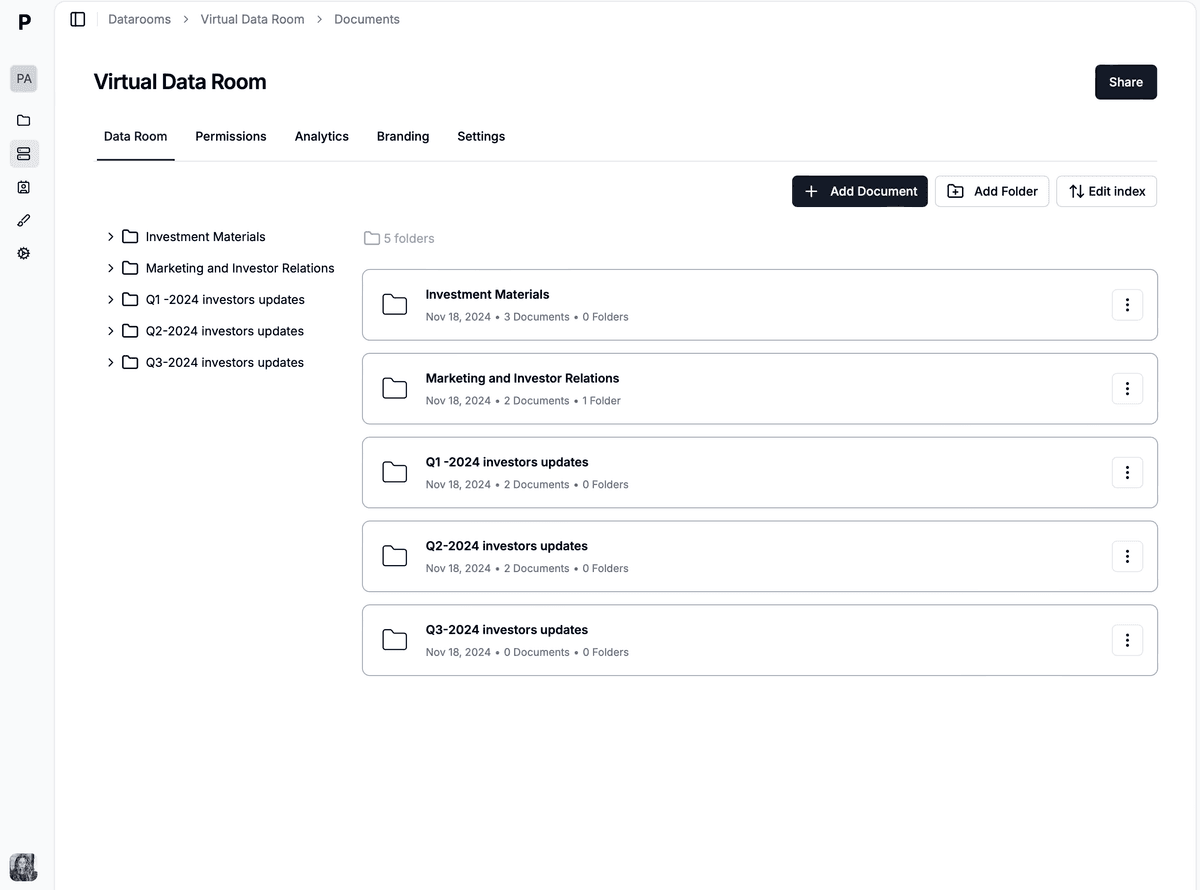
Dynamic watermarking stamps per-session viewer email, IP, and timestamp on every page. A leaked document can be traced back to the specific viewer and access event.
NDA enforcement before access. Recipients must accept an NDA before any document loads. Acceptance is logged with timestamp, IP, and email - an evidentiary record for litigation.
Granular folder and file permissions scoped per bidder, investor, or partner. Buy-side counsel sees the full diligence binder; a strategic competitor sees only Stage-1 materials.
Allow lists and email verification ensure that only verified counterparties can open a link. A forwarded URL fails identity verification without an authorized email match.
Download and print blocking per link. Highly sensitive materials remain view-only.
Append-only audit log with per-page dwell-time, viewer identity, and exportable trail for post-close disputes and regulatory review.
Link expiration and manual revocation. Access ends automatically at deal close or manually the moment a bidder drops out.
Q&A module with per-bidder scoping that prevents competing bidders from seeing each other's questions.
A documented data security strategy includes risk management, incident response, and continuous improvement.
Risk management
Risk management is the proactive identification, measurement, and treatment of data security risks. Three pillars:
Risk assessment. Document threats, vulnerabilities, likelihood, and impact. Refresh at least annually and after major changes.
Mitigation strategies. Apply security controls, conduct security audits, and run employee training. Prioritize controls by risk-to-cost ratio.
Risk register. Maintain a documented register of identified risks with owners, mitigation status, and review dates.
Incident response
When a security incident occurs, response speed determines impact. A documented incident response plan covers:
Detection. Identify the incident through monitoring, alerts, or external reports.
Containment. Stop the spread by isolating affected systems and revoking compromised credentials.
Eradication. Remove the threat, patch vulnerabilities, and reset affected systems.
Recovery. Restore normal operations from clean backups; validate integrity before bringing systems back online.
Post-incident review. Document the timeline, root cause, mitigation effectiveness, and lessons learned.
GDPR requires breach notification within 72 hours. HIPAA requires breach notification within 60 days. SOC 2 audit attestation requires documented incident response procedures with evidence of testing.
Continuous improvement
Security is an ongoing program, not a one-time project. Continuous improvement combines:
Quarterly access reviews to verify least-privilege defaults are still in effect.
Annual penetration testing by an independent third party.
Annual SOC 2 Type II audit with continuous-monitoring controls in between.
Employee security training with simulated phishing and post-incident learning sessions.
Vendor risk reviews annually for sub-processors handling sensitive data.
Papermark data security posture
Papermark's security architecture and compliance posture cover the controls described above out of the box. The full technical detail is on the Papermark security page.
Control category
Papermark default
Encryption at rest
AES-256
Encryption in transit
TLS 1.2+ over HTTPS, TLS 1.3 supported
Hosting region
Europe by default; US available; Enterprise can select 38+ global regions
MFA
Yes for admin accounts; SSO via SAML/OIDC for Enterprise
Granular permissions
Folder + file level, per user and per group
Dynamic watermarking
Per-session viewer email, IP, timestamp on every page
NDA gating
Built-in NDA acceptance gate before document access
Audit log
Append-only with full export
Compliance
SOC 2 Type II, GDPR, CCPA, HIPAA-ready (with BAA)
Self-hosted option
Open-source AGPL deployment available
Breach notification
72-hour notification under GDPR Article 33
DPA
Standard DPA available under signature for enterprise customers