



mergers-and-acquisitions
Independent Sponsor in 2026: 7 Steps and the Carry Split Trap
The independent sponsor model in 2026: three fee layers, promote tiers, capital partners, and running the deal in a data room for independent sponsors.
A search fund is an investment vehicle in which an entrepreneur raises a small pool of capital from investors to find, acquire, and then personally run a single privately held company. It is the main structure behind entrepreneurship through acquisition, and Stanford GSB has tracked its performance since 1984.
The headline return is real and the headline risk is bigger than most first-time searchers price in. Roughly half of concluded searches in the recent cohorts never buy anything at all, and about 26 percent of the companies that do get bought lose capital. This guide covers the raise, the 20-month search, what searchers actually buy, what the returns look like once the outliers come out, and the document infrastructure the model needs.
A searcher runs two completely different document processes: a two-year investor raise and three or four live diligence targets. A data room for a search fund handles both under one subscription, with a scoped link per investor and per diligence workstream. Section 8 covers the setup step by step.
A search fund is a two-stage investment vehicle. In the first stage, an entrepreneur (the searcher, usually one or two people, often recent MBA graduates or operators in their thirties) raises a modest amount of capital from a group of investors to cover salary, travel, legal fees, and deal costs while they look for a company to buy. In the second stage, once a target is identified, those same investors get the first right to fund the acquisition itself, and the searcher becomes the CEO of the acquired business.
What distinguishes a search fund from private equity is that the searcher is buying a job as much as an asset. There is no portfolio, no fund-level diversification, and no plan to hand the company to a professional management team. The searcher moves to wherever the business is, takes over as chief executive, and holds for five to seven years before selling. That concentration is precisely why the model attracts capital: investors are backing an owner-operator whose entire net worth and career are tied to one company.
The Stanford Graduate School of Business has studied the model since it was first formalized in 1984, and its biennial Search Fund Study is the reference data set for the asset class. The 2026 edition tracks 862 traditional search funds across the United States and Canada. New fund formation peaked in 2023 and has held near record levels through 2025, which means competition for the same lower middle market targets has intensified considerably compared with a decade ago.
Searchers concentrate on profitable, durable, and often unglamorous businesses: business services, vertical software, education, tech-enabled services, and healthcare services. The common thread is recurring or repeat revenue, a fragmented customer base, an owner ready to retire, and a business small enough that private equity funds will not compete for it but large enough to support a full-time CEO's salary and acquisition debt.
The model runs in four distinct phases, each with its own capital, its own risk, and its own failure mode. The sequencing is important: search capital is deliberately small and deliberately separate from acquisition capital, because the two are underwriting completely different things. Search capital is a bet on a person's ability to find something; acquisition capital is a bet on a specific company.
Phase one is raising the search fund. The searcher writes a private placement memorandum, builds a target profile, and sells units to 10 to 20 investors, most of whom are experienced search fund backers who have done this many times. Phase two is the search itself, which the 2026 study puts at a median of about 20 months and which consists overwhelmingly of proprietary outreach: thousands of emails and calls to owners of businesses that are not formally for sale.
Phase three is the acquisition. Once a target signs a letter of intent, the searcher runs financial due diligence, commissions a quality of earnings report, assembles debt, and goes back to the search investors for the equity. Phase four is the operating period, which is where the returns are actually made and where the searcher spends five to seven years growing EBITDA before an exit to a strategic buyer, a private equity firm, or another search fund.
| Phase | Typical duration | Capital involved |
|---|---|---|
| 1. Raise search capital | 3 to 6 months | Median $550,000 from a median of 13 investors |
| 2. Search and sourcing | Median about 20 months | Search capital funds salary and deal costs |
| 3. Acquisition | 3 to 6 months from LOI to close | Median $16.0M enterprise value at 6.2x EBITDA |
| 4. Operate and exit | 5 to 7 years | Acquisition equity plus senior and seller debt |
Search capital is small by design. The 2026 Stanford study reports a median raise of $550,000, a record high, which typically covers two years of a modest salary for one or two searchers, an administrative budget, travel, and the legal and accounting costs of pursuing three or four deals that will not close. Anything larger tends to reduce urgency; anything smaller tends to run out before the searcher finds anything.
The capital is sold in units, and the median fund in the study had 13 investors. The investor base is unusually repeat-heavy: a relatively small community of dedicated search fund investors, family offices, and successful former searchers takes positions across many funds, which is how they diversify a model that is otherwise a single-company bet. Getting into that community usually requires warm introductions from a business school network, an accelerator, or a former searcher.
The economics of the units are what make the model work for both sides. Search capital typically converts into acquisition equity at a step-up, often 150 percent, which rewards investors for backing the searcher before there was anything to buy. Investors also receive a right of first refusal on the acquisition equity, meaning they can fund the deal but are not obliged to. The searcher's own equity usually vests in three tranches: one at closing, one over four or five years of tenure, and one tied to hitting an IRR hurdle at exit, commonly around 20 to 35 percent in total.
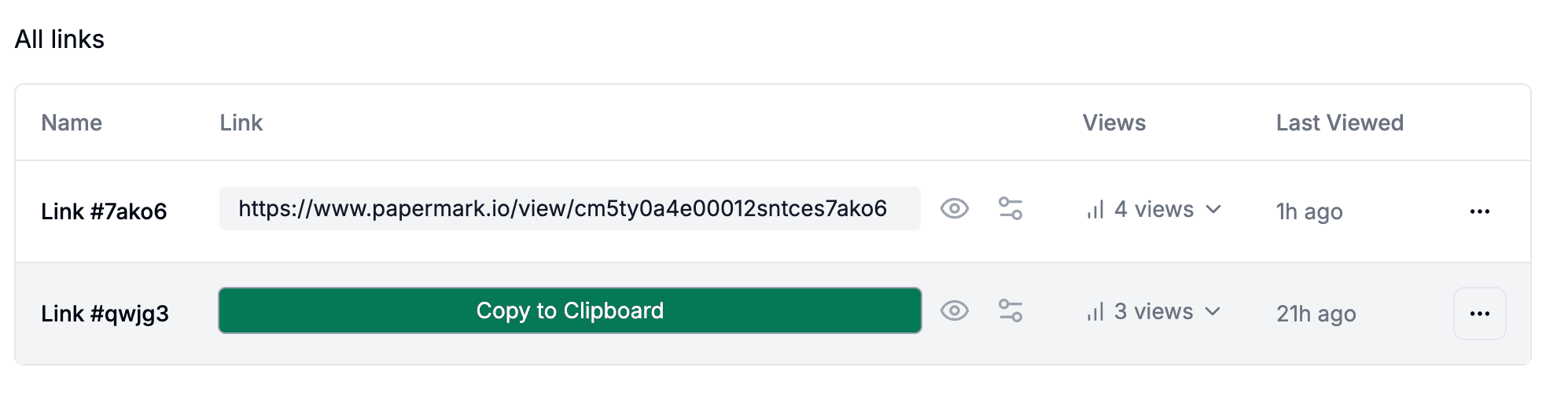
Practically, the raise is a document exercise before it is anything else. A searcher approaching 30 or 40 prospective investors is circulating a private placement memorandum, a target profile, a personal track record, and unit subscription documents, and the useful signal is not who replies but who actually read the memorandum. Sending the PPM as an email attachment throws that signal away, which is why most searchers now run the raise from a data room for a search fund with page-by-page analytics on every viewer.
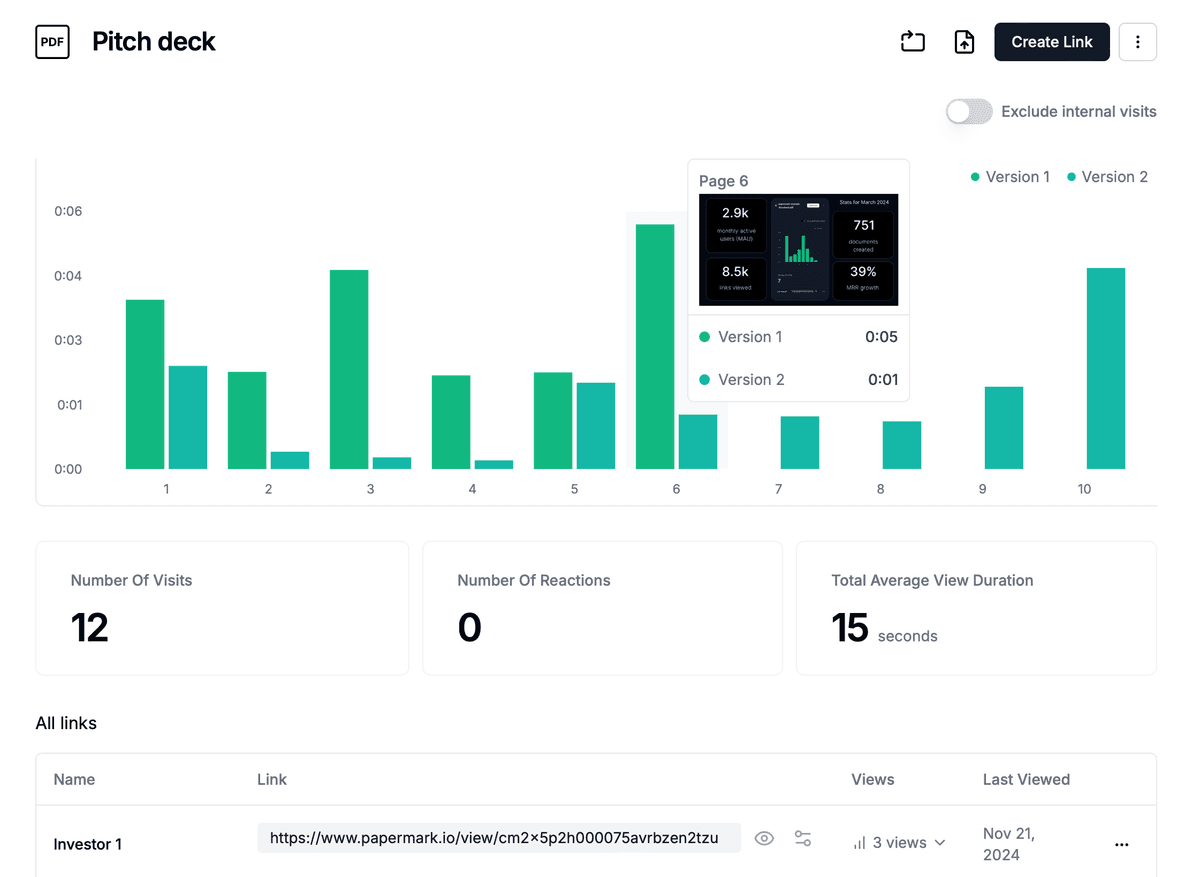
Page-level analytics show which prospective investors opened the PPM, how far they got, and where they stopped.
The 2026 study gives a precise picture of the target. In the 2024 to 2025 cohort, the median acquisition had an enterprise value of $16.0 million, EBITDA of $2.5 million, an EBITDA margin of 25 percent, and a purchase multiple of 6.2x. Across the full history of the data set the medians are $13.5 million and 6.3x, so prices have risen in dollar terms while multiples have stayed remarkably stable. Companies typically employ 30 to 40 people.
Those numbers describe a specific kind of business. At $2.5 million of EBITDA the company is large enough to afford a professional CEO, a finance function, and acquisition debt, but too small to attract the lower middle market private equity funds that generally start looking at $5 million of EBITDA. It usually has an owner who founded it, no institutional shareholders, financial statements that have been reviewed rather than audited, and a customer base that is stable but under-managed.
The search criteria most investors want to see are consistent across funds, and a searcher who drifts from them tends to lose investor support quickly.
The headline number is striking. As of 31 December 2025, the aggregate return across all tracked search funds was 33.9 percent IRR on 4.75x invested capital, and funds that had acquired and fully exited averaged 39.3 percent IRR and 5.98x. Aggregate public market equivalent across all search funds sits at 2.88, meaning the asset class has substantially outperformed the S&P 500 over its history.
The distribution behind that average matters more than the average. Remove the funds that returned 10x or more and the aggregate falls to roughly 2.8x ROI and 27 percent IRR. Approximately 26 percent of acquired companies produce a loss of capital. This is a power-law asset class: a small number of exceptional outcomes carry the aggregate, and the median investor experience is meaningfully below the headline figure. Any searcher pitching 33.9 percent IRR as an expected return is misreading the data.
The other number searchers underweight is the probability of ever buying anything. Historically, 58 percent of concluded searches ended in an acquisition. For the 2021 to 2024 cohorts that figure is closer to 48 percent, reflecting a more crowded market with more searchers chasing the same targets. A searcher should plan for a roughly even chance of spending two years and returning the remaining search capital, which is why investors size search units to be individually immaterial.
| Metric | Value |
|---|---|
| Funds tracked (US and Canada, 1984 to 2025) | 862 |
| Aggregate IRR / ROI, all funds | 33.9% / 4.75x |
| Aggregate IRR / ROI excluding 10x-plus funds | 27% / 2.8x |
| Fully exited funds | 39.3% IRR / 5.98x |
| Acquisitions producing a loss of capital | About 26% |
| Concluded searches ending in an acquisition (all time) | 58% |
| Same figure, 2021 to 2024 cohorts | About 48% |
The traditional model described above is not the only route. A self-funded search means the entrepreneur covers their own living costs during the search, forgoes the investor step-up, and raises acquisition capital deal by deal, often using an SBA 7(a) loan in the United States. The upside is a much larger equity stake, frequently 60 to 80 percent rather than the 20 to 35 percent a traditional searcher earns. The downside is no salary, no institutional support, and a personal guarantee on the debt.
Sponsored or accelerator-backed search sits in between. A single firm funds the search, provides deal support and back-office infrastructure, and takes a larger share of the economics in return. This suits first-time searchers who value the diligence support and the introductions more than the marginal equity points, and it has grown quickly as the searcher population has expanded.
An international search fund is a fourth variant. The Stanford study's 862-fund figure covers the United States and Canada only; a separate international data set tracks funds across Europe, Latin America, and Asia, where less competition is often offset by shallower acquisition debt markets and slower sale processes. Choosing between these models is largely a question of how much capital the searcher personally has and how much support they need.
The three domestic models diverge most on two dimensions that matter to a first-time searcher: how much equity they end up with, and how much personal downside they carry while looking.
| # | Model | Search funding | Typical searcher equity | Typical target size |
|---|---|---|---|---|
| 1 | Traditional search fund | Median $550,000 from about 13 investors | 20 to 35 percent, vesting in 3 tranches | $16.0M enterprise value at 6.2x EBITDA |
| 2 | Self-funded search | Personal savings, often alongside a day job | 60 to 80 percent | $1.5M to $5M EBITDA, SBA 7(a) debt |
| 3 | Sponsored or accelerator-backed | A single firm funds the search and back office | Lower than traditional, varies by sponsor | Similar to traditional, with deal support |
| 4 | International search fund | Similar to traditional, smaller investor pool | 20 to 35 percent | Shallower acquisition debt, slower processes |
The document requirements diverge with them. A traditional searcher runs an investor room for two years and then a diligence room per target. A self-funded searcher skips the first room entirely but needs a sharper second one, because an SBA lender underwriting 80 percent of the purchase price asks for more documentation than a group of repeat search investors does.
Marisol Vance leaves a healthcare operations role in 2026 to launch Kestrel Search Partners. She raises $550,000 across 14 units from a mix of dedicated search fund investors and two family offices, on standard terms: a 150 percent step-up into acquisition equity, a right of first refusal on the deal, and a three-tranche vesting schedule that gets her to 28 percent of the equity if she hits a 30 percent IRR at exit.
She spends 19 months sourcing. Her thesis is outsourced clinical compliance services in the American Midwest, and her outreach produces about 2,400 owner contacts, 61 management calls, and four letters of intent. Three fail: one owner decides not to sell, one has customer concentration of 44 percent in a single hospital system, and one falls apart when the quality of earnings report rejects $600,000 of add-backs and the seller refuses to reprice.
The fourth becomes the deal. Cardinal Compliance Services has revenue of $9.8 million, normalized EBITDA of $2.4 million, and a 24 percent margin, close to the study medians. Marisol agrees $15.4 million, a 6.4x multiple, funded with $6.9 million of senior debt, $2.3 million of seller note, and $6.2 million of equity from ten of her fourteen original investors plus two new ones.
Worked scenario at 6.4x EBITDA. Ten of the original 14 search investors take up the equity, which is why the search capital step-up matters more than the headline unit price.
Diligence runs eight weeks across financial, legal, tax, and insurance workstreams, with four separate adviser teams needing different slices of the same 380-document set. Marisol runs it from one data room with a scoped link per workstream, so the lender's credit team never sees employee compensation files and the tax adviser never sees the customer contracts. She closes in month 23 and becomes CEO the following Monday.
Four adviser teams, one document set, four scoped links: the standard structure for a search fund acquisition.
The overlooked cost in that scenario is the three deals that died. Marisol opened a room for each of the four targets, and only the fourth closed. A per-deal virtual data room subscription would have billed her for all four, which is the arithmetic that makes flat, unlimited-room pricing the right model for a search fund rather than a nice-to-have.
A data room for a search fund has to do two jobs that look nothing like each other. For roughly two years it is an investor-facing room holding a private placement memorandum, a target profile, and unit documents, opened by 30 or 40 people you are trying to persuade. Then, three or four times, it becomes a diligence workspace holding somebody else's general ledger, opened by advisers you are paying. Searchers who buy a per-deal virtual data room subscription pay twice for the second job and get nothing for the first.
Papermark is a secure, fully customizable, and developer-friendly data room built for modern dealmakers, with page-by-page analytics, dynamic watermarking, and transparent pricing (open-source and self-hosting available).
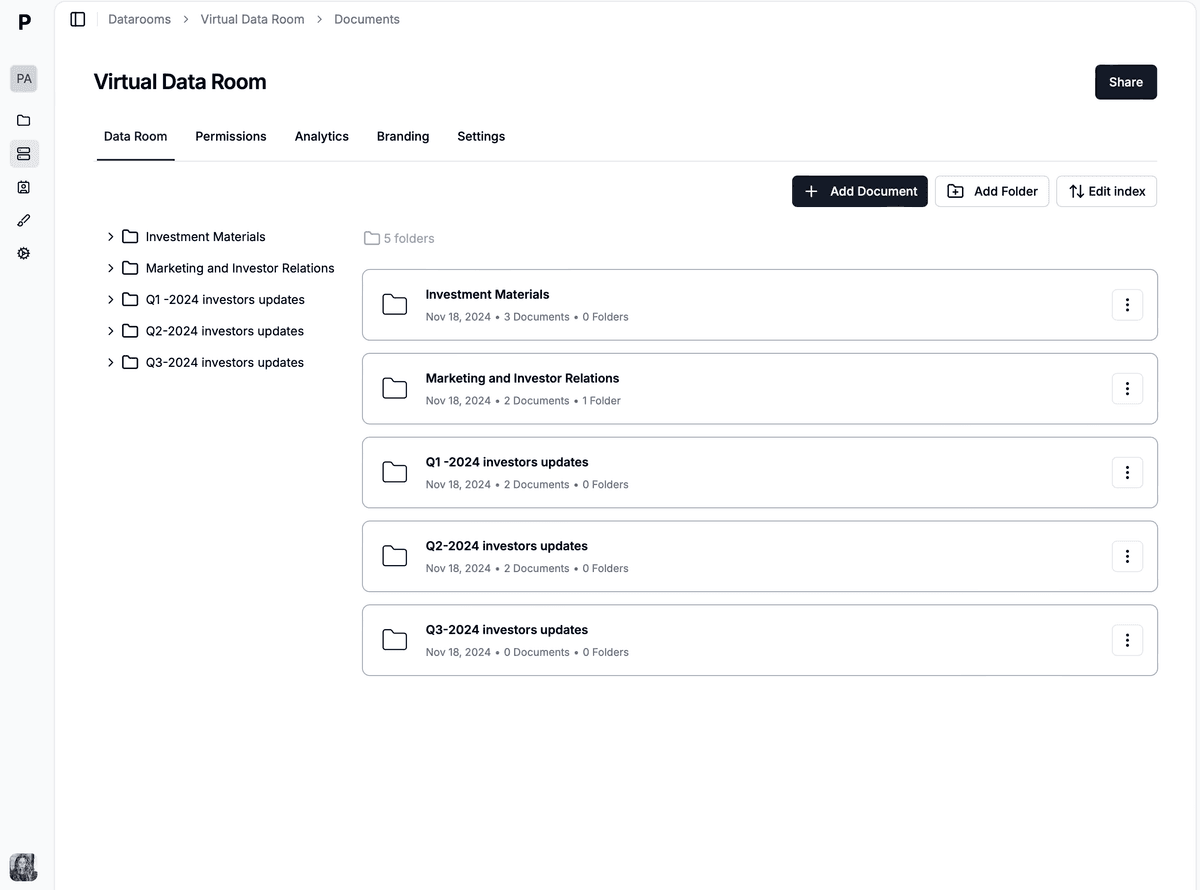
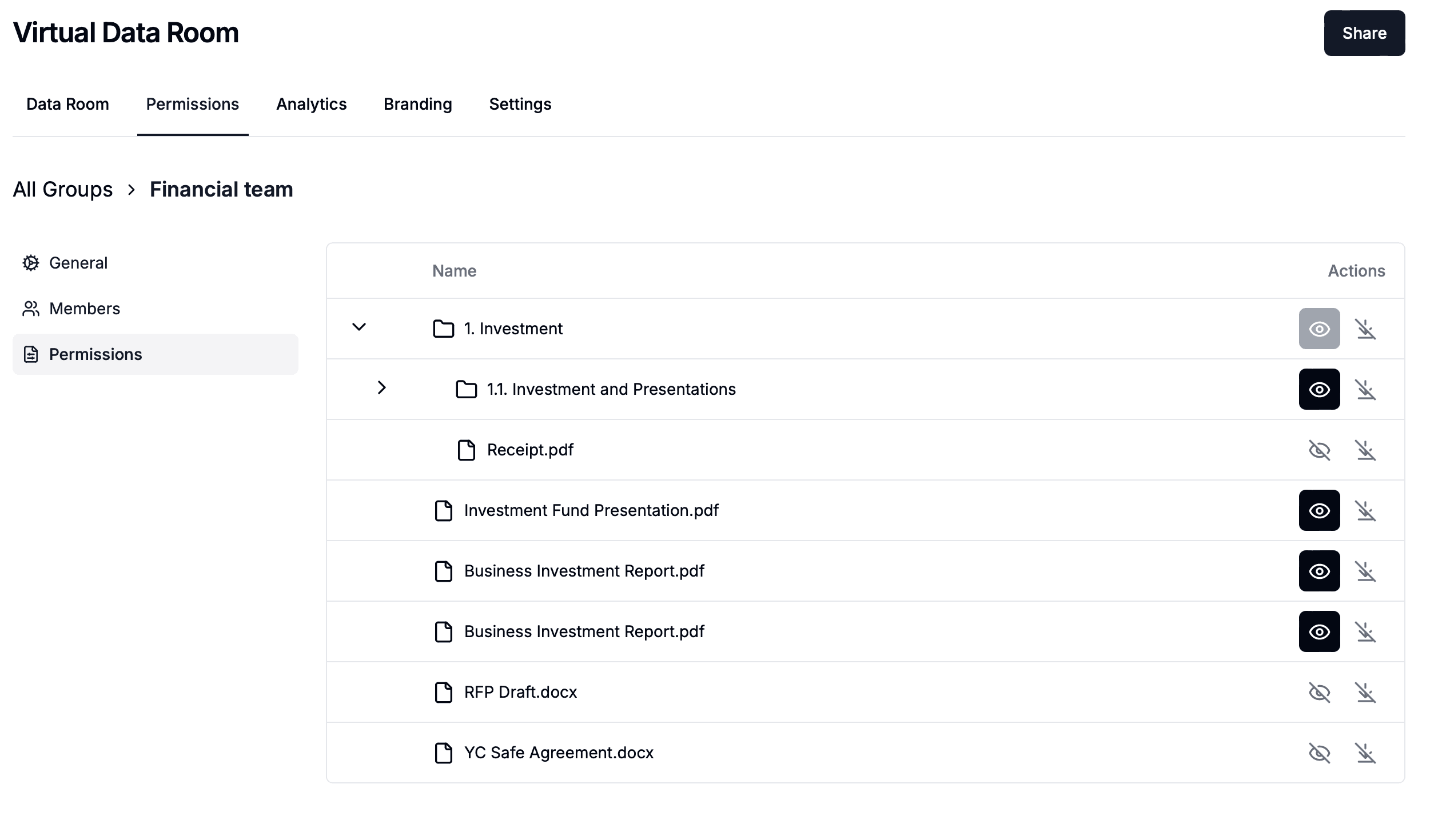
A search fund data room in Papermark, with a scoped link for each diligence workstream on a live acquisition.
Four things about the search fund model make a dedicated room worth more than it would be to a one-off buyer. If you are still choosing a platform, our comparison of the best virtual data rooms covers pricing model, bidder management and compliance across the main providers.
You will open three or four rooms for every one that closes. The 2026 Stanford data puts recent cohorts at roughly a 48 percent chance of ever completing an acquisition, and Marisol's scenario above is typical: four letters of intent, one close. Per-deal pricing charges you for the failures. A data room for a search fund on a flat subscription with unlimited rooms means a dead target costs you nothing beyond the time.
Investor attention is the only signal you get during the raise. Search investors are repeat participants who see dozens of memoranda a year and reply slowly to all of them. Knowing that a family office spent eleven minutes on the target profile and never opened the unit documents tells you something an email thread never will, and it changes who you call back first.
A first-time fund has to look institutional. You are asking people to wire $40,000 into a vehicle with no track record and no portfolio. A branded room on your own domain with an NDA gate in front of it reads very differently from a Google Drive folder shared to a personal Gmail address, and the difference costs nothing to produce.
Four adviser teams need four different views of the seller's files. On a live acquisition the financial, legal, tax, and insurance teams work through the same 380-document set from a seller who is nervous about all of them. Scoping each team to its own folders is the difference between a controlled process and an owner who stops cooperating.
The rest of this section is the practical build: five steps to a data room for a search fund that covers both the raise and the deals.
Create one room for the raise and treat it as a permanent asset, not a campaign. It holds the private placement memorandum, the target profile, your track record, the unit subscription documents, and later the quarterly search updates that keep investors warm through a 20-month hunt.
Link-based access means no investor has to create an account to open it, which removes the single biggest drop-off point in an investor raise. Add email verification so you still know who each viewer is, and use the One-Click NDA gate where the target profile is specific enough to be worth protecting.
Point the room at your own subdomain, load your logo and colours, and set the room's cover. Custom domains and advanced branding are included on the Data Rooms plan, and unlimited custom domains means the investor room and each deal room can each sit on their own address.
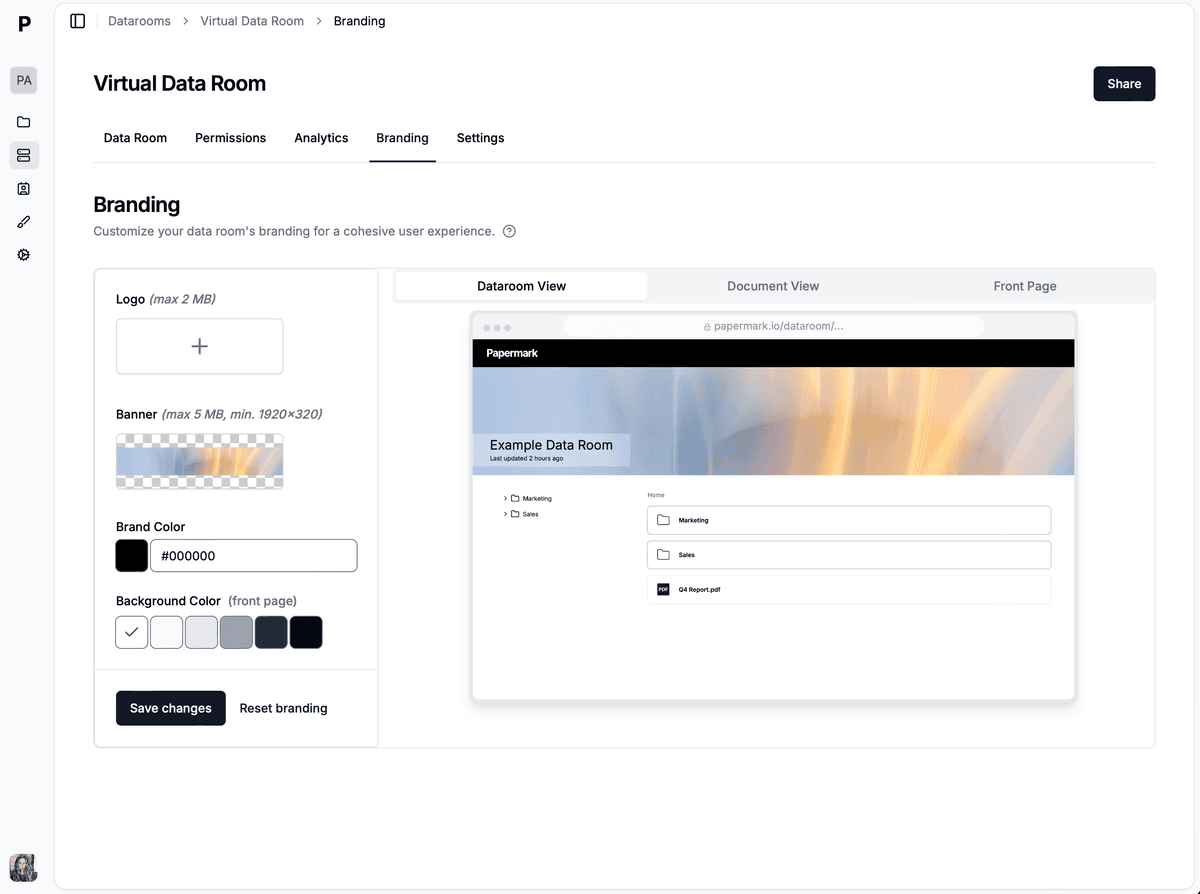
Branding and a custom domain are what make a first-time search fund's investor room read as institutional rather than improvised.
Page-by-page analytics record which investor opened the memorandum, which pages they read, how long they spent, and where they stopped. Across 40 prospective investors that produces a ranked follow-up list you could not otherwise build, and it is the closest thing a searcher gets to a pipeline.
The same telemetry works on the deal side. An SBA lender's credit analyst who has spent thirty minutes in the customer concentration schedule has found the thing they are going to ask about, and you will usually have a week to prepare the answer.
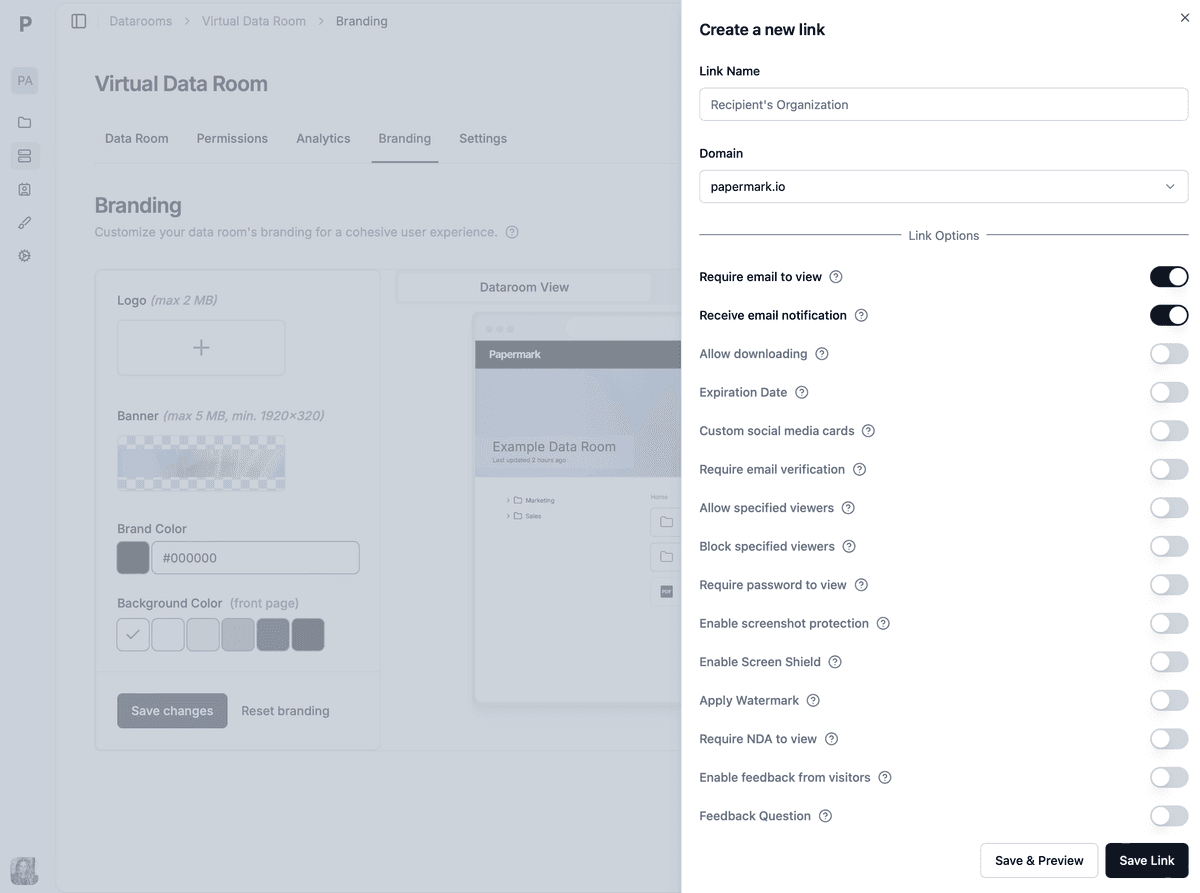
Once a letter of intent is signed, spin up a separate room for that target and give each diligence workstream its own link.
| Workstream | Folders granted | Rights |
|---|---|---|
| Financial diligence and QoE provider | Financial, tax, general ledger | View and download |
| Legal counsel | Corporate, contracts, litigation, property | View and download |
| Tax adviser | Tax filings, payroll, entity structure | View only |
| Insurance and benefits review | Policies, claims history, employee census | View only |
| Lender credit team | Financial, customer concentration, collateral | View only, watermarked |
Granular file-level permissions are set per link, so the lender's credit team never opens employee compensation files and the tax adviser never sees the customer contracts. Dynamic watermarking stamps the viewer's email, IP, and timestamp on every page of the seller's contract file, which is usually what a nervous owner asks for before agreeing to upload it at all.
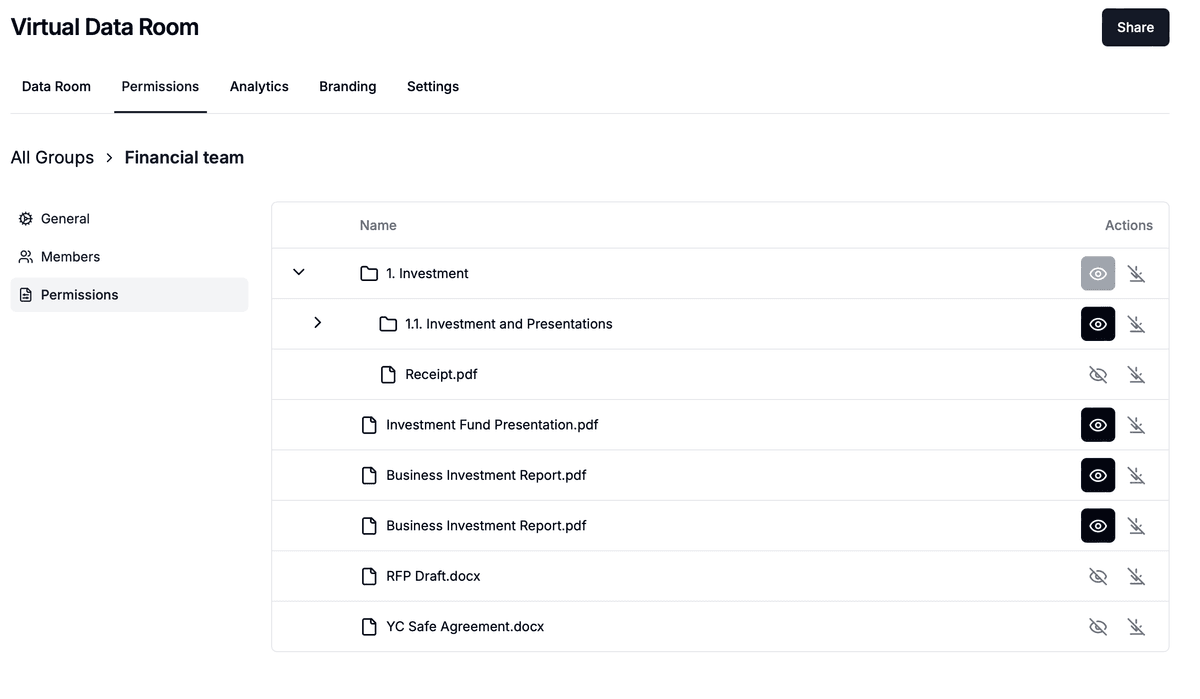
Five workstreams, one document set, five scoped links over the same underlying files.
Diligence requests arrive in waves, and a seller's controller running a business at the same time will lose an email thread inside a week. The Q&A module threads each question against the document that prompted it, with permissions controlling who sees which threads, and request files lets an adviser ask the seller for a missing export inside the room rather than by email.
When a deal dies, data room freeze archives it as an immutable ZIP with a certificate rather than leaving it live, which matters because you signed a confidentiality agreement with an owner who is now going back to running their company. When a deal closes, the same archive is the record your investors will want when they underwrite the next one.
Papermark is our #1 VDR provider for M&A transactions right now. In two deals we used custom branding, dynamic watermarking, and granular permissions.
Tyler
The Data Rooms plan is €99/month with a 7-day free trial and includes 3 team members, unlimited data room visitors, unlimited data rooms, unlimited documents with no file size limit, custom domains, dynamic watermarking, NDA agreements, and granular file-level permissions. Data Rooms Plus at €249/month adds 5 team members, the Q&A module, the audit log, automatic file indexing, and SOC 2 Type II. Premium at €549/month adds 10 members, AI redaction, API access, SSO, and whitelabeling. Data Rooms Unlimited at €999/month removes per-seat charges entirely, so teams that add reviewers mid-deal pay one number regardless of headcount, and it carries every Premium capability including AI redaction.
For a search fund the unlimited-rooms line is the one that matters. A 20-month search costs roughly €2,000 on the Data Rooms plan and covers the investor room plus every target room you open along the way, which is less than the legal fee on a single letter of intent that goes nowhere.
No credit card required.
The independent sponsor model in 2026: three fee layers, promote tiers, capital partners, and running the deal in a data room for independent sponsors.
Entrepreneurship through acquisition in 2026: four search models, SBA financing up to $5M, an 8-step process, and the data room for an ETA acquisition.
Insurance due diligence in 2026: the 12 policy lines to review, 5 years of loss runs, the run-off tail trap, and the data room insurance diligence runs on.