


datarooms
11 Ansarada alternatives in 2026: skip the quote-only VDR
Compare 11 Ansarada alternatives in 2026 on pricing, storage, and security. Find a cheaper VDR than Ansarada's quote-only $479+/month plans.
ShareFile is a secure file sharing and client portal platform owned by Progress Software, priced per user with a 3 to 5 user minimum on every tier. Its Virtual Data Room plan is $77 per user per month with a 5-user minimum, so a deal room starts at $385/month before anyone is added. This guide compares the 10 strongest ShareFile alternatives in 2026 on real pricing, security, and best-fit use case.
The short version for most teams: Papermark if you want flat pricing, page-level analytics, and a data room without per-seat maths; Box or Egnyte if you need enterprise content management across a large workforce; SecureDocs or iDeals if you specifically need a legacy VDR brand your counterparty already recognises.
No credit card required.
How we compared these providers: pricing is taken from each vendor's published pricing page at the monthly rate rather than the discounted annual rate, because the monthly figure is what a team actually pays in the first year. Ratings are from G2 and Capterra with review counts. Competitors are described neutrally, and every entry carries at least one honest limitation.
| # | Provider | Starting price (monthly) | Best for |
|---|---|---|---|
| 1 | Papermark | From €99/month flat, 7-day trial | Flat-rate data rooms with page-level analytics and dynamic watermarking, no per-seat cost |
| 2 | Box | $20 to $47/user/month, 3-user minimum | Enterprise content management with a large integration catalogue |
| 3 | Dropbox Business | From $18/user/month, 3-user minimum | Teams that want sync-first file storage with basic link controls |
| 4 | Microsoft SharePoint and OneDrive | From $5/user/month | Organisations already standardised on Microsoft 365 |
| 5 | Egnyte | From $22/user/month | Hybrid cloud and on-premises storage with ransomware detection |
| 6 | Tresorit | From $14.50/user/month | End-to-end encrypted storage under Swiss and EU jurisdiction |
| 7 | Onehub | Data Room Edition from $300/month, billed annually | Branded client workspaces without a full VDR feature set |
| 8 | SecureDocs | From $450/month | Simple subscription VDR with unlimited users for a single deal |
| 9 | Digify | From $480/month | Document rights management and device fingerprinting |
| 10 | iDeals | Custom quote, 30-day free trial | Mid-market M&A with a long formal Q&A phase |
ShareFile is a capable product, and the reasons people leave it are mostly structural rather than about missing features.
The first is the pricing model. Every ShareFile tier is priced per user with a minimum seat count: Advanced at $18.15 per user per month with a 3-user minimum, Premium at $28.60, Industry Advantage at $45.83, and the Virtual Data Room plan at $77 per user per month with a 5-user minimum. That last one is the number that pushes deal teams to look elsewhere, because $385/month is the floor before you add a sixth person, and a deal team of ten costs $770/month. Annual billing takes roughly 10 percent off, but the seat maths does not change.
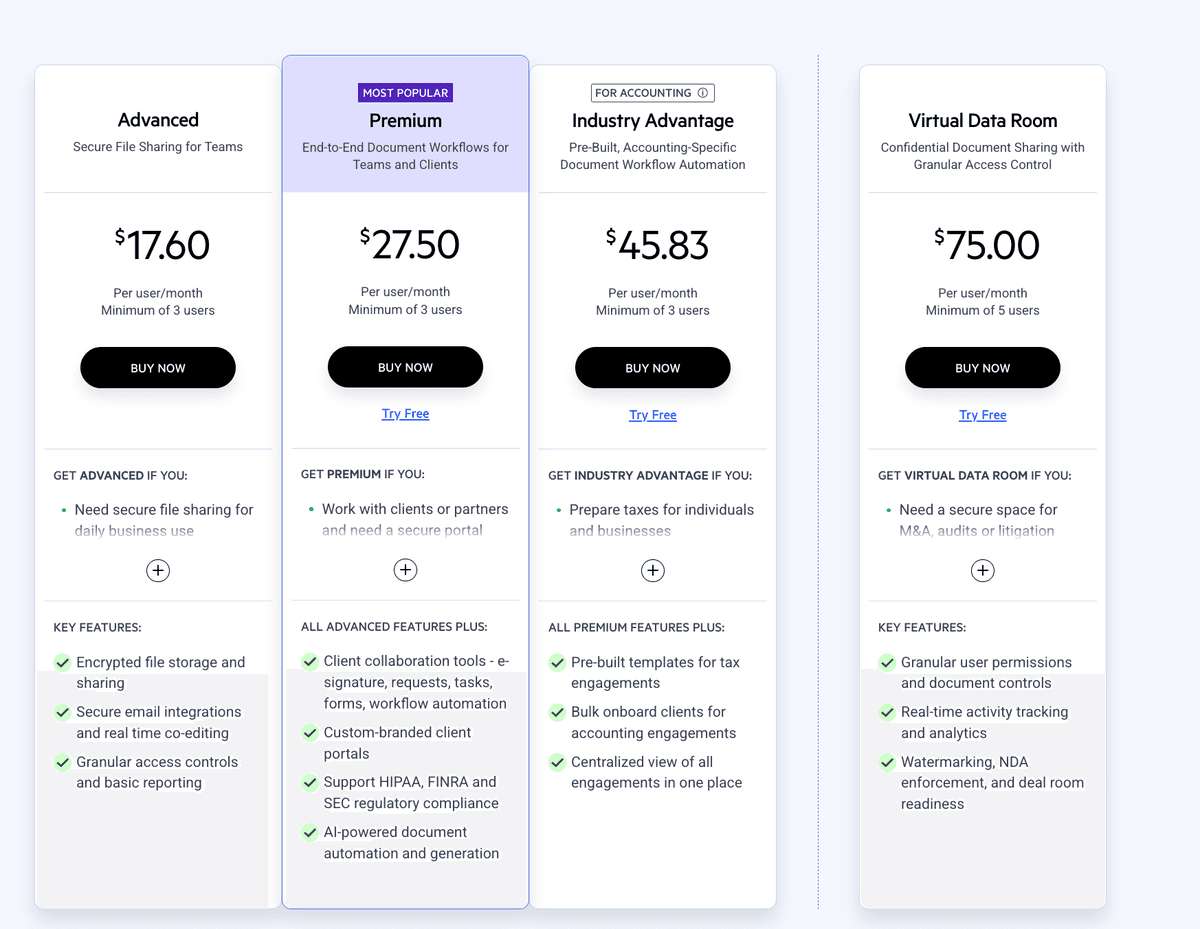
ShareFile prices every tier per user with a 3 to 5 seat minimum, so cost scales with team size rather than with usage.
The second is the absence of a free tier. ShareFile offers a Try Free trial on the Premium, Industry Advantage, and Virtual Data Room plans, but there is no permanent free plan, so there is no low-commitment way to test it against a live workflow or to keep a dormant room between deals.
The third is analytics depth. ShareFile tracks file-level activity, which answers whether a document was opened. Deal teams and fundraisers increasingly want to know which page held attention and for how long, because that is the signal that tells you which section of a memorandum a buyer is actually working through. Page-level engagement is a different capability from access logging, and it is the most common reason people move to a purpose-built data room.
The table below sets the two head-to-head on the dimensions that decide most switches.
| Dimension | ShareFile | Papermark |
|---|---|---|
| Pricing model | Per user, 3 to 5 seat minimum on every tier | Flat, from €99/month |
| Data room entry price | $385/month (5 users at $77) | €99/month, 3 team members |
| External viewers | Counted against the plan | Unlimited, not charged |
| Free plan | Trial only, no permanent free tier | Free plan at €0 |
| Analytics | File-level activity tracking | Page-by-page, per viewer |
| Dynamic watermarking | (email, IP, timestamp per page) | |
| Custom domain per room | Branded portals | from €99/month |
| Public API and self-hosting | REST API, CLI, MCP, AGPL self-host |
The fourth is scope mismatch in both directions. Firms that only need a secure client upload flow find themselves paying for workflow automation and e-signature they do not use. Firms running real M&A processes find the VDR tier's per-seat cost hard to justify against flat-rate competitors. If you are weighing the wider market rather than just ShareFile, our comparison of the best virtual data rooms covers pricing models, bidder management, and compliance across every major provider.
Website: papermark.com
Pricing: From €99/month (Data Rooms plan, 7-day free trial). Free plan available.
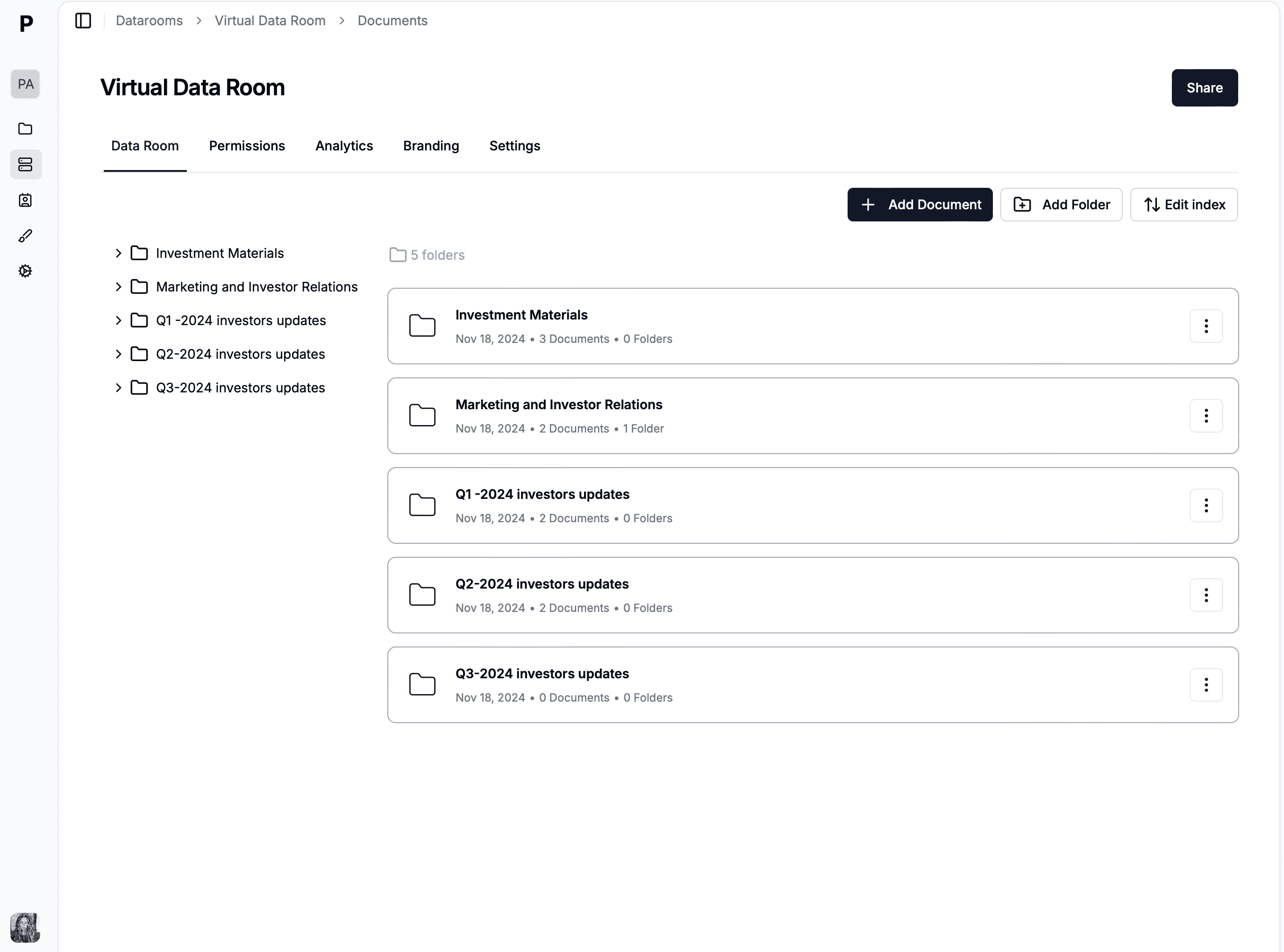
Papermark is a secure, fully customizable, and developer-friendly data room built for modern dealmakers, with page-by-page analytics, dynamic watermarking, and transparent pricing from €99/month. It is the direct answer to ShareFile's per-seat model: one flat plan, unlimited data rooms, unlimited documents with no file size limit, and no charge for the external viewers who make up most of the people looking at your documents. It is also open-source and self-hostable for teams that need full data sovereignty.
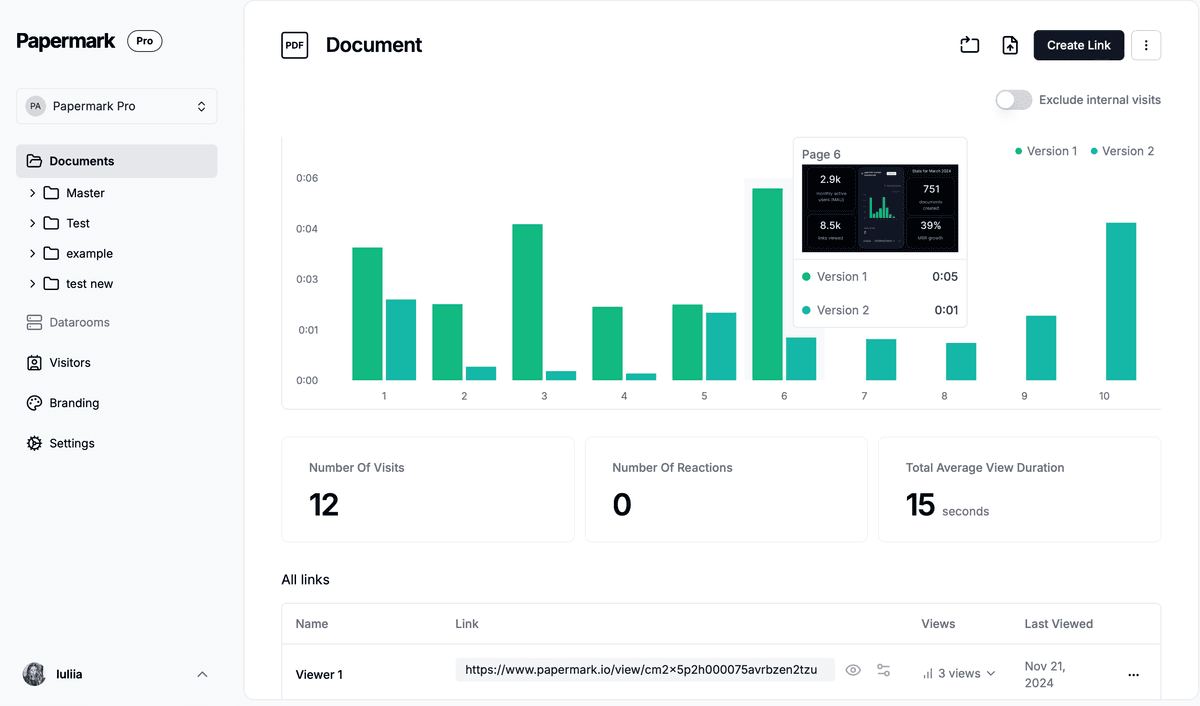
Page-by-page analytics show which viewer opened which page and for how long, not just whether a file was accessed.
Page-level analytics is the capability most teams cite when they switch. You see which viewer opened the room, which document and which page they spent time on, whether they returned, and whether the link was forwarded. On a fundraise that tells you which investor read the financial model rather than the summary. On a sell-side process it tells you which bidder has stopped engaging. ShareFile's activity tracking answers a narrower question.
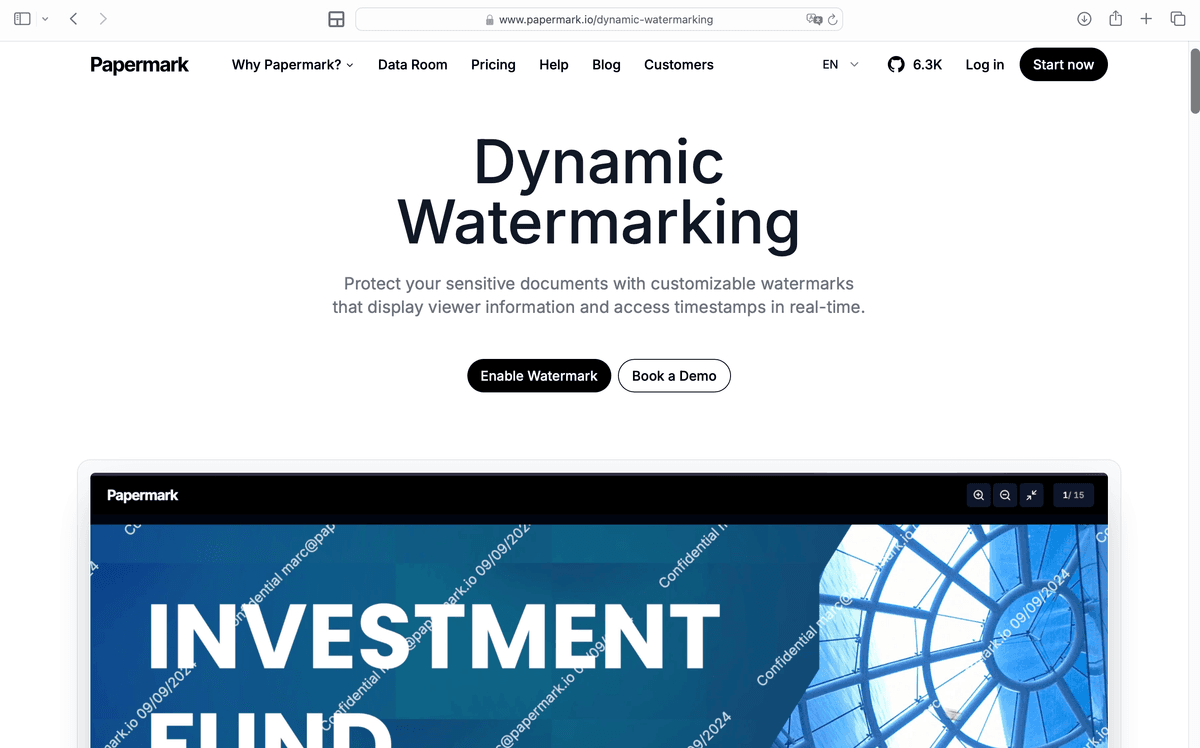
Dynamic watermarking renders viewer identity into each page as it is served, which is what makes a leaked page traceable.
Papermark covers the controls deal teams ask for: dynamic watermarking that stamps each viewer's email, IP, and timestamp on every page as it renders, view-only mode and screenshot protection, a one-click NDA gate with an auditable acceptance record, and granular file-level permissions per viewer group. Access is link-based with optional email verification, so counterparties never create an account, which is the single biggest driver of whether a room actually gets used. It is GDPR, HIPAA, and CCPA compliant, with SOC 2 Type II from the Data Rooms Plus plan, AES-256 encryption at rest, TLS in transit, and EU hosting available.
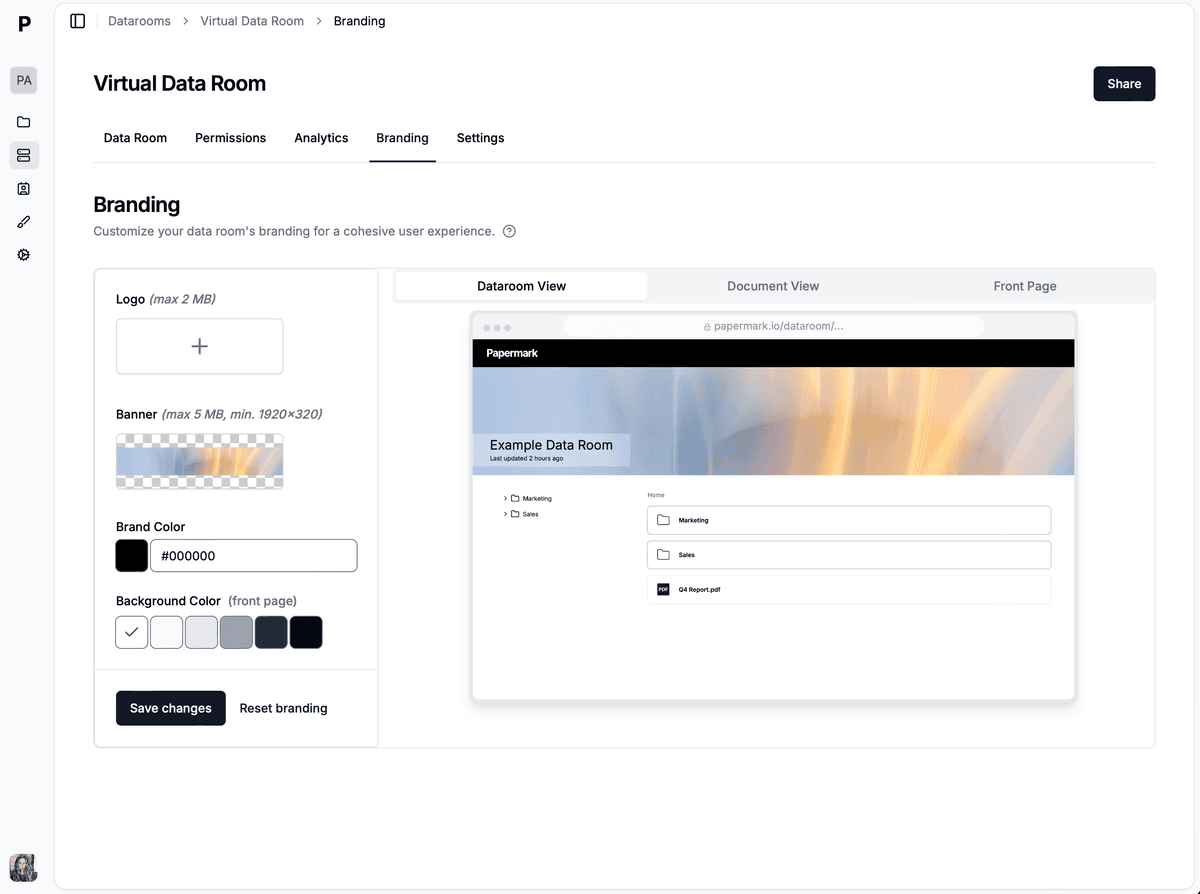
Every room can run on your own domain with your logo and colours, with Papermark branding removed entirely.
Custom domains for data rooms are included from the €99/month plan, so an advisory firm can give every client a room that looks like the firm rather than like a vendor. Full white-labelling and custom layouts sit on the Premium plan. This is where Papermark differs most visibly from general file-sharing tools, which give you a folder inside their own interface.
Papermark publishes a REST API, a CLI, and an MCP server, so data rooms, links, and permissions can be created programmatically and by AI agents. That matters for firms running the same room structure across dozens of deals a year, and for products that need to provision a room per customer. No other provider in this list offers a documented public API of the same scope.
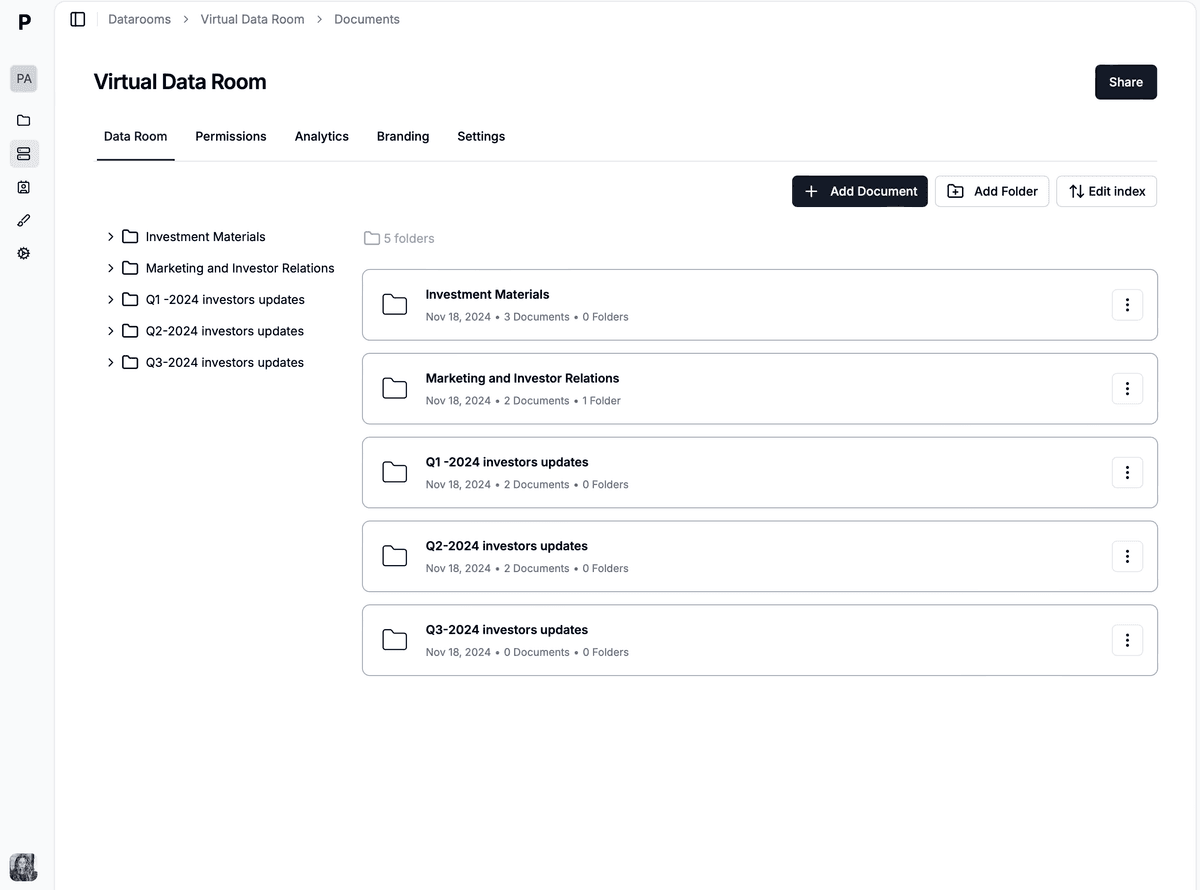
Unlimited data rooms on every paid plan, so one room per deal or per client costs nothing extra.
See the full Papermark Data Rooms pricing. Against ShareFile's Virtual Data Room tier at $385/month for 5 users, the €99/month plan covers 3 team members and an unlimited number of external viewers.
Limitation to be honest about: Papermark is a newer brand than the legacy VDRs, so on very large cross-border processes where the sell-side bank mandates a specific vendor, brand recognition can still decide the choice. It is also not a general file-sync product: if what you want is a mapped drive on every laptop, Box, Egnyte, or Dropbox fit that better.
Website: box.com
Pricing: $20 to $47 per user per month depending on tier, with a 3-user minimum.
Box is an enterprise content management platform with a large integration catalogue, strong governance tooling, and compliance coverage that includes FedRAMP authorisation, which matters for public sector work. It handles the same client-portal and secure-sharing jobs ShareFile does, at a similar per-user shape, and adds retention policies, legal hold, and classification for organisations with formal records management requirements.
For deal work, Box is used as a data room by teams who already own it rather than by teams choosing one. It has permissions and watermarking, but the workflow is built around collaboration rather than around a time-boxed diligence process with bidder groups and a Q&A phase.
Limitation: external collaborators are commonly asked to create a Box account, which adds friction with counterparties who will use the room once. Advanced governance and security features sit on the higher tiers, so the entry price is not the working price.
Website: dropbox.com
Pricing: From $18 per user per month with a 3-user minimum.
Dropbox Business is a sync-first storage platform with password-protected links, link expiry, and a large integration ecosystem. For firms whose main requirement is that files are on every device and shareable in two clicks, it does that better than most secure-sharing products, and the interface needs no training.
Dropbox also owns DocSend, which is the product actually aimed at the tracked-document use case, sold separately.
Limitation: the security model is link-centric rather than room-centric, so there are no bidder groups, no structured Q&A, and no dynamic per-viewer watermarking on the standard business plans. Analytics stop at whether a link was opened.
Website: microsoft.com
Pricing: From $5 per user per month as part of Microsoft 365 Business plans.
If your organisation already pays for Microsoft 365, SharePoint and OneDrive are the cheapest credible ShareFile replacement, because the marginal cost is close to zero. Document libraries, versioning, retention labels, and sensitivity labels cover a lot of ground, and external sharing controls have improved considerably.
The practical experience for external parties is the sticking point. Guest access through Entra ID works, but it involves an invitation and identity step that counterparties frequently stall on, and permissions inheritance in SharePoint is famously easy to get wrong at speed. See our guide to creating a data room in SharePoint for what the setup involves.
Limitation: no page-level analytics, no dynamic watermarking, and no NDA gate, so a genuine diligence process needs either a lot of manual process around it or a purpose-built room.
Website: egnyte.com
Pricing: From $22 per user per month.
Egnyte is the strongest option in this list for organisations that need cloud access to storage that also lives on-premises. Architecture, engineering, and construction firms with hundreds of gigabytes on a local NAS use it to get cloud access and backup without migrating everything, and its ransomware detection monitors file behaviour and can freeze suspicious activity.
Limitation: setup expects hands-on IT involvement and the interface is built for administrators rather than end users, so it fits poorly in a firm without dedicated IT. It does not offer branded rooms or page-level engagement analytics, so it governs storage well and external presentation less well.
Website: tresorit.com
Pricing: From $14.50 per user per month.
Tresorit is an end-to-end encrypted storage and sharing service under Swiss and EU jurisdiction, which makes it a common pick for firms whose primary requirement is data residency and zero-knowledge encryption rather than deal workflow. Files are encrypted client-side, so the provider cannot read them, and sharing links can carry passwords, expiry, and download limits.
Limitation: end-to-end encryption is the reason for the product and also the reason it cannot offer server-side page rendering, per-page analytics, or dynamic watermarking. It is priced per user, so it does not solve the seat-count problem that pushes teams away from ShareFile.
Website: onehub.com
Pricing: Data Room Edition from $300/month, billed annually.
Onehub sits between cloud storage and a data room, with branded workspaces, granular roles, and a clean client-facing interface. Firms that want a client portal with their own logo, without buying an enterprise content platform, tend to like it, and pricing is flat rather than per user, which is a genuine advantage over ShareFile.
Limitation: the features deal teams care about, including watermarking and NDA gating, are gated to the Data Room Edition at $300/month, and there is no structured Q&A module or page-level analytics even at that tier.
Website: securedocs.com
Pricing: From $450/month.
SecureDocs is a subscription virtual data room with unlimited users and storage, aimed at teams who want a room live the same day without a procurement cycle. The feature set is deliberately narrow: permissions, audit trail, watermarking, and a simple Q&A, with none of the collaboration surface of a content platform.
Limitation: the entry price is high relative to what a small team gets, and the product has changed little in recent years, with no page-level analytics and limited branding compared with newer alternatives.
Website: digify.com
Pricing: From $480/month (Team plan).
Digify focuses on document rights management: watermarking, print and download control, device fingerprinting, and the ability to expire access to files already delivered through its viewer. Teams whose main worry is what happens to a document after it leaves consider it for that reason.
Limitation: pricing is high for the room count and seat count included, and users report caps on data rooms and team members on lower tiers. Post-delivery revocation only works inside the Digify viewer, so it does not apply to a file exported by any other route.
Website: idealsvdr.com
Pricing: Custom quote, with a 30-day free trial.
iDeals is a mid-market and enterprise VDR with granular permissions, fence view, redaction, and a formal Q&A workflow with role-based routing and approval chains. On a process with a long structured Q&A phase and many bidder groups, that workflow is more developed than most alternatives in this list.
Limitation: pricing is not published, so every engagement starts with a sales call and a scoping conversation, and entry plans have historically carried tight storage limits. It has a G2 rating of 4.7/5 with 634 reviews.
Two questions narrow the field faster than any feature matrix.
Are you replacing file storage or replacing a deal room? If ShareFile is your company's general file platform, the replacements are Box, Egnyte, Dropbox, or Microsoft 365, and the decision is about governance, integrations, and per-user cost across your whole workforce. If ShareFile is where you run diligence and client document exchange, the replacements are Papermark, SecureDocs, iDeals, or Digify, and the decision is about permissions, watermarking, analytics, and how many external viewers you can invite without paying per head.
Does your cost scale with your team or with your usage? This is the question ShareFile's model forces. Per-user pricing is fine when the users are your employees and the count is stable. It is punishing when most of the people opening documents are counterparties, clients, and advisors, because a 5-seat minimum on a VDR tier means a two-person advisory firm pays for five. Flat-rate providers, including Papermark at €99/month and SecureDocs at $450/month, remove that variable entirely.
| Your situation | Best pick | Why |
|---|---|---|
| Running deals or diligence with external parties | Papermark | €99/month flat, unlimited external viewers, page-level analytics, dynamic watermarking |
| Company-wide file platform for 200+ staff | Box or Egnyte | Governance, retention, and integration depth across a whole workforce |
| Already paying for Microsoft 365 | SharePoint and OneDrive | Marginal cost close to zero if guest access is acceptable |
| Data residency and zero-knowledge encryption first | Tresorit | Client-side encryption under Swiss and EU jurisdiction |
| One-off deal, want a room live today | Papermark or SecureDocs | Self-serve setup with a 7-day trial, or a flat subscription VDR |
| Long formal Q&A with many bidder groups | iDeals or Papermark | Role-based Q&A routing; Papermark's Q&A module is on Data Rooms Plus at €249/month |
| Branded client portal without enterprise ECM | Papermark or Onehub | Custom domain and branding per client room |
Compare 11 Ansarada alternatives in 2026 on pricing, storage, and security. Find a cheaper VDR than Ansarada's quote-only $479+/month plans.
DealRoom VDR review for 2026: $25,000/year start, AI diligence, FirmRoom ownership, and 4 alternatives. Papermark from €99/month with AI redaction.
HighQ Dataroom review for 2026: features, real pricing estimates, honest pros and cons, and 5 legal VDR alternatives including a data room from €99/month.