



mergers-and-acquisitions
14 Best Business Brokers in San Antonio, TX for Selling in 2026
A verified guide to 14 business brokers in San Antonio, TX, with deal sizes, focus sectors, fee models and how to run a confidential sale process in 2026.
A competitive bidding process, or M&A auction process, is a controlled sale in which several buyers get the same information, under the same deadlines, and bid against each other in rounds. Aim for 3 to 5 qualified offers over 4 to 8 months, and run each bidder through its own link in a secure data room such as Papermark.
The difference between a bilateral sale and a competitive process is leverage. With one buyer, every term is negotiated against your fear that they walk. With three, each buyer negotiates against the other two, and advisors commonly report that a well-run process lifts the final price meaningfully above the first unsolicited offer. This guide covers the auction types, the five rounds, the process letter, how to score bids, and how to manage bidders in a data room.
A competitive bidding process is a structured sale where the seller, usually through an advisor, invites multiple buyers to bid on the same terms and timetable. Every bidder sees the same CIM and the same data room documents at each stage, submits bids by the same deadline, and is told the same rules. The structure is what creates price tension: no bidder knows the others' numbers, and every bidder knows there are others.
The first decision is how many buyers to approach. More buyers means better price discovery and higher leak risk. Fewer buyers means more confidentiality and less tension. Most lower middle market sales run a limited or targeted auction.
A broad auction contacts 50 to 200 potential buyers, including strategic acquirers and financial sponsors. It maximizes price discovery and is common for businesses with wide appeal. The trade-off is confidentiality: with that many teasers out, competitors and employees are more likely to hear about the sale.
A limited auction contacts 10 to 30 buyers chosen for strategic fit or financial capacity. It is the default for most advised sales because it keeps enough tension to move price while limiting the number of parties who see sensitive documents.
A targeted process contacts 3 to 8 buyers the advisor believes are most likely to pay a premium, often direct competitors or adjacent strategics. It protects confidentiality and suits businesses where a leak would hurt customer or employee relationships, but there is less competition to fall back on if one bidder drops.
A one-on-one negotiation is not an auction at all. It is fast and private, and it usually starts from an unsolicited offer. It gives the seller the weakest leverage, which is why advisors often recommend turning an inbound approach into a targeted process with two or three more buyers.
| Auction type | Buyers contacted | Best for | Confidentiality risk | Trade-off |
|---|---|---|---|---|
| Broad | 50 to 200 | Wide buyer appeal, price discovery | High | Leaks, more management time |
| Limited | 10 to 30 | Most advised mid-market sales | Medium | Balanced tension and control |
| Targeted | 3 to 8 | Sensitive businesses, clear strategic fit | Low | Less tension if a bidder drops |
| One-on-one | 1 | Speed, an unsolicited offer | Lowest | Weakest leverage on price |
A competitive bidding process runs in five rounds, each with a deadline and a defined level of access to information. Buyers earn more access by bidding, and the seller narrows the field at each step. The whole process typically takes 4 to 8 months from launch to closing.
Before launch, the advisor builds the buyer list, writes the teaser and CIM, and prepares the data room. The seller agrees the evaluation criteria in advance: minimum price, structure preferences, how much rollover is acceptable and how long the owner will stay. A sell-side quality of earnings, if commissioned, should be in draft. Our guide to sell-side due diligence covers this preparation.
The teaser goes to the buyer list. Interested buyers sign an NDA and receive the CIM plus access to a first-round folder in the data room: summary financials, a customer concentration summary and an overview of operations. A first-round process letter sets the deadline for indications of interest (IOIs). A limited auction usually produces 10 to 20 NDAs and 4 to 8 IOIs.
The seller shortlists 3 to 5 bidders based on IOIs and engagement. Shortlisted bidders get management presentations, site visits and access to a deeper data room folder with contracts, detailed financials and HR summaries. A second process letter, often with a markup of the seller's draft purchase agreement attached, sets the deadline for letters of intent or final bids.
If two or more final bids are close, the advisor asks the top bidders for a best-and-final offer in writing, with a short deadline of a few days. Only then does the seller sign an LOI and grant exclusivity, usually 30 to 60 days. Our guide to the letter of intent in an acquisition covers the exclusivity terms to negotiate.
The winning bidder completes confirmatory diligence with full data room access, the lawyers finalize the purchase agreement and disclosure schedules, and the deal signs and closes. Keep the runner-up informed and on good terms until signing, because a retrade is much harder for a buyer to push when the seller has a credible alternative.
| # | Round | Typical length | Bidders | Data room access | Output |
|---|---|---|---|---|---|
| 0 | Preparation | 2 to 6 weeks | None | Room built, closed | CIM, buyer list, criteria |
| 1 | Teaser, NDA, CIM | 4 to 6 weeks | 10 to 20 NDAs | First-round folder | 4 to 8 IOIs |
| 2 | Management meetings | 4 to 8 weeks | 3 to 5 shortlisted | Second-round folders | LOIs or final bids |
| 3 | Best-and-final | Days | 2 to 3 | Unchanged | Signed LOI, exclusivity |
| 4 | Confirmatory diligence | 6 to 12 weeks | 1 | Full room plus Q&A | Signed purchase agreement |
A process letter is the instruction sheet that tells every bidder what to submit, by when, and under what rules. It keeps bids comparable and deadlines firm. Without one, each bidder sends a different format on a different day, and the seller ends up negotiating structure before seeing the price.
Send a first-round process letter with the CIM and a second-round letter to the shortlist. The skeleton below covers a first-round letter.
The second-round letter adds the LOI or final bid deadline, asks for a markup of the draft purchase agreement, and requires committed financing evidence. Copy the access rules into the data room itself, as the NDA or a notice on the landing page, so bidders see them every time they log in.
The highest headline price is not always the best bid. Two offers at $20M can differ by several million dollars in what the seller actually receives, depending on how much is paid at closing, how much is deferred, and how likely the deal is to close on those terms.
Score every bid on the same matrix. Cash at close is what you can count on. An earnout depends on future performance that the buyer will control. Rollover equity is a bet on the buyer's next exit. The working capital peg can quietly move the price by 3 to 5 percent. And financing certainty decides whether the bid survives to closing: a sponsor with committed equity and a debt commitment letter is worth more than a higher number with "financing to be arranged".
| Factor | Bidder A | Bidder B | Bidder C |
|---|---|---|---|
| Headline enterprise value | $24.0M | $22.5M | $25.5M |
| Cash at close | $20.4M | $21.4M | $17.9M |
| Earnout or deferred | $1.2M | $0 | $4.0M |
| Rollover equity | $2.4M | $1.1M | $3.6M |
| Working capital peg | Trailing 12-month average | Trailing 12-month average | To be set in diligence |
| Financing committed | |||
| Exclusivity requested | 45 days | 30 days | 90 days |
| Data room engagement | High | High | Low |
| Score out of 10 | 8 | 8.5 | 5 |
Bidder C has the highest headline and the weakest bid: the lowest cash at close, an unset peg, no committed financing and a 90-day exclusivity request. Bidder B is $1.5M lower on headline and $1M higher on cash at close.
The job in the middle of an auction is to keep every serious bidder working without pushing any of them out. Bidders drop when they think they cannot win, when the process feels disorganized, or when another opportunity looks easier.
Set deadlines and keep them. An advisor who extends an IOI deadline for one bidder signals to the others that the process is soft. If a bidder genuinely needs more time, extend for everyone and say so in writing.
Hold management presentations for all shortlisted bidders within the same one or two weeks. Sequential meetings over a month let early bidders cool off and late bidders learn what the others asked.
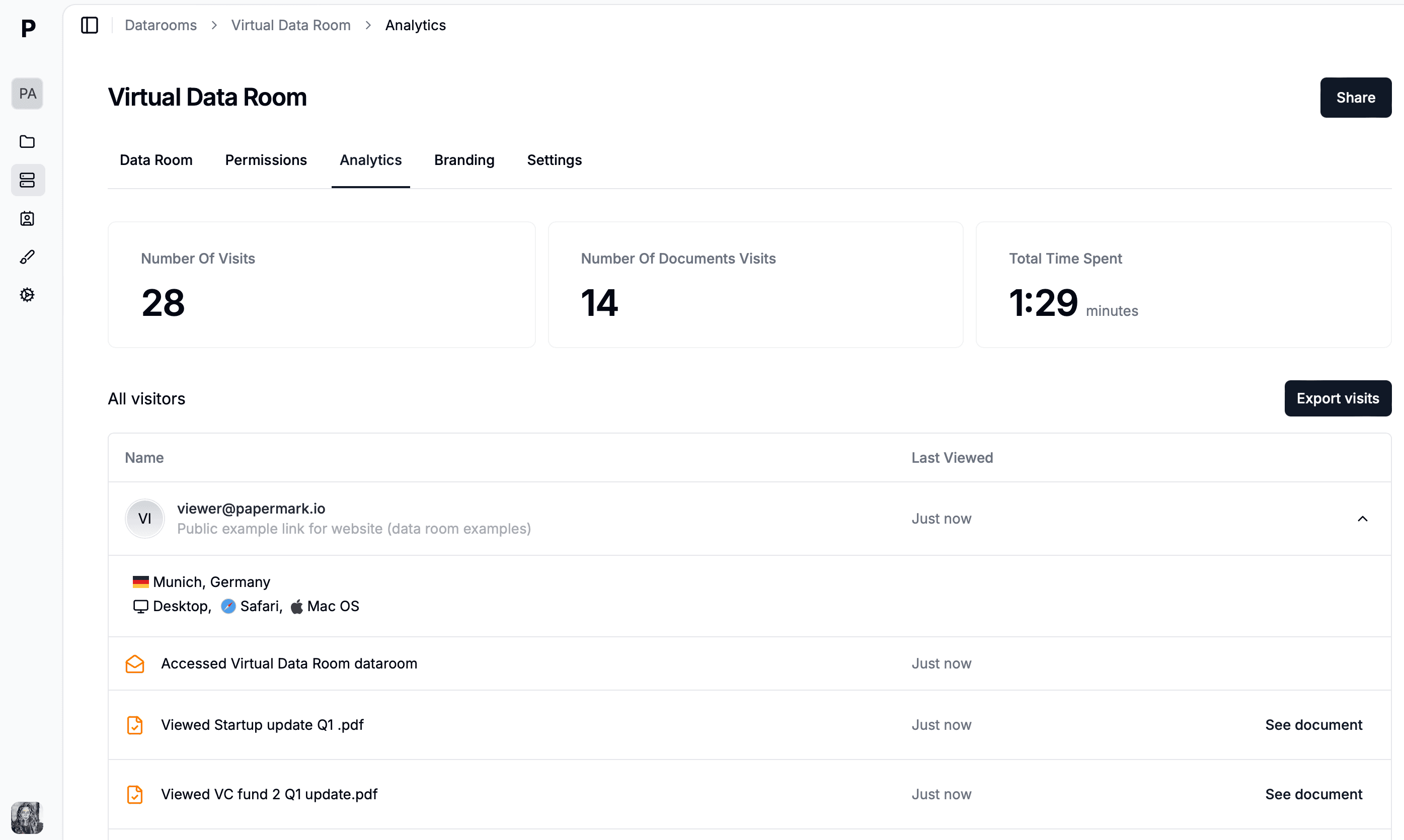
Data room analytics show who is actually doing the work before the deadline. A bidder whose team has spent three hours in the financial folder and returned to the customer contracts is building a model. A bidder who opened the CIM once two weeks ago is not, whatever they say on calls. Use per-bidder analytics to decide where the advisor spends follow-up time, and to spot a bidder who is about to drop before they tell you.
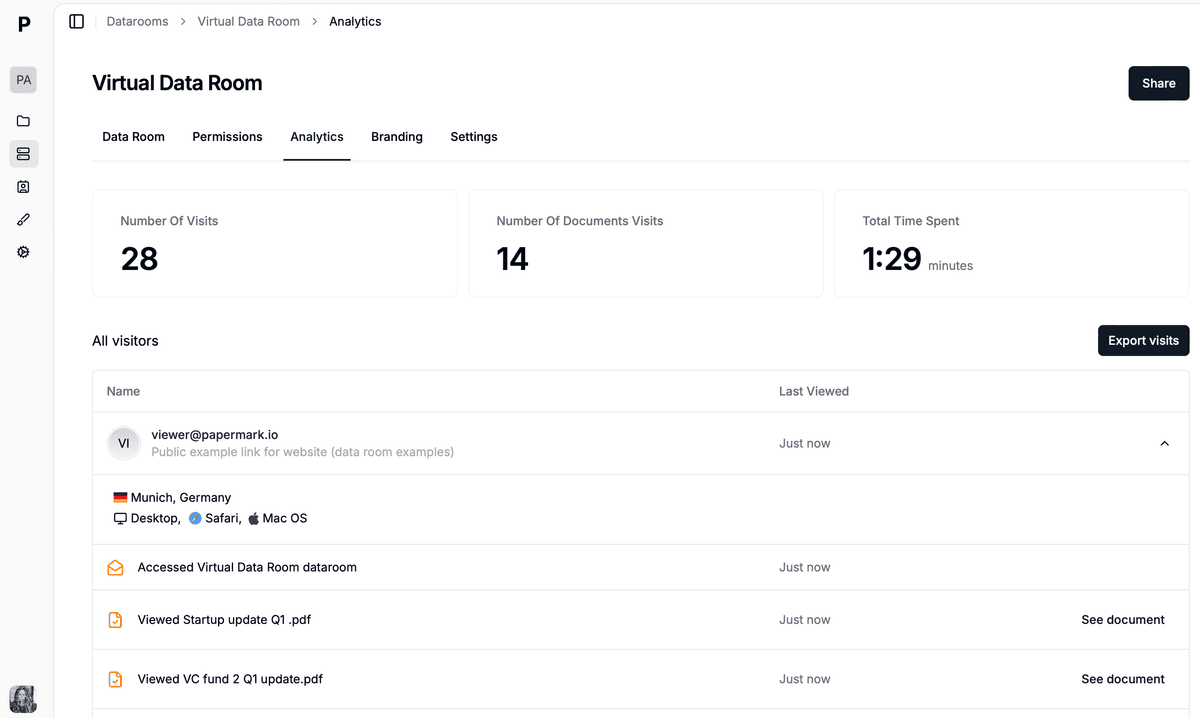
Per-bidder engagement before the IOI deadline shows who is preparing a real number.
Grant exclusivity only after best-and-final, never with the first LOI. Once signed, keep it short, 30 to 60 days, with a hard end date, no automatic renewal and extensions tied to milestones such as a committed financing letter. Every day of exclusivity is a day your other bidders are moving on.
A competitive process is not always the right choice. It costs more management time, more advisor fees and more confidentiality risk than a negotiated sale, and in some situations the extra tension does not pay for itself.
Skip or shrink the auction when there is only one natural buyer, for example a supplier or customer whose integration value no one else can match. Skip it when confidentiality is critical, such as a business whose key customers or staff would leave on hearing it is for sale. And skip it when the buyer universe is genuinely tiny, because an auction with two half-interested bidders signals weakness rather than demand. In those cases, a targeted process with 2 or 3 parties often captures most of the benefit.
The most expensive mistake is granting exclusivity too early, on the first LOI, before other bidders have finished their work. The second is inconsistent information: one bidder gets an answer by phone that the others never see, which is unfair and creates disclosure problems later. Publish answers to common questions to all bidders.
The third is leaks: teasers that identify the company, CIMs sent as attachments, or a shared drive link forwarded inside a bidder's network. The fourth is deadline drift, which teaches bidders that the timetable is optional. The fifth is a re-trade after diligence that the seller could have prevented by disclosing the problem early in the data room, when it was a fact rather than a discovery.
Priya Nair owns a hypothetical B2B software company with $8M of ARR and $2.4M of EBITDA. Her advisor recommends a limited auction and contacts 26 buyers: 11 strategics and 15 private equity funds.
Fourteen buyers accept the NDA in the data room within three weeks, each in its own group with access to the CIM and a 32-document first-round folder. Before the IOI deadline, analytics show that 4 groups never went past the CIM, while 6 spent more than two hours in the financial and customer cohort files. Six IOIs arrive, between $26M and $34M. The advisor shortlists 4 based on price, structure and engagement, holds all four management meetings in the same week, and opens the second-round folders to those 4 groups only.
Three LOIs arrive at the round 2 deadline, at $30M, $31.5M and $33M. The $33M bid asks for 90 days of exclusivity and leaves the working capital peg open. The advisor asks the top two for best-and-final within five days. The $31.5M bidder comes back at $32.5M with $29M at closing, a peg fixed in the LOI and 45 days of exclusivity. Priya signs it. Confirmatory diligence runs 52 days with 164 questions through the Q&A module, the runner-up stays warm until signing, and the room is frozen at closing.
Worked scenario. Data room engagement helped narrow 14 NDAs to 4 shortlisted bidders.
In Papermark, a secure, fully customizable, and developer-friendly data room for modern dealmakers, each bidder runs in its own group with its own link, so bidders never see each other's names, questions or activity. The same documents serve every bidder, and the group decides what each one can open at each round.
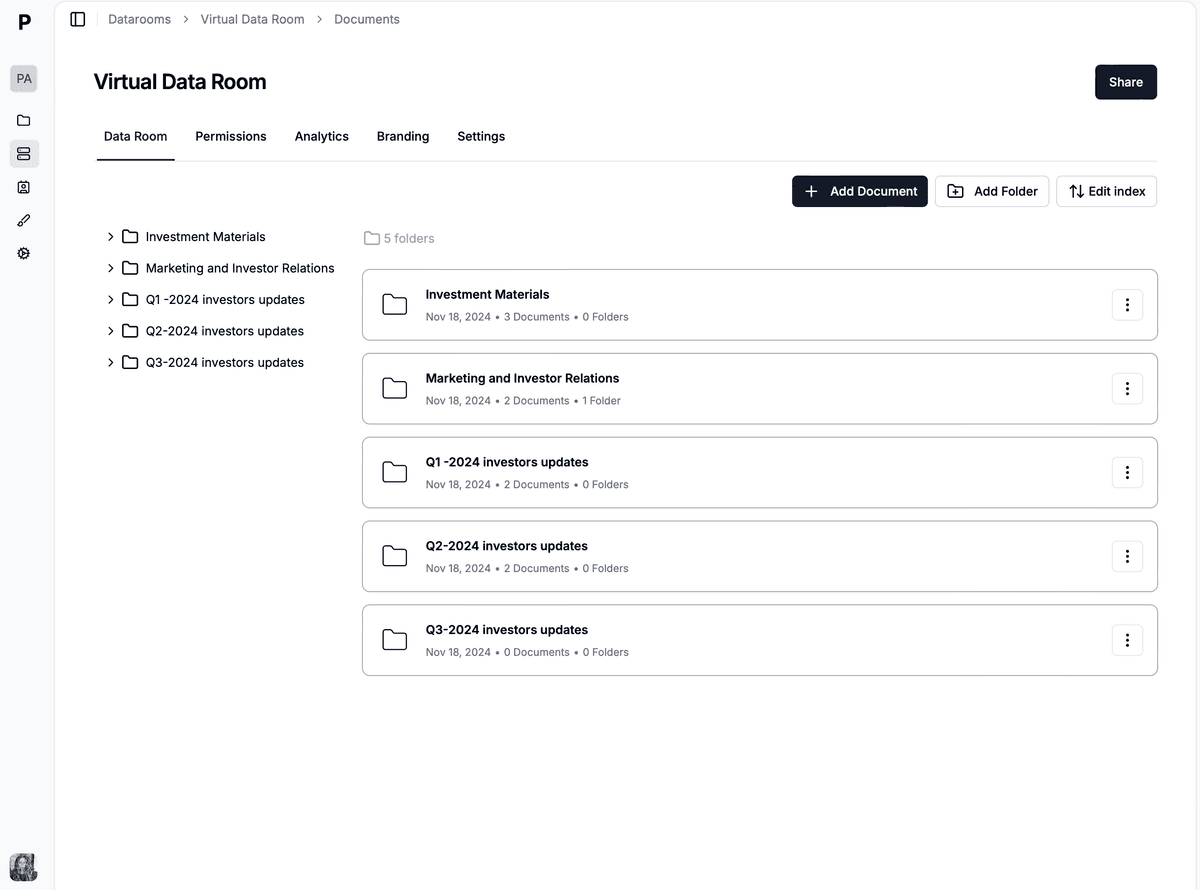
One room for the auction: a first-round folder for every NDA signer and second-round folders for the shortlist.
A data room for a competitive bidding process solves the four problems that make auctions hard to run on email and shared drives. Bidders move at different speeds, so each needs its own access level. Information has to be released in stages, so the shortlist sees more than the first round. The same questions arrive from five directions, so answers have to be consistent. And the seller needs a record of what each bidder saw, both for leverage during the sale and for the disclosure position after it. Unlimited data room visitors mean you never ration access by headcount on a bidder's team.
Create one permission group per bidder. In round 1, every group sees the first-round folder. When a bidder is shortlisted, widen that group's access to the second-round folders. When a bidder drops, revoke the link. Moving a bidder between rounds is a permission change, not a new upload, so every bidder always sees the same current version of each document. Granular permissions apply at folder and file level.
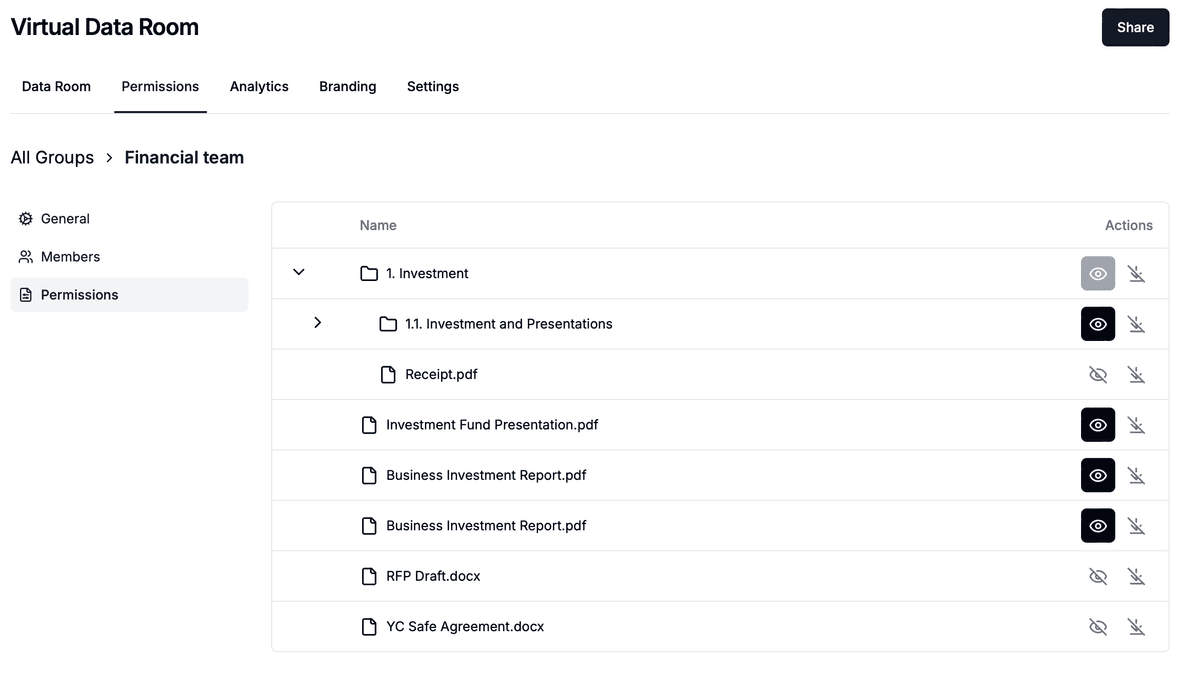
One group per bidder, so shortlisting a bidder opens the next folder for that group only.
Attach the NDA to every bidder's link with NDA gating, so nothing renders until it is accepted, and the acceptance is recorded against a verified email with a timestamp. Email verification with a one-time code and a domain allowlist per bidder stop a forwarded link from opening for someone outside the bidder's team.
Turn on dynamic watermarking on the Data Rooms plan for financials, customer contracts and payroll. Each page shows the viewer's email, IP address and timestamp, so a page that leaks to a competitor is traceable to the bidder who viewed it. Disable downloads on the second-round folders.
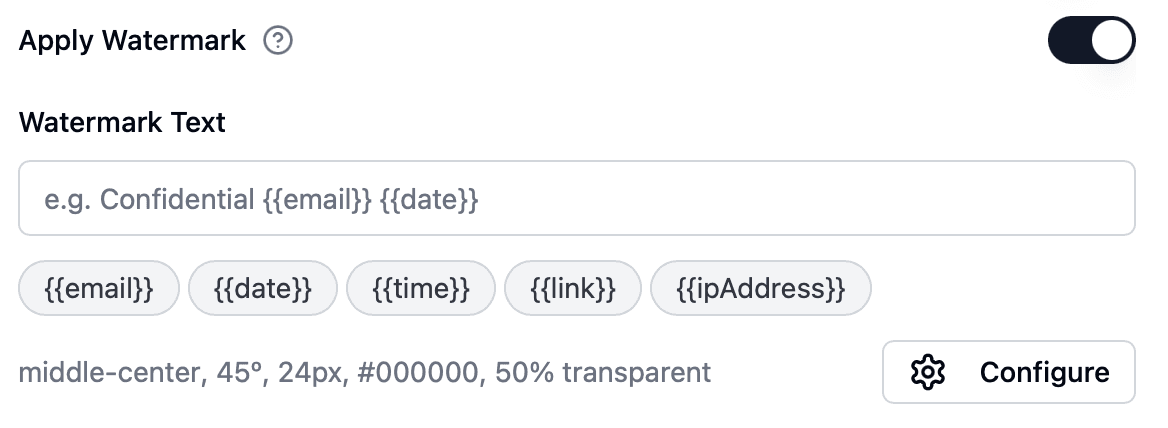
Watermarks name the viewer on every page of the financials and customer contracts.
On Data Rooms Plus, the Q&A module keeps each bidder's questions private to that bidder, attached to the document they refer to. Answers to generic questions can be published to every bidder at once, so all bidders get the same information, which is the core rule of a fair auction.
When the purchase agreement is signed, freeze the room. Freeze on Data Rooms Plus and above locks access and exports a tamper-evident archive of documents and access logs, the record of what each bidder was shown.

Papermark is our #1 VDR provider for M&A transactions right now. In two deals we used custom branding, dynamic watermarking, and granular permissions.
Tyler
The Data Rooms plan is $99/month (billed annually) with a 7-day free trial, and includes 3 team members, unlimited data rooms, unlimited data room visitors, unlimited documents, NDA agreements, dynamic watermarking and granular file-level permissions. Data Rooms Plus adds the Q&A module and data room freeze, and Data Rooms Premium adds AI redaction. Advisors running several auctions can automate setup through the API, CLI and MCP server. There is no charge per bidder, so a 20-bidder limited auction costs the same as a 3-bidder targeted one. If you are comparing providers, see our review of the best virtual data rooms.
No credit card required.
A verified guide to 14 business brokers in San Antonio, TX, with deal sizes, focus sectors, fee models and how to run a confidential sale process in 2026.
How to sell a business in 2026: the 9 tools sellers need, from accounting and valuation to marketplaces, NDAs and a secure data room, with costs and setup order.
13 verified business brokers in Chicago compared by deal size, sector and fee model, plus Illinois broker registration rules and what local buyers pay in 2026.