



mergers-and-acquisitions
How to prepare a company for acquisition in 2026: a 24-month roadmap
How to prepare a company for acquisition in 2026: a 24-month exit planning roadmap, a 30-item readiness checklist, asset vs stock sale and the data room.
How to sell a company: set your goals, clean the financials, value the business, hire a broker or advisor, write the CIM, open a secure data room such as Papermark, market confidentially under NDA, sign an LOI, complete due diligence and the purchase agreement, then close. Expect 6 to 12 months to close after 12 to 24 months of preparation.
Most owners sell a company once. The steps are well known to brokers and bankers, but the order matters more than owners expect, and two steps get skipped most often: valuing the business before choosing a buyer channel, and building the data room before any buyer asks for documents. This guide covers each of the 10 steps, who owns it, how long it takes, the IRS tax step, and a month-by-month example.
The table is the full process on one screen. Months are counted from the decision to sell, for a lower middle market company with an advisor. Smaller main-street sales compress steps 3 to 7.
| # | Step | Who owns it | Typical timing | Key document |
|---|---|---|---|---|
| 1 | Decide what you want | Owner | Week 0 | Goals memo |
| 2 | Get financials in order | Owner and CPA | Months 1 to 3 | 3 to 5 years of statements, add-backs |
| 3 | Value the company | Advisor or appraiser | Months 2 to 3 | Valuation report |
| 4 | Build the sale team | Owner | Month 3 | Engagement letters |
| 5 | Prepare teaser and CIM | Advisor | Months 3 to 4 | Teaser, CIM |
| 6 | Open a data room | Owner and advisor | Month 4 | Data room index |
| 7 | Market confidentially, sign NDAs | Advisor | Months 4 to 6 | NDA, buyer list |
| 8 | Compare offers, sign the LOI | Owner, advisor, attorney | Months 6 to 7 | IOIs, LOI |
| 9 | Due diligence and purchase agreement | Attorney, CPA | Months 7 to 10 | APA or SPA, schedules |
| 10 | Close and transition | All | Months 10 to 12 | Closing memo, escrow agreement |
The first step in selling a company is deciding what a good outcome means for you, because price, speed and certainty pull in different directions. A strategic buyer may pay the most and take the longest. A private equity fund may close faster but ask you to roll equity and stay for three years. A management buyout keeps the culture but often depends on seller financing.
Write down four answers before you talk to anyone. Do you want a full sale or a partial one that leaves you a minority stake? How long are you willing to stay after closing, 6 months or 3 years? What is the minimum net amount, after tax and fees, that would make you sign? And which matters most if you have to choose: the highest price, the fastest close or the most certain one?
Those answers decide the buyer channel, the structure you will accept in the LOI and how hard you push on earnouts. Owners who skip this step tend to accept the first serious offer, then discover that 30 percent of it is deferred.
Buyers price a company on its earnings, so clean financials are the foundation of every later step. You need 3 to 5 years of profit and loss statements, balance sheets and filed tax returns that reconcile with each other, ideally on an accrual basis.
Then build the earnings bridge. For businesses under roughly $1M of profit, that is seller's discretionary earnings (SDE): profit plus the owner's salary and benefits plus genuine one-off costs. For larger companies, it is adjusted EBITDA. Every add-back needs a source document and a one-line reason. Buyers will test each one, and an add-back that does not survive their review comes off the price at the multiple.
Above about $3M of EBITDA, consider a sell-side quality of earnings report. It costs roughly $15,000 to $25,000 below $3M of EBITDA and $25,000 to $50,000 between $3M and $10M, and it finds what the buyer's accountants would find, while you still have time to fix it. Our guides to financial due diligence and sell-side due diligence cover both reviews.
Valuation tells you what a realistic buyer will pay, and it is the number every later negotiation starts from. There are three common methods. The earnings method applies a multiple to SDE or EBITDA. The market method compares your company to recent sales of similar businesses. The asset method adds up what the assets are worth, and it sets a floor rather than a price for most profitable companies.
Small businesses typically sell at 2 to 4 times SDE, while lower middle market companies sell on EBITDA multiples that vary widely by sector, growth and customer concentration. A broker's opinion of value is often free, and a certified appraisal costs about $5,000 to $50,000.
Keep two numbers in mind: the headline price and your net proceeds. A $10M headline with $1M in escrow, a $1.5M earnout, a 7 percent broker fee and capital gains tax can leave the owner with well under $7M at closing. Model the net number before you set an asking price.
Selling a company is a team effort, and the team is usually four people: you, a deal advisor, an M&A attorney and a CPA. The advisor finds buyers and runs the process. The attorney drafts and negotiates the NDA, LOI and purchase agreement. The CPA models the tax outcome and supports diligence. Our guide to corporate finance advisory explains how advisory mandates work.
The right advisor depends on size. Business brokers handle main-street sales, usually under $5M in price, and charge a success fee commonly between 5 and 10 percent. M&A advisors work the lower middle market, roughly $5M to $100M, with a monthly retainer and a success fee on a sliding scale, often a variant of the Lehman formula that starts higher on the first million and steps down. Investment banks run larger auctions with bigger retainers and minimum fees.
| Advisor | Typical deal size | Fee structure | Buyer reach |
|---|---|---|---|
| Business broker | Under $5M | Success fee, commonly 5 to 10 percent | Listings, local buyers, SBA-financed buyers |
| M&A advisor | $5M to $100M | Retainer plus sliding success fee | PE funds, strategics, search funds |
| Investment bank | $100M+ | Retainer, success fee, minimum fee | Global strategics, large sponsors |
The teaser and the confidential information memorandum are how buyers first meet your company. The teaser is a blind one-page summary: sector, region, revenue band, EBITDA band and reason for sale, with no name. The CIM is a 20 to 50 page document covering history, products, customers, team, financials and growth plan, and buyers read it only after signing an NDA.
The CIM is where the equity story lives, so it should answer the questions a buyer would otherwise ask in the first call: why customers stay, what happens if the owner leaves, and where growth comes from. Share it as a tracked, watermarked link rather than an email attachment, so you know who read it. Our confidential information memorandum guide covers the structure.
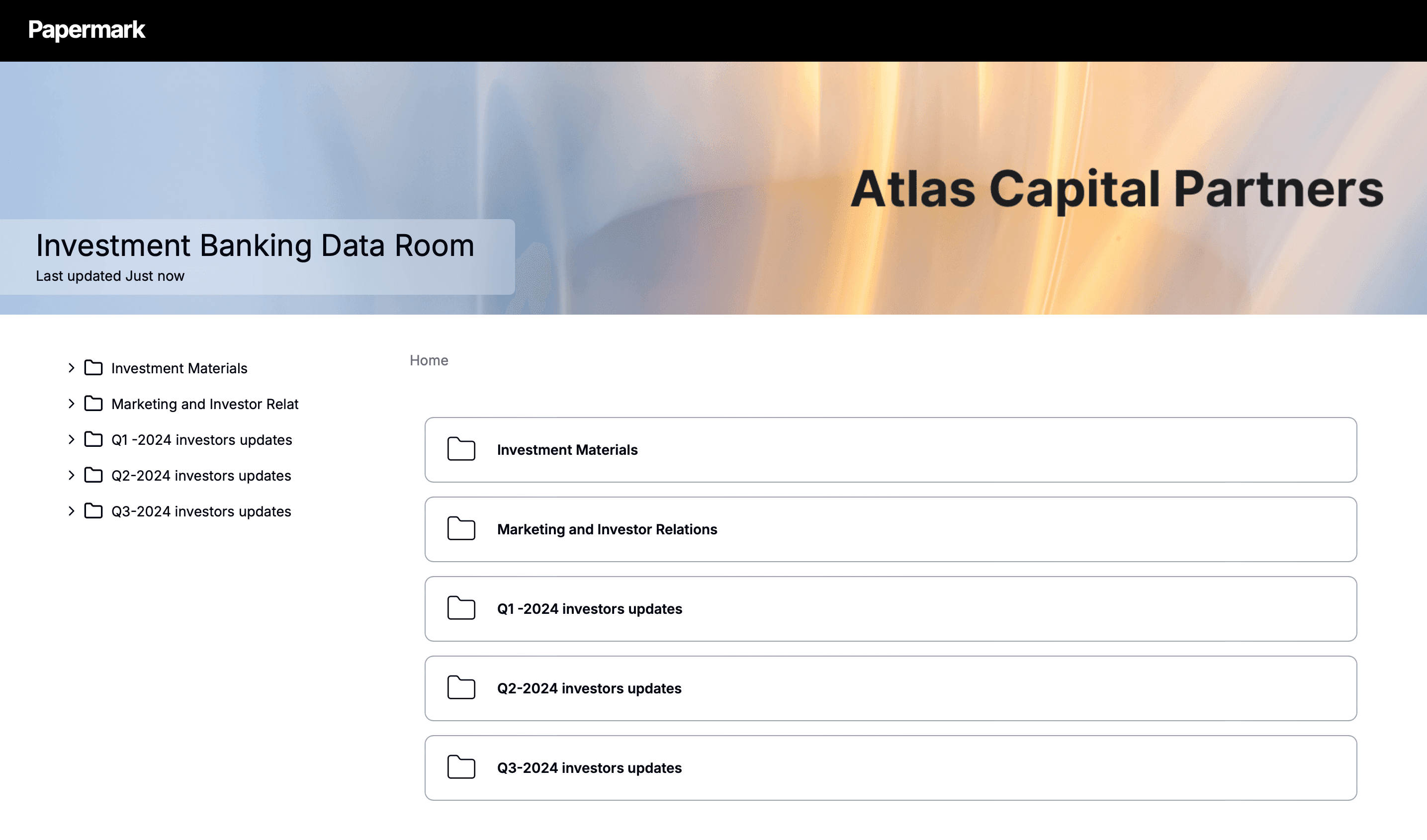
Open a secure data room before the first teaser goes out, so every buyer who signs an NDA gets documents through a controlled link rather than email. Papermark is a secure, modern data room that gates each link behind the NDA, gives every buyer its own link and watermarks every page with the viewer's email.
The room starts small. Load the 30 to 40 documents a buyer needs to submit an indication of interest: the CIM, three years of summary financials, the earnings bridge, a customer concentration summary, an org chart and an overview of key contracts. Add the detailed contracts, payroll, tax filings and IP records later, in a folder that only finalists can open.
Three features matter at this step. NDA gating records each acceptance against a verified email. Per-buyer links let you revoke one buyer without touching the others. And page-by-page analytics show which buyers read the financials, which tells you who to call first. Owners who prepare the room in this step, rather than after the LOI, avoid 4 to 8 weeks of chasing documents during exclusivity, when the buyer holds the leverage.
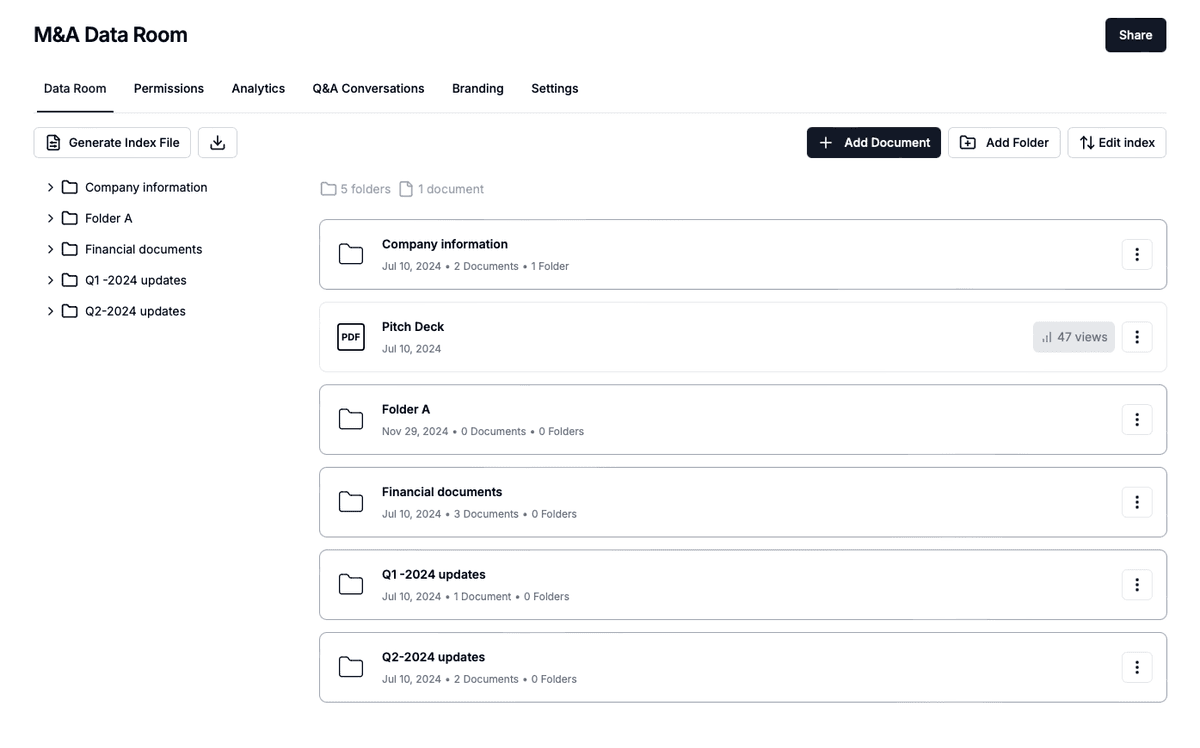
The data room is live before the teaser goes out, so the first NDA leads straight to a controlled link.
Confidential marketing means buyers learn what you sell before they learn who you are. Your advisor sends the teaser to a targeted list of strategic buyers, private equity funds and search funds, or lists the business on a marketplace such as BizBuySell, Acquire.com or Flippa for smaller deals.
Interested buyers sign an NDA before receiving the CIM and data room access. A targeted outreach to 30 to 80 buyers usually yields 10 to 25 NDAs. Keep employees, customers and suppliers out of the loop at this stage, and tell buyers in writing that contact with them is off limits.
Track every buyer's stage in a spreadsheet or CRM: teaser sent, NDA signed, CIM opened, call held. Data room analytics fill in the gaps, because the buyer who says they are very interested but has not opened the financials in two weeks is telling you something.
Offers usually arrive in two rounds. First, buyers send an indication of interest (IOI) with a valuation range, structure and financing source. You shortlist three to five, hold management meetings, open more of the data room, then ask for letters of intent (LOI) with a firm price.
When several buyers are interested, run a competitive process with fixed deadlines rather than negotiating with each in turn. Our guide to the competitive bidding process when selling a business covers rounds, process letters and bid scoring.
The LOI sets price, structure, working capital target, escrow, conditions and an exclusivity period, usually 30 to 90 days. Exclusivity is the term that changes the balance of power, because once you sign it, you cannot talk to other buyers. Keep it short, with a hard end date. Our guide to the letter of intent in an acquisition covers each term.
After the LOI, the buyer's accountants, lawyers and tax advisors review the company in detail, typically for 30 to 90 days. They test the earnings, read the contracts, check tax filings and look for liabilities. At the same time, the attorneys draft the purchase agreement and the disclosure schedules.
Diligence questions arrive in volume, often 100 to 300 on a mid-sized deal. Running them through the data room's Q&A, rather than email, keeps each answer attached to the document it refers to. In Papermark, the Q&A module is part of Data Rooms Plus. Our guide to the M&A due diligence checklist lists what buyers request.
The structure of the sale decides who keeps the liabilities and how you are taxed. In an asset sale, the buyer picks the assets and contracts it wants and leaves most liabilities with the seller. In a stock sale, the buyer acquires the entity, liabilities included. Buyers prefer asset sales for the stepped-up tax basis; sellers usually prefer stock sales for capital gains treatment and a cleaner exit.
| Factor | Asset sale | Stock sale |
|---|---|---|
| What transfers | Selected assets and contracts | The whole entity |
| Who keeps liabilities | Mostly the seller | The buyer, backed by indemnities |
| Seller tax | Mix of capital gain and ordinary income on recapture | Generally capital gain |
| Buyer preference | Preferred, stepped-up basis | Less preferred |
| IRS filing | Form 8594 by both parties | Not required for the stock |
| Consents needed | Often many contract assignments | Change-of-control clauses only |
In an asset sale, the price is allocated across asset classes, such as cash, receivables, inventory, equipment and goodwill, and both buyer and seller report that allocation on IRS Form 8594. The allocation matters to you because gain on goodwill is generally capital gain, while gain on equipment up to prior depreciation is recaptured as ordinary income. IRS Publication 544 covers sales of business assets, and Publication 537 covers installment sales, which apply if part of the price is paid over time through seller financing.
C corporations face an extra layer: an asset sale is taxed at the corporate level, then again when proceeds are distributed. This is general information, not tax advice. Ask your CPA to model both structures before you sign the LOI.
Closing is when the purchase agreement is signed, conditions are met and funds move. Expect a holdback or escrow of 5 to 15 percent of the price for 12 to 24 months, third-party consents on key contracts or the lease, and a transition services agreement that defines how long you stay and what you do.
Freeze the data room at signing. In Papermark, data room freeze on Data Rooms Plus and above locks the room and exports a tamper-evident archive of every document and the access log. If a warranty claim arrives a year later, that archive shows exactly what was disclosed and when.
Then plan the handover: employee announcements, customer calls with the new owner, and the knowledge transfer that protects any earnout you are still owed.
Each step has an owner, and sales stall when two people think the other one has it. This table is the division of labor on a typical advised sale.
| Role | Owns | Signs off on |
|---|---|---|
| Owner | Goals, buyer meetings, operating the business | Asking price, LOI, purchase agreement |
| Broker or advisor | Valuation, CIM, buyer list, process timeline | Shortlist and bid comparison |
| M&A attorney | NDA, LOI, purchase agreement, schedules | Legal terms and disclosure |
| CPA | Financial statements, QoE support, tax structure | Asset vs stock model, Form 8594 allocation |
| Data room (Papermark) | Document control, NDA gating, buyer analytics, Q&A | The disclosure record at close |
Most document requests are predictable, so collect them by the step at which a buyer will ask. The core set goes into the data room at step 6; the rest goes in as diligence starts. Our due diligence template has the full request list.
Daniel Reyes owns a hypothetical industrial distribution company in Texas with $5.2M of revenue and $1.1M of adjusted EBITDA. He wants to retire within 18 months and is willing to stay six months after closing.
In months 1 to 3, his CPA moves the books to accrual and builds an EBITDA bridge with $180,000 of add-backs. An M&A advisor values the company at 4.5 to 5.5 times EBITDA, roughly $5M to $6M, and signs on with a $5,000 monthly retainer credited against a success fee. In month 4, the advisor writes the CIM while Daniel's office manager builds the data room: 36 documents in the first-round folder and 280 more in a finalist folder that stays closed.
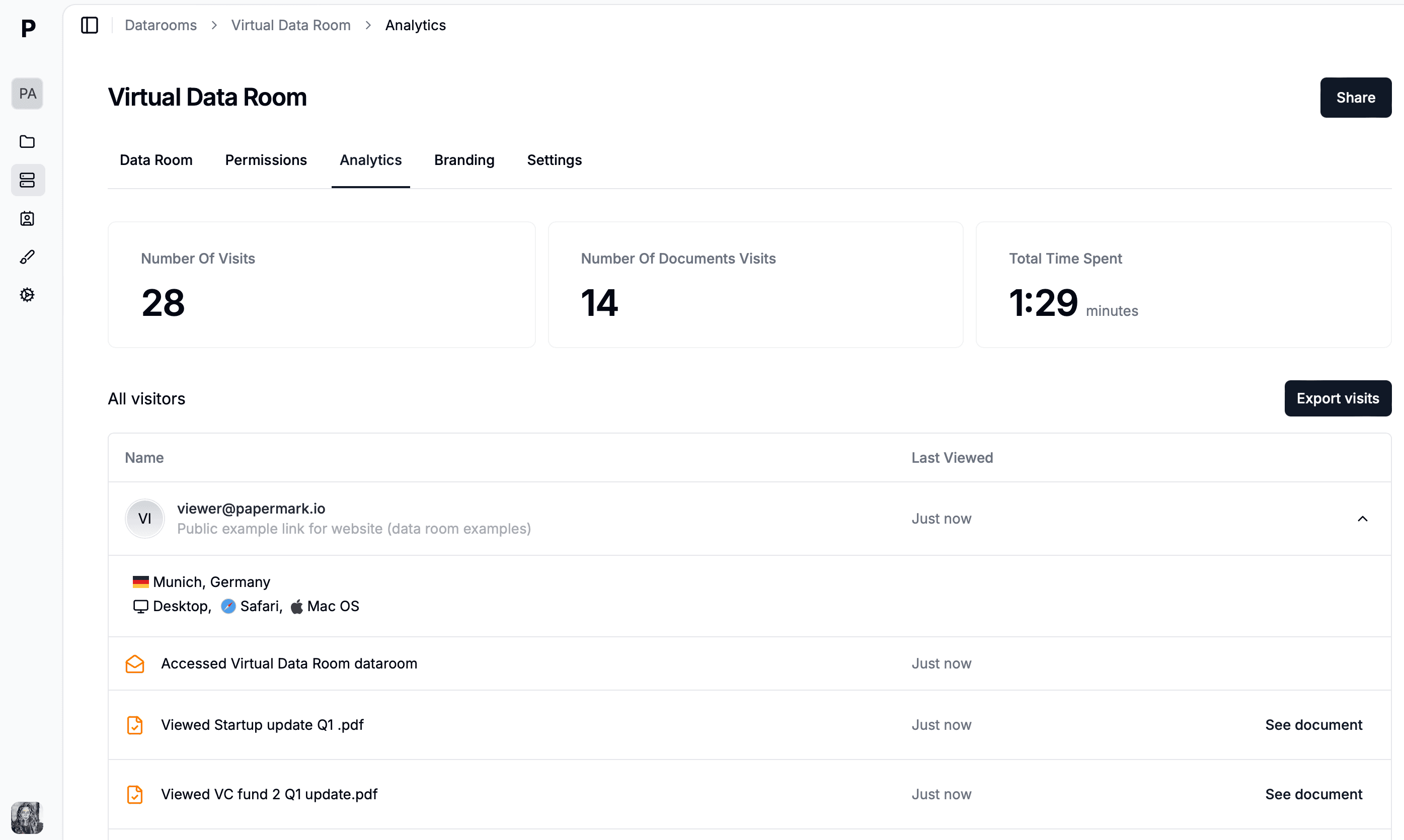
Months 4 to 6 are outreach. The advisor contacts 62 buyers, 17 sign the NDA in the data room, and 6 submit IOIs between $4.6M and $6.1M. Analytics show that the two lowest bidders never opened the customer folder, so the advisor invites the top four to management meetings and opens the finalist folder to them.
In month 7, three LOIs arrive. Daniel signs at $5.8M with a private equity-backed platform: $5.0M cash at closing, $580,000 in escrow for 18 months and a $220,000 earnout, with 45 days of exclusivity. Due diligence runs 64 days, with 188 questions answered through the data room. The asset purchase allocation puts most of the price on goodwill, which his CPA had modeled before the LOI. The deal closes in month 11, and the room is frozen the same day.
Worked scenario. 86 percent of the headline price arrives at closing; escrow and earnout make up the rest.
A data room for selling your company has to do two jobs at once. During marketing, it gives 10 to 25 buyers controlled, staged access to the same documents without letting any of them see what the others read. After closing, it becomes the record of what was disclosed. A shared drive does neither.
Papermark is a secure, fully customizable, and developer-friendly data room for modern dealmakers, with page-by-page analytics, dynamic watermarking, unlimited data room visitors and transparent pricing. Advisors who run several mandates can automate setup with the public API, CLI and MCP server, and open source and self-hosting are available.
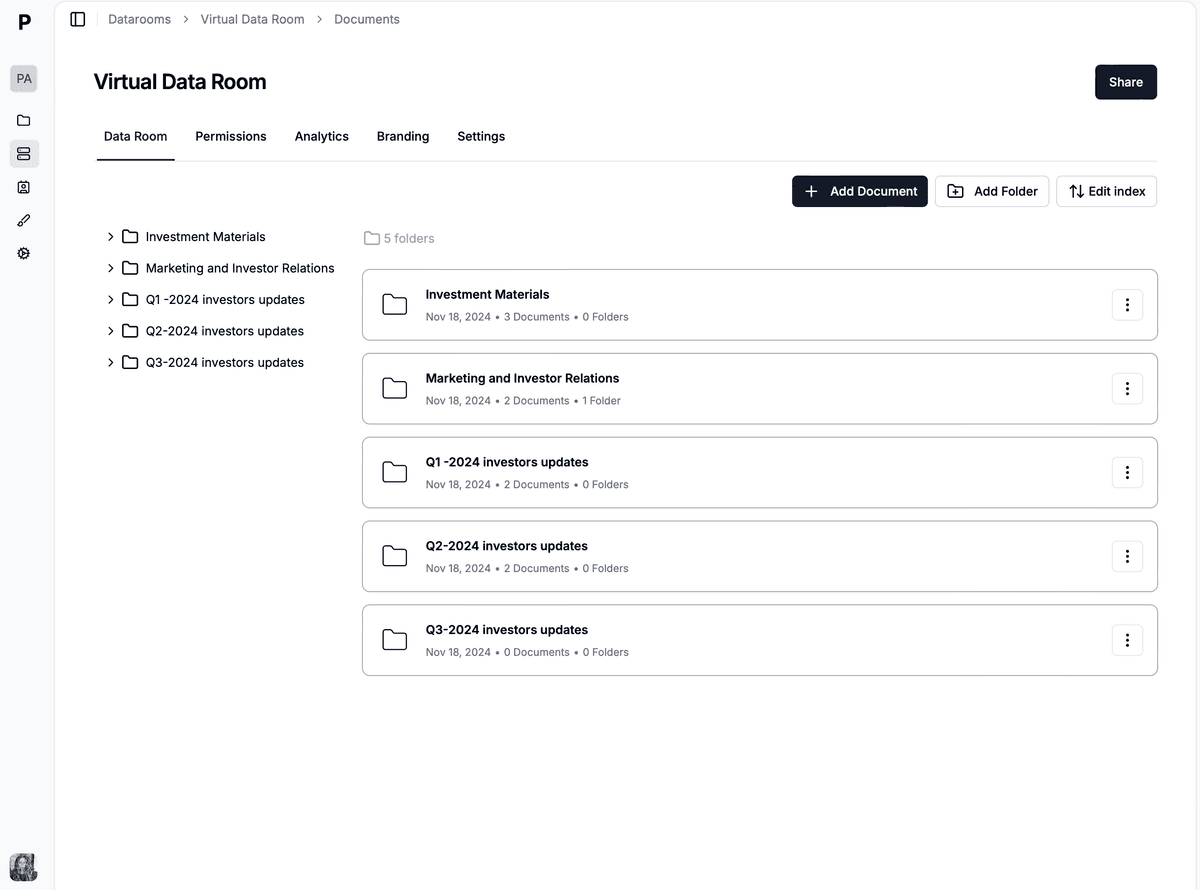
One room for the whole sale: a first-round folder for every NDA signer and a finalist folder for the shortlist.
You need a data room for selling your company because buyers are competitors as often as they are partners. A strategic buyer who loses the auction still knows your customer pricing if you sent it by email. Per-buyer links, watermarks and download controls limit what a losing bidder walks away with.
You also need it for leverage. Analytics tell you which buyers are doing the work before you choose who gets exclusivity, and the Q&A log keeps diligence answers consistent across bidders. If you are comparing providers, our review of the best virtual data rooms covers pricing and features.
Create one room with a first-round tier (CIM, summary financials, customer summary) and a finalist tier (contracts, payroll, tax, IP). Drag the folder tree in at once, and use the data room folder structure guide for the index.
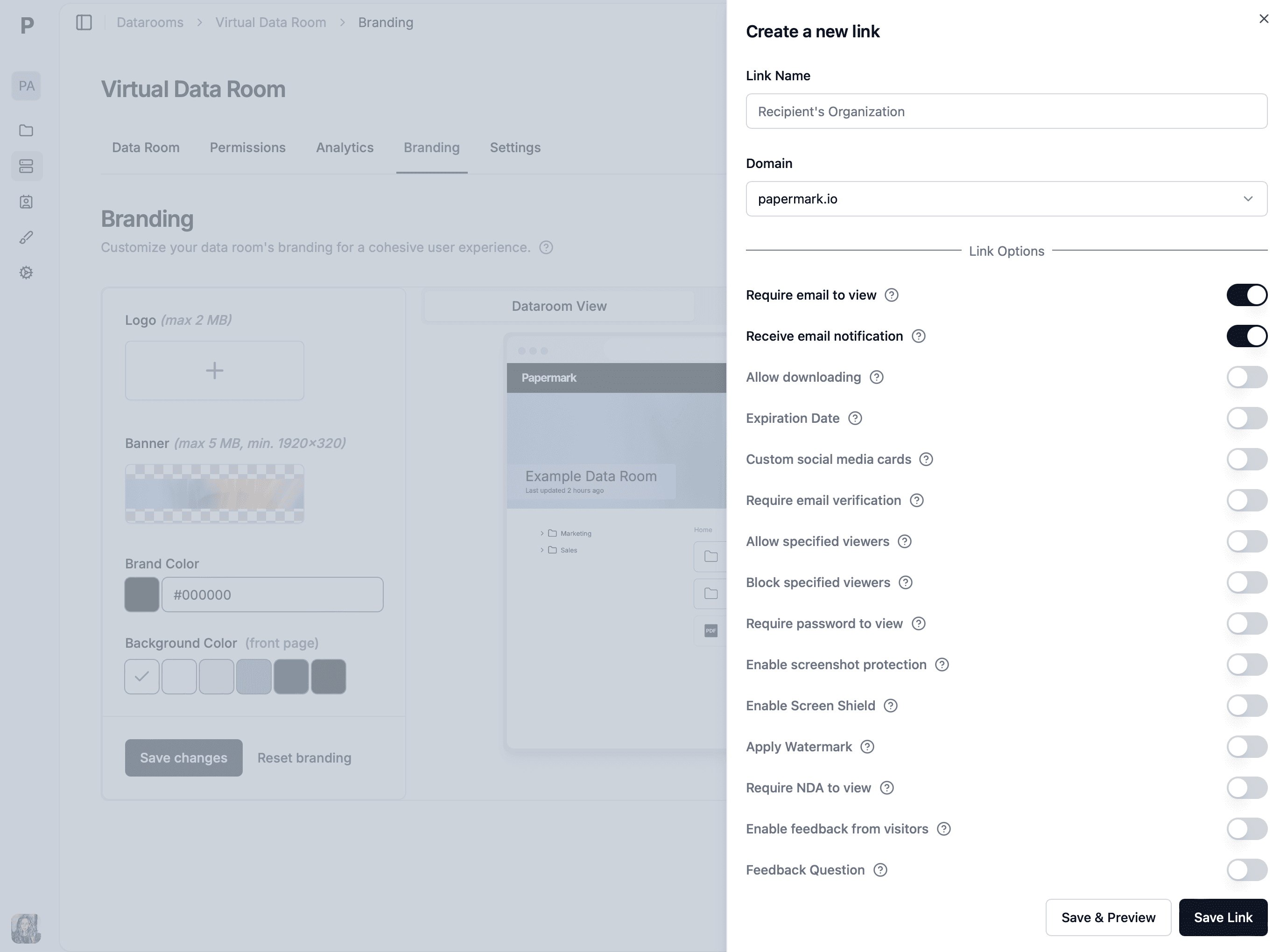
Issue a separate link per buyer with email verification and the NDA attached. Granular permissions on each link decide which tier the buyer sees, so promoting a buyer to the finalist round is a permission change, not a new upload.
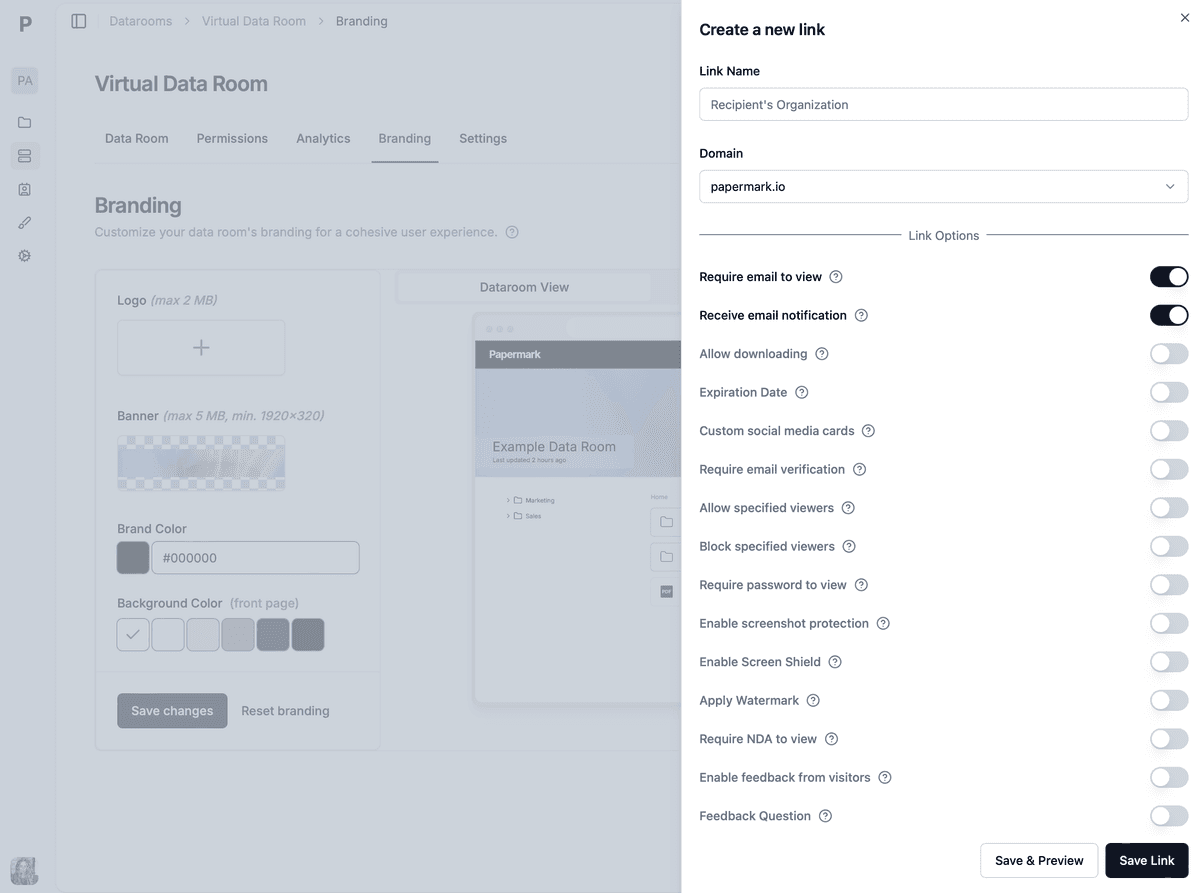
Each buyer link has its own scope, expiry and download setting.
Turn on dynamic watermarking for financials, customer contracts and payroll, and disable download on the finalist tier. Every page carries the viewer's email, IP address and timestamp.
Page-by-page analytics show time spent per document per buyer. Use them to decide who gets management meetings and who gets the finalist folder.
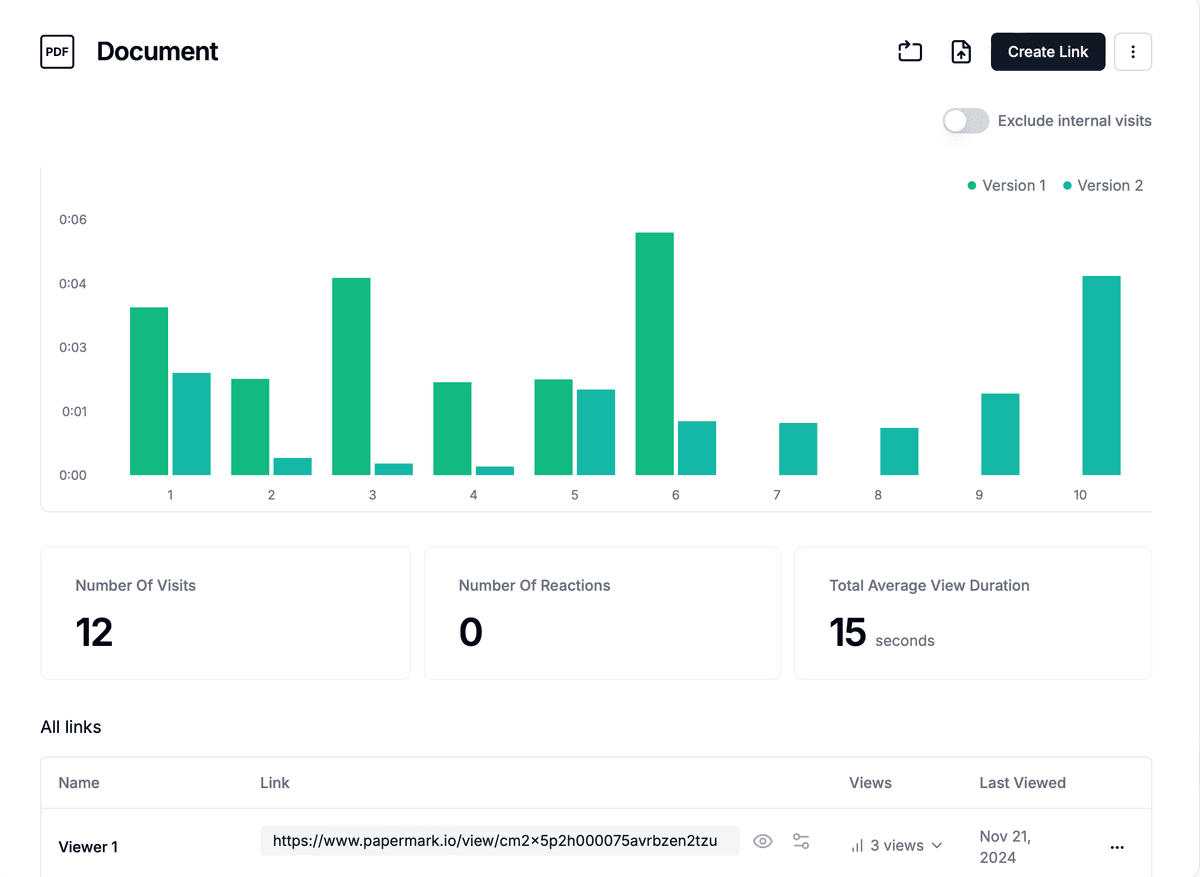
Time per page shows which buyers are preparing a real offer.
On Data Rooms Plus, the Q&A module keeps each diligence question attached to its document and scoped to the buyer who asked it. At signing, freeze the room to lock it and export a tamper-evident archive for your records.

Papermark is our #1 VDR provider for M&A transactions right now. In two deals we used custom branding, dynamic watermarking, and granular permissions.
Tyler
The Data Rooms plan is $99/month (billed annually) with a 7-day free trial, and includes 3 team members, unlimited data rooms, unlimited data room visitors, unlimited documents, a custom domain, NDA agreements, dynamic watermarking and granular file-level permissions. Data Rooms Plus adds the Q&A module and data room freeze for the diligence and closing stages, and Data Rooms Premium adds AI redaction. There is no per-project fee and no charge per buyer.
No credit card required.
How to prepare a company for acquisition in 2026: a 24-month exit planning roadmap, a 30-item readiness checklist, asset vs stock sale and the data room.
How to sell a business in 2026: the 9 tools sellers need, from accounting and valuation to marketplaces, NDAs and a secure data room, with costs and setup order.
IP due diligence in 2026: the 7 asset classes, the chain-of-title trap, open-source and AI risk, and how to run it in a data room for IP due diligence.