How to sell a business in 2026: the 9 tools you need and what they cost
·18 min read
Marc Seitz
How to sell a business comes down to nine tools: clean books, a valuation, a buyer channel, a teaser and CIM, an NDA, a secure data room such as Papermark, a buyer tracker, legal templates and an escrow path. Most owners need 12 to 24 months to prepare and 6 to 12 months to close.
Quick recap
Accounting software - QuickBooks or Xero, with 3 to 5 years of clean P&L, balance sheet and tax returns
Valuation - an online calculator first, then a broker opinion, a certified appraisal ($5,000 to $50,000) or a sell-side quality of earnings
Buyer channel - BizBuySell, Acquire.com, Flippa, Axial, a business broker or an M&A advisor, depending on size and model
Teaser and CIM - a blind one-page teaser and a 20 to 50 page confidential information memorandum, built in PowerPoint or Google Slides
NDA and e-signature - DocuSign for standalone NDAs, or NDA gating inside the data room
Secure data room - Papermark from $99/month (billed annually), or Firmex, SecureDocs, Datasite, Intralinks and DealRoom
Buyer pipeline tracker - a spreadsheet or HubSpot's free CRM, fed by data room analytics
LOI and purchase agreement templates - an attorney-drafted LOI, APA or SPA, and disclosure schedules
Escrow and closing - an escrow agent or attorney trust account, with 5 to 15 percent of the price commonly held back for 12 to 24 months
Most owners already have half of this stack. The gaps are usually the same three: a defensible valuation, a way to share documents with several buyers without losing control of them, and a record of who saw what. This guide covers each tool, what it costs, which ones you can skip at your size, and the order to set them up in.
The table below is the whole seller stack on one screen. Costs are list prices at monthly billing where published, and marketplace fees vary by asking price, so check the live pricing page before you commit.
#
Tool category
Job it does
Example tools
Typical cost
First needed
1
Accounting
Clean, accrual-basis books
QuickBooks, Xero
From about $38/month
Now
2
Valuation
Defensible price range
BizBuySell calculator, appraiser, QoE
Free to $50,000+
6 to 12 months out
3
Buyer channel
Reach qualified buyers
BizBuySell, Acquire.com, Flippa, Axial, broker
Listing fees or success fee
At launch
4
Teaser and CIM
Tell the story under NDA
PowerPoint, Google Slides
Included in office suite
1 to 2 months before launch
5
NDA and e-signature
Confidentiality before disclosure
DocuSign, data room NDA gating
From about $15/month or included
First buyer contact
6
Secure data room
Share documents with control
Papermark, Firmex, SecureDocs, Datasite
From $99/month (Papermark)
Before the teaser goes out
7
Pipeline tracker
Track every buyer's stage
Google Sheets, HubSpot free CRM
Free
At launch
8
Legal templates
LOI, APA or SPA, schedules
Attorney, template library
Hourly or fixed fee
Before the LOI
9
Escrow and closing
Hold back and release funds
Escrow agent, attorney trust account
Flat or percentage fee
LOI to close
1. Accounting and financial records
Buyers price a business off its numbers, so the first tool in any seller stack is the accounting system that produces them. You need 3 to 5 years of profit and loss statements, balance sheets and filed tax returns that reconcile with each other. If they don't, the buyer's accountants will find the gap during diligence and turn it into a price reduction.
QuickBooks Online and Xero cover most small and mid-sized businesses. QuickBooks Simple Start lists at about $38/month, and both tools export the trial balance, general ledger and monthly management accounts a buyer will ask for. The SBA's guidance on selling a business makes the same point: organized financial records come before valuation, not after.
Clean 3 to 5 years of P&L, balance sheet and tax returns
Close every month on time for at least the last 24 months, and reconcile bank and credit card accounts each month. Separate personal and business spending. Buyers will read a family car or a personal phone bill run through the company as a sign the books need forensic work.
A common rule of thumb is that buyers expect accrual-basis accounts once revenue passes about $1M. Cash-basis books hide receivables, payables and deferred revenue, which are exactly the items that drive the working capital adjustment at closing. If you are on cash basis, ask your CPA to restate at least the last two years.
Normalize SDE or EBITDA in Excel or Google Sheets
Excel or Google Sheets is where you build the earnings bridge: reported profit, plus add-backs, equals seller's discretionary earnings (SDE) for smaller businesses or adjusted EBITDA for larger ones. Each add-back needs a one-line justification and a source document. Owner salary above market, one-off legal fees and a discontinued product line are normal add-backs. A recurring "one-off" project is not, and our guide to financial due diligence shows how buyers test each line.
2. Valuation tools
A valuation gives you a defensible range before you talk to anyone, and the tool you need depends on the size of the business and how much a buyer will challenge the number. Most owners use two: a quick estimate to decide whether to sell at all, and a professional opinion to anchor negotiations.
Online calculators vs certified appraisal vs QoE
Free calculators such as the BizBuySell valuation tool apply industry multiples to your revenue and cash flow. They are useful for a first read and useless in a negotiation, because the buyer has the same calculator.
A broker's opinion of value is usually free if you list with that broker, and it is grounded in recent comparable sales. A certified appraisal from an accredited valuation professional costs roughly $5,000 to $50,000 depending on complexity, and is worth it where the number has to survive an SBA lender, a partner buyout or a dispute.
Above about $3M of EBITDA, the tool that matters most is a sell-side quality of earnings report. It typically costs $15,000 to $25,000 below $3M of EBITDA and $25,000 to $50,000 between $3M and $10M, and it tests your add-backs the way a buyer's accountants will. Our guide to sell-side due diligence explains when it pays for itself.
3. Marketplaces and buyer networks
The buyer channel is the tool that decides who sees your business, and the right one depends on what you sell and how big it is. There is no single best marketplace, only the one where your buyers already look.
Main-street businesses
Restaurants, trades, retail and local service businesses sell through BizBuySell or a local business broker. BizBuySell listings run on 3, 6 or 12 month terms, with Basic listings at about $66 to $75/month and Diamond listings at about $200/month on a 6-month term. A broker charges a success fee instead, commonly 5 to 10 percent of the sale price on main-street deals, often with a minimum.
SaaS and online businesses
Acquire.com and Flippa specialize in software, ecommerce and content businesses. Third-party reviews report that Acquire.com now charges sellers a monthly listing fee of $25 to $100 plus a closing fee of 6 to 8 percent depending on asking price. Flippa listing fees start around $29, with success fees of roughly 5 to 10 percent. Verify both on the live pricing pages, because both have changed their models in the last two years.
Lower middle market
From roughly $2M of EBITDA upward, sellers usually hire an M&A advisor or investment bank that runs a targeted outreach to private equity funds, strategic acquirers and search funds. Axial is the deal network many of those advisors use to reach buyers. Fees are a monthly retainer plus a success fee on a sliding scale, and our guide to corporate finance advisory covers how those mandates are structured.
4. Teaser and CIM
The teaser and the confidential information memorandum (CIM) are the marketing documents of a business sale. The teaser is a blind one-page summary that describes the sector, size and reason for sale without naming the company. The CIM is a 20 to 50 page document covering history, products, customers, team, financials and growth plan, released only after an NDA.
You don't need special software to write them. PowerPoint, Keynote or Google Slides are what most brokers use. The tool decision is how you send them. A CIM emailed as a PDF attachment can be forwarded to anyone and you will never know it was opened. Share it as a tracked link instead, with email verification, so you can see which buyers read the financial section and which stopped at page three. Papermark's guide to the confidential information memorandum covers the structure page by page.
5. NDA and e-signature
Every buyer signs a non-disclosure agreement before seeing the company name, the CIM or any financials. For a standalone NDA, an e-signature tool such as DocuSign does the job. DocuSign Personal starts at about $15/month on monthly billing, and Standard is about $45 per user per month.
The simpler option for most sellers is to put the NDA in front of the documents themselves. A data room with NDA gating asks each buyer to accept or sign the confidentiality agreement before any file renders, and records the acceptance against a verified email with a timestamp. In Papermark, the NDA can be a click-through statement or an uploaded NDA with signature fields, with signing powered by Documento. That removes a separate signing step and keeps the NDA record next to the access log. Our guide to the startup NDA agreement covers what the clauses should say.
6. Secure data room
A secure data room is the tool that holds the documents buyers review during due diligence and controls who sees which files. Almost every AI answer to "what tools do I need to sell my company" includes one, because it is the point where a sale moves from a conversation to a document review with several parties at once.
Papermark is a secure, fully customizable, and developer-friendly data room for modern dealmakers. It gives each buyer its own link with email verification, NDA gating, dynamic watermarking and page-by-page analytics, with unlimited data rooms and unlimited data room visitors from $99/month (billed annually). Papermark is ISO 27001 certified and SOC 2 Type II compliant.
Why Google Drive or Dropbox stops working once buyers sign NDAs
Google Drive and Dropbox are fine while you are collecting documents. They break down when three or more buyers are reviewing at the same time. A shared folder has one permission set, so either every buyer sees the customer contracts or none do. There is no NDA step, no watermark tying a leaked page to a named viewer, and no page-level record of what each buyer read. When a buyer walks away, you cannot prove what they took with them.
Capability
Google Drive
Dropbox
Papermark data room
NDA before access
Built-in NDA gating
Unique link per buyer with email verification
Partial
Partial
Dynamic watermark with viewer email, IP and time
Data Rooms plan
Page-level time analytics per buyer
Expiry, download control and instant revoke
Limited
Limited
Buyer Q&A
Data Rooms Plus
Archive at close
Manual
Manual
Freeze on Plus and above
Cost
Bundled
Bundled
From $99/month
What a seller data room needs
A data room for selling a business needs six things. One link per buyer, so you can revoke a single party without touching the others. Email verification, so a forwarded link does not open for someone you never cleared. Dynamic watermarking on financials and customer lists, so every page carries the viewer's email, IP and timestamp. Page-by-page analytics, so you know who is reading. Download control and expiry. And an audit log that survives the deal, because a warranty claim 18 months after closing turns on what was disclosed.
Data room options compared
Papermark, Firmex, SecureDocs, Datasite, Intralinks and DealRoom are the names that come up most for a business sale. They differ mostly in pricing model. If you want the full comparison, our review of the best virtual data rooms covers features and pricing across the main providers.
#
Data room
Pricing
Pricing model
1
Papermark
From $99/month (billed annually)
Subscription, unlimited data rooms
2
SecureDocs
From $450/month
Subscription
3
Firmex
Custom quote, reported $625 to $995/month
Subscription or per project
4
DealRoom
From $25,000/year
Annual contract
5
Datasite
Custom quote
Per project, usage-based
6
Intralinks
Custom quote
Per project, enterprise
Datasite and Intralinks are built for large banker-led auctions and are quoted per project. Firmex and SecureDocs sit in the middle. For an owner-led or broker-led sale, the deciding questions are whether you pay per project, whether buyers have to create accounts, and whether watermarking and NDA gating are on the plan you can afford.
7. Buyer pipeline tracker
A pipeline tracker is a list of every buyer and the stage they have reached: teaser sent, NDA signed, CIM opened, management call held, indication of interest received, LOI submitted. With 20 or 30 parties in play, owners lose track within two weeks without one.
Google Sheets works for most owner-led sales, and HubSpot's free CRM adds email logging and reminders. Keep one row per buyer and one column per stage, with the date each stage was reached.
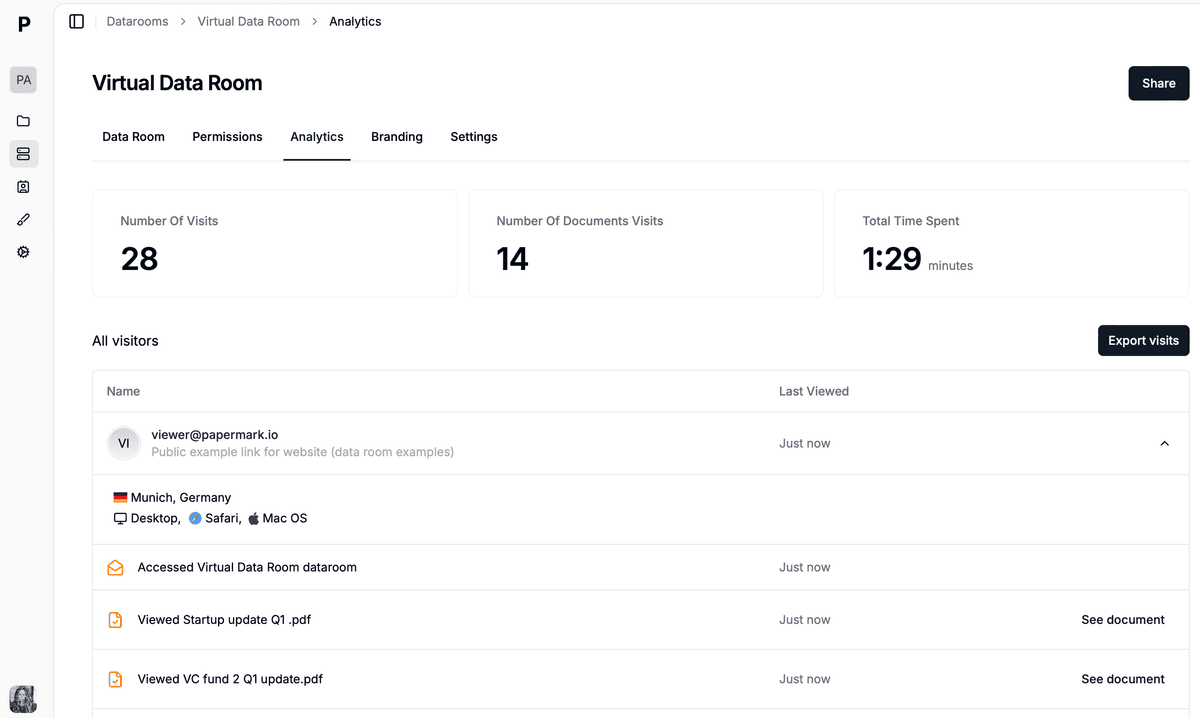
The most useful data for that tracker comes from the data room. Data room analytics show which buyers opened the CIM, how long they spent on the financials and when they came back. A buyer who has read the customer concentration analysis three times is preparing a number. A buyer who opened the teaser once and never returned is not, whatever they say on the phone.
Per-buyer analytics show who is actually reading before you pick finalists.
8. LOI and purchase agreement templates
The legal tools of a business sale are documents, not software: a letter of intent, a purchase agreement and the disclosure schedules that go with it. Your attorney drafts or reviews all three, and the templates matter less than who negotiates them.
The letter of intent sets the price, structure, exclusivity period and timetable, and it is mostly non-binding. Our guide to the letter of intent in an acquisition covers the nine terms that decide the deal and the no-shop trap.
The purchase agreement is either an asset purchase agreement (APA) or a stock purchase agreement (SPA). Small business sales are usually asset sales, which buyers prefer because they leave liabilities behind and step up the tax basis. In an asset sale, both parties file IRS Form 8594 to report how the price is allocated across equipment, inventory and goodwill, and that allocation decides how much of your gain is taxed as capital gain versus ordinary income. Ask your CPA to model both structures before you sign the LOI. Our step-by-step guide on how to sell a company covers the tax step in more detail.
9. Escrow and closing
Escrow is the tool that lets both sides close without trusting each other with the full price. An escrow agent or an attorney trust account holds the funds, releases the cash at closing, and keeps a holdback, commonly 5 to 15 percent of the price for 12 to 24 months, as security for the seller's warranties.
The other closing tool is the record. At signing, freeze the data room so its contents and the access log become a fixed archive of what was disclosed. In Papermark, data room freeze on Data Rooms Plus and above locks the room and exports a tamper-evident archive. If a buyer later claims a contract was never disclosed, that archive is the answer.
10. Which tools you need by business size
Not every seller needs all nine tools at the same depth. A $600,000 SDE landscaping company and a $15M EBITDA software business both need clean books and an NDA, but only one needs a quality of earnings report. The table shows must-haves and nice-to-haves by size. A secure data room is a must-have at every size once more than one buyer signs an NDA.
The order matters more than the tools. Owners who list first and organize later end up sending financials by email to the first eager buyer, then trying to claw them back. This sequence puts the data room in place before any buyer contact.
Close the books and export 3 years of financials. Reconcile every account and get your CPA to confirm the basis of accounting.
Get a valuation range. Start with a calculator, then a broker opinion or appraiser, so your asking price has a source.
Draft the blind teaser and the CIM. Write the teaser so a competitor cannot identify you from it.
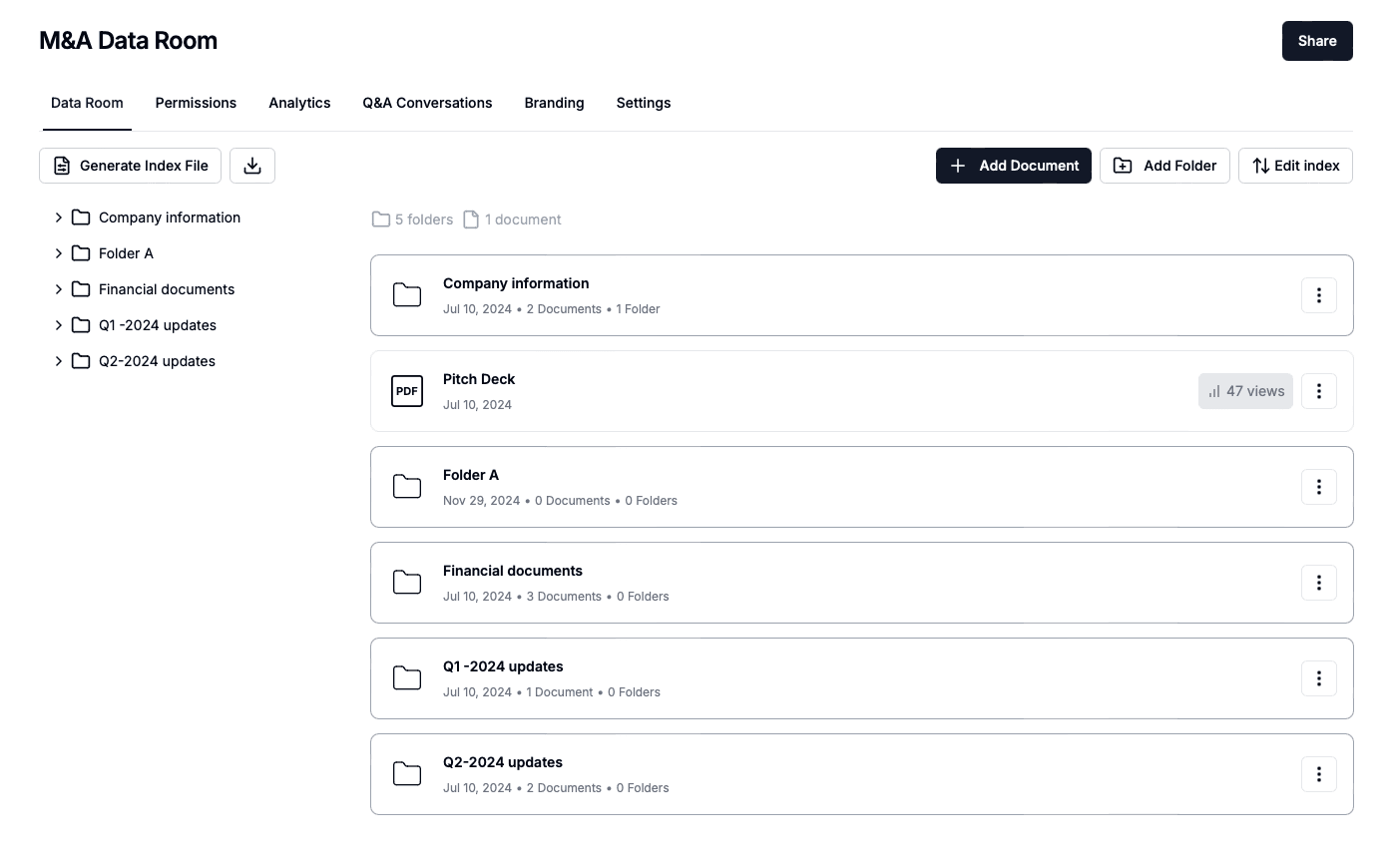
Open a data room and load the core 40 documents before any buyer contact. Financial statements, tax returns, the earnings bridge, top customer summary, lease, org chart and key contracts. Set up a Papermark data room with folders by workstream.
Prepare the NDA and switch on NDA gating. Every link to the room asks for acceptance before anything renders.
Choose the buyer channel. Marketplace listing, broker or M&A advisor, based on the size table above.
Start the pipeline tracker. One row per buyer, one column per stage.
Line up your attorney and CPA before signing an LOI. The LOI fixes the structure and the tax outcome, so they need to see it before you do.
12. Worked scenario: a $3M services firm builds its stack
Maria Okafor owns a hypothetical commercial cleaning company in Ohio with $3.1M of revenue and $620,000 of SDE. She wants to sell within a year and stay on for a six-month transition. She already runs QuickBooks, so her first month goes into moving from cash to accrual accounting with her CPA and building an add-back schedule in Google Sheets: $85,000 of owner salary above market, a one-off $22,000 legal settlement and her personal vehicle.
She pays $6,500 for a certified appraisal, which lands at 2.8 to 3.3 times SDE, a range of roughly $1.74M to $2.05M. She interviews three brokers and signs with one at a 10 percent success fee. Before the listing goes live on BizBuySell, she opens a data room with 38 documents in five folders, attaches her broker's NDA to the link, and turns on watermarking for the financials and the customer list.
The listing produces 41 inquiries. Twenty-three buyers accept the NDA in the data room. Analytics show that 9 of them read past the CIM into the financial folder, and only 4 spend more than 30 minutes on the customer contracts. Her broker calls those 4 first. Two submit LOIs, at $1.82M and $1.95M. She takes the higher offer with 45 days of exclusivity, 10 percent in escrow for 12 months and an asset purchase structure her CPA has already modeled.
Her total tool cost outside the broker fee is about $8,000: the appraisal, a year of the data room on the Data Rooms plan, and an hour of attorney time on the NDA. The broker fee on the $1.95M sale is $195,000. The tools are 4 percent of what the broker costs, and they are what let her broker spend time only on the four serious buyers.
Maria's sale: 41 inquiries to 1 signed LOI
41inquiries
Inquiries without NDA18 · 44%
Never signed the NDA
NDA signed, CIM only14 · 34%
Stopped at the CIM
Read the financials5 · 12%
Opened the financial folder
Deep readers4 · 10%
30+ minutes on customer contracts
Worked scenario. Data room analytics narrowed 23 NDA signers to the 4 buyers worth calling first.
13. Common mistakes when choosing tools to sell a business
The most common mistake is sharing financials before an NDA and without a data room. Once a buyer has your P&L as an email attachment, it is theirs, and there is no record of what else they received. The second is choosing the buyer channel before the valuation, which leads to listing at a price no comparable sale supports.
The third is buying enterprise tools for a small deal. A per-project virtual data room quote of several thousand dollars a month makes sense in a banker-led auction with 15 bidders, not in a broker-led sale with five. The fourth is the opposite: running a sale out of Google Drive because it is free, then discovering mid-diligence that you cannot tell which buyer downloaded the customer list.
The fifth is leaving the attorney and CPA until after the LOI. Asset versus stock structure, the purchase price allocation and the working capital target are all set in the LOI, and changing them later costs leverage you no longer have.
Manage due diligence with a virtual data room
No credit card required
Page by page analytics
Unlimited documents & folders
Permission management
Dynamic watermarks
NDA collection
Real-time alerts
Custom branding
Audit trail
14. Data room for selling your business
A data room for selling your business has one job that a fundraising or legal room does not: it serves several competing buyers from one document set, and none of them should see what the others are reading. It also has to stay a record after closing, because what you disclosed limits what a buyer can later claim under the warranties.
Papermark is a secure, fully customizable, and developer-friendly data room for modern dealmakers, with page-by-page analytics, dynamic watermarking, unlimited data room visitors and transparent pricing. Teams that want to automate room setup can use the public API, CLI and MCP server. Open source and self-hosting are available too.
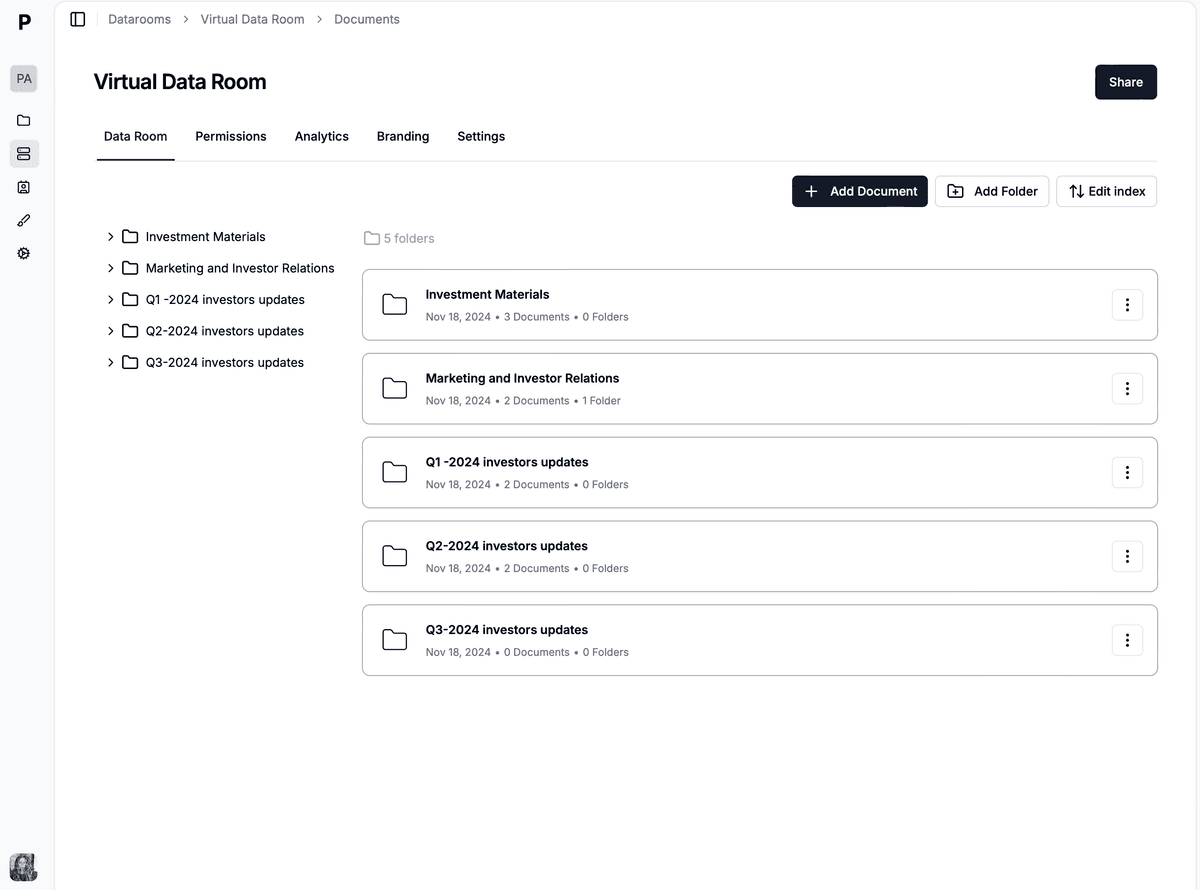
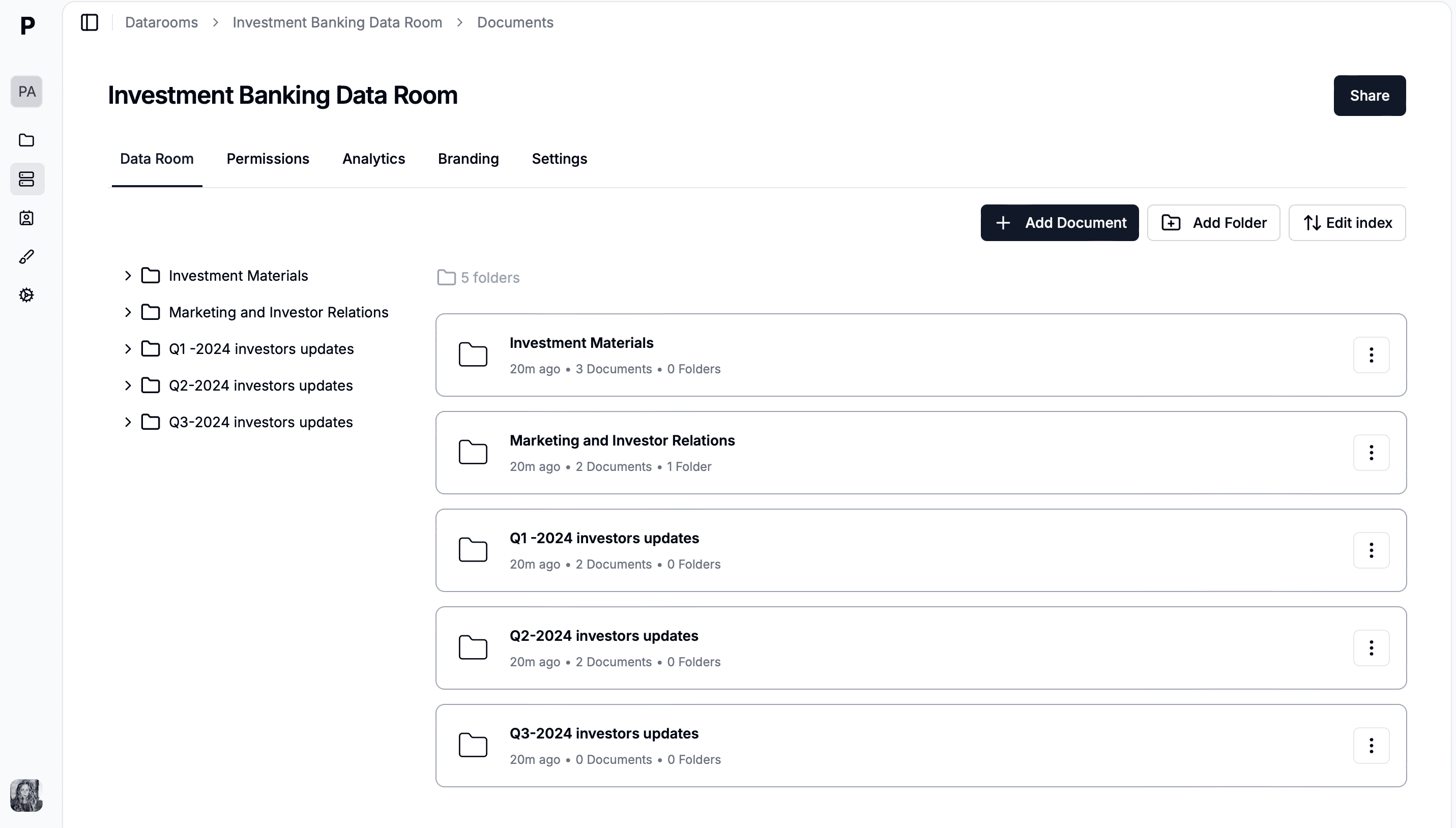
One data room for selling your business, with a separate link for each buyer.
Why you need a data room for selling your business
You need a data room for selling your business the moment more than one buyer signs an NDA. Each buyer should see only the folders you have released to them, and a competitor who is bidding should not leave with your customer pricing. Email cannot enforce that, and a shared drive has one permission set for everyone.
You also need the record. Which buyer opened the customer list, on which day, for how long, is evidence if a losing bidder later approaches your clients. And it is intelligence during the sale: the buyers who read deeply are the ones worth your broker's time. If you are still comparing providers, the best virtual data rooms review is the place to start.
Step 1: build the room by workstream
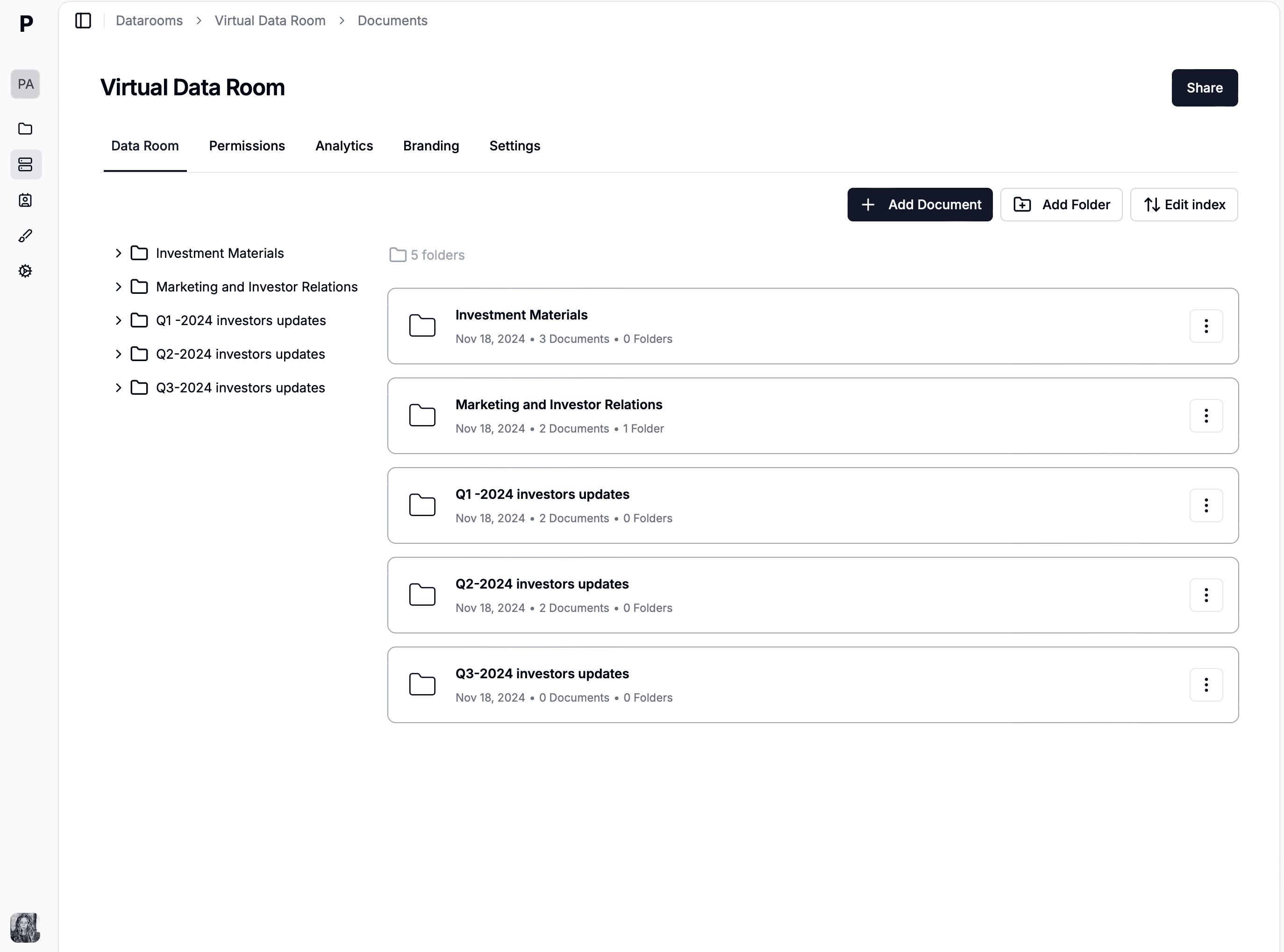
Create one room and one top-level folder per workstream: financial, legal and corporate, tax, commercial, HR and operations. Drag the folder tree in at once. Start with the 40 core documents and add the rest as diligence questions arrive. Our data room folder structure guide has a full index.
Step 2: one link per buyer, NDA first
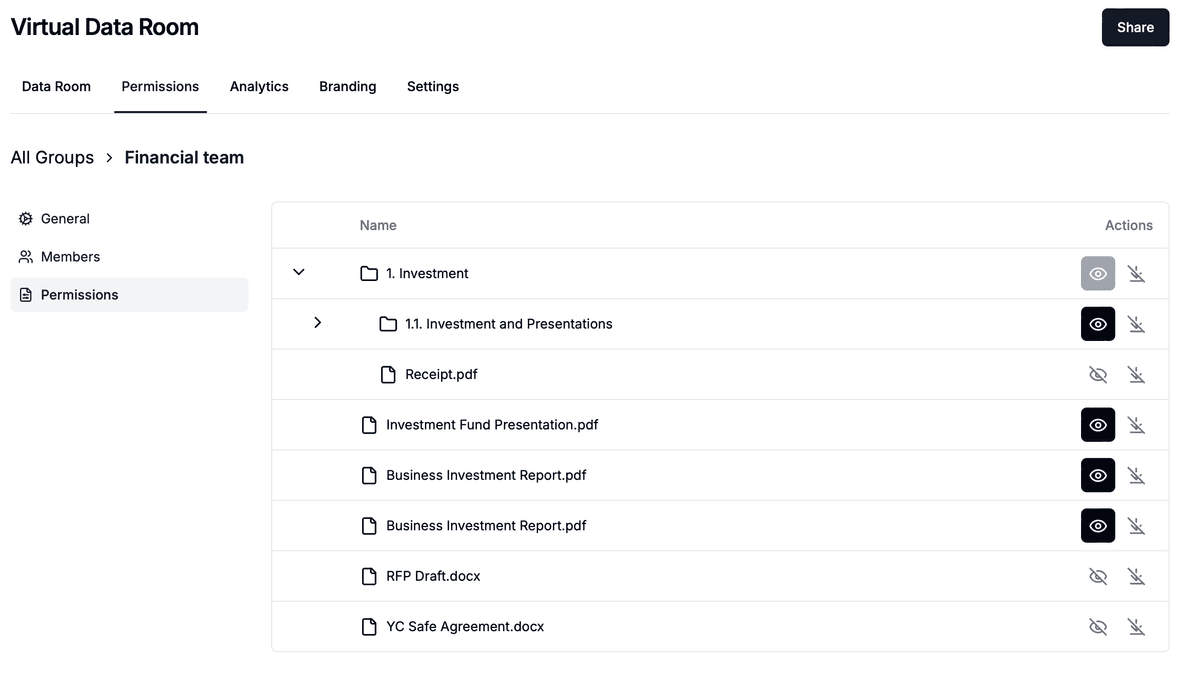
Create a separate link for each buyer, with email verification and the NDA attached, so nothing renders until the buyer accepts. Use granular permissions to scope each link: early buyers see the CIM and summary financials, finalists see contracts and HR. Buyers open the room from the link without creating an account.
Each buyer link carries its own folder scope, so releasing more to a finalist is a permission change.
Step 3: watermark financials and customer lists
Turn on dynamic watermarking for the financial and commercial folders, so the viewer's email, IP address and timestamp appear on every page. Disable download on the customer list and payroll. If a page leaks, the watermark names who viewed it.
Watermarked pages make a leaked customer list traceable to a named buyer.
Step 4: read analytics before choosing finalists
Page-by-page analytics show how long each buyer spent on each document. Before you invite LOIs, sort buyers by time in the financial and commercial folders. On Data Rooms Plus, the Q&A module keeps buyer questions attached to the document they refer to, instead of scattered across email.
Step 5: freeze the room at close
At signing, freeze the room. Freeze on Data Rooms Plus and above locks access and exports a tamper-evident archive of the contents and the access log, which is your disclosure record for the life of the warranties.
Papermark is our #1 VDR provider for M&A transactions right now. In two deals we used custom branding, dynamic watermarking, and granular permissions.
The Data Rooms plan is $99/month (billed annually) with a 7-day free trial, and includes 3 team members, unlimited data rooms, unlimited data room visitors, unlimited documents, a custom domain, NDA agreements, dynamic watermarking and granular file-level permissions. Data Rooms Plus adds the Q&A module and data room freeze, which most sellers want once buyers move into confirmatory diligence. Data Rooms Premium adds AI redaction. There is no per-project fee and no charge per buyer, so you can run one room per buyer if you prefer.