




datarooms
Data Room Checklist 2026: 40 Essential Documents (M&A, Fundraising, Due Diligence)
Data room checklist 2026 with 40 essential documents for M&A, fundraising, and due diligence, staged by deal type, plus what buyers actually open first.
An a16z data room checklist for fundraising is five files Andreessen Horowitz tells founders to have ready before a partner meeting: the deck, the cap table, monthly financials, usage, and unit economics. Papermark is a secure, fully customizable, and developer-friendly data room for modern dealmakers. This guide covers seed fundraising, a later startup round, and what a16z says to leave out.
Fundraising a16z is not a demo-day blast. A partner has to walk into a Monday meeting with a memo the rest of the firm can argue with. The data room is the exhibit list for that memo. If the exhibits are late, inconsistent, or padded with files nobody opens, the meeting slips a week, and a week is how a seed process dies.
This guide follows a16z's own published checklist, then splits it into seed fundraising and a later startup round. Section 9 is the practical build.
An a16z data room checklist is the short set of documents a founder sends after a first meeting goes well, so the investor can finish diligence and write the memo. Justine Moore's guide from 25 August 2022 defines a data room as a collection of documents that helps investors get up to speed, with the goal of giving them what they need to discuss the company with the rest of the team.
That is a different job from a sale process. A virtual data room for an acquisition holds hundreds of files over four to six months, with staged bidders and a Q&A module. Fundraising a16z at seed is five files and a link you can revoke. Building the acquisition version because a famous firm is in the process wastes the week you needed for the memo.
The checklist is also a preparation tool, not only a sharing tool. Moore's guide says to have the room ready before you officially start the raise, because assembling it forces the deck and the model to use the same numbers. Founders who build it after the partner asks are exporting cohorts at midnight and sending a second version two days later. The second version is the one that creates the red flag.
Nothing here is an a16z policy you can cite in a negotiation. The 2022 guide is the firm's public checklist, and Speedrun's deal page is the firm's public early-stage offer. Partners still ask for whatever the specific company makes relevant. The checklist tells you what to lead with.
Fundraising a16z happens on three different clocks, and the room should match the clock. Mix them up and you either send a pre-launch company a Series A binder, or you send a growth-stage partner a deck and nothing else.
Speedrun is the only path with published terms. The Speedrun deal page says the firm invests up to $1 million: $500,000 for 10% upfront on a SAFE, and another $500,000 into the next round within 18 months. Companies also get more than $10 million in partner credits, the firm asks for pro rata and an option pool, and it does not take a board seat at this stage. Acceptance is rolling and the wire goes out on close. That room can be thin, because the decision is the program, not a six-week confirmatory review.
A direct seed conversation is the opposite. a16z does not publish a single seed check size outside Speedrun, so you cannot build the room to a dollar figure. You build it so one partner can defend the company to the others. The memo needs the five files. Legal documents stay in a closed folder until someone names a concern.
A later round, once you already have revenue, customers, and employees, is when the same firm starts to look like a lead with counsel. The five files are still the front door. Contracts, employment agreements, and a full cohort export are the second door, opened for the people who ask, not for every associate who saw the deck.
| Path | What is published | What the room is for | Clock |
|---|---|---|---|
| Speedrun | $500K for 10%, plus $500K within 18 months | Deck, team, roadmap, any pilot | Rolling, wire on close |
| Direct seed | No single published check size | The 5 files, so a partner can write a memo | Before the first meeting |
| Later round | Negotiated, with pro rata if Speedrun | The 5 files, plus contracts if counsel asks | Weeks, not a demo day |
A data room for YC startups is built for a three-week batch where dozens of firms look at once. Fundraising a16z is usually one firm going deep, then a partnership meeting. Tiered links still matter, because the associate, the partner, and outside counsel should not all see the same folder on day one.
These are the five things the guide says to include. Each one is a file an investor can open without a call. If a file needs you in the room to explain which tab is real, it is not finished.
Pitch deck. Thesis, product, competition, traction, team, and a rough plan for the money. This is the file that already went out as a tracked link. The room copy should be the same file, not a newer draft with a different ARR.
Cap table. Current holders, how much they invested, and what they own. Every safe, including the small one from before incorporation was tidy, has to be on it. Carta's templates are what a16z points founders to. A screenshot from a slide is not a cap table.
Historical P&L and burn. Monthly, from gross revenue through net income to cash out. Break out revenue types and the major costs, and show the cash balance if you are not also sharing a balance sheet. Mark actuals and projections so a reader can see where history stops. Three months of history for a three-year-old company is one of the red flags they name.
Usage data. Growth of signups and active users, where those users come from and what each channel costs, how often they come back, and retention by cohort. Cohorts should be the full set, not the best month. Bright spots are welcome as a note on top of the full data, not instead of it.
LTV, CAC, and payback. The question they want answered is whether the average customer is profitable after the cost to acquire and serve them. They want blended CAC, a clear assumption set for LTV, and payback period. An LTV/CAC above 1 means contribution profit exceeds acquisition cost. An annual plan paid upfront can show a payback under 1 month, and that only belongs in the file if it is how you actually charge.
| File | What a16z wants in it | When it exists |
|---|---|---|
| Pitch deck | Thesis, product, competition, traction, team, use of funds | Always |
| Cap table | Holders, amount invested, ownership, every safe | Once anyone has invested |
| Monthly P&L and burn | Revenue to cash out, costs broken out, actuals marked | Once you have history |
| Usage data | Growth, channels, engagement, full retention cohorts | Once users exist |
| LTV, CAC, payback | Blended CAC, stated LTV assumptions, payback | Once you acquire customers |
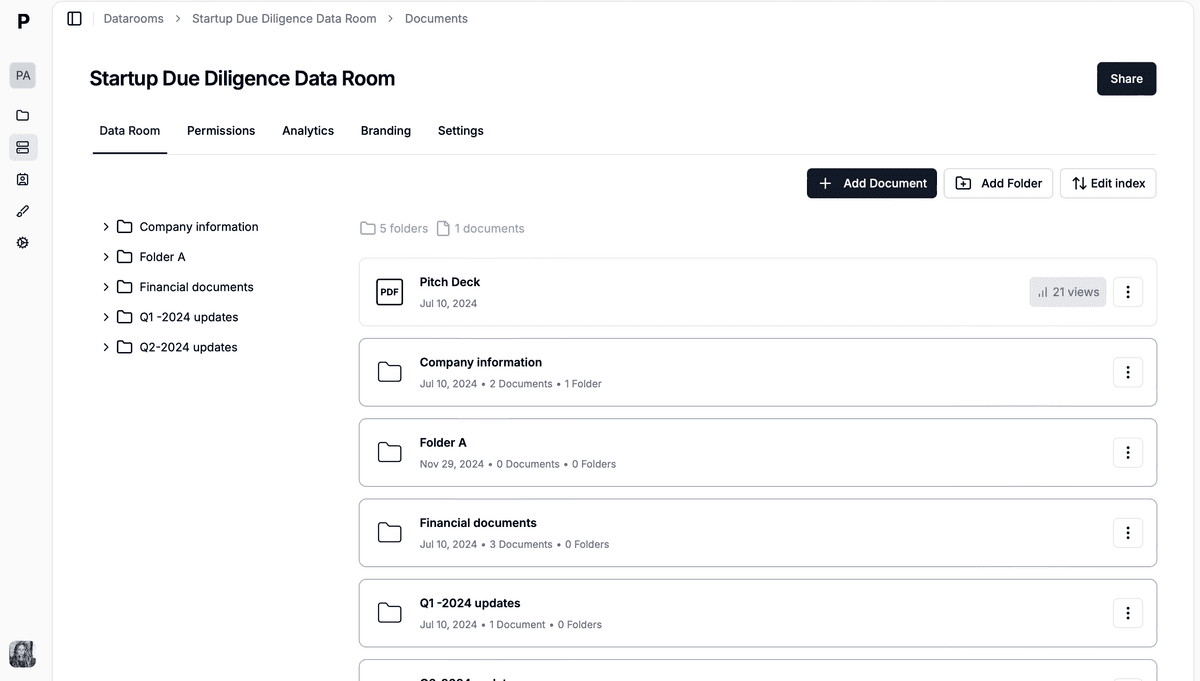
Five folders are enough for an a16z data room checklist. A binder of contracts is a second link, not the front door.
An a16z data room checklist seed fundraising round is the five files, trimmed to what actually exists. Seed is where founders over-build, because every public checklist online was written for a priced round with counsel.
If you have not launched, a16z's own answer is short. The room is a deck, information on the team, a roadmap for what you will do before the next round, and data from a beta or pilot if you have one. There is no honest monthly P&L to show, and inventing a three-year model to fill the gap is the document they tell you not to build. Milestones for the next 12 to 18 months are the substitute: what you will hit, and what it costs to hit it.
If you have launched and you are raising a seed with revenue, send the five files and stop. Bank statements for the last three to six months are the one extra that earns its place, because they answer whether the revenue in the deck reached the account. IP assignments for every founder and contractor belong in the closed folder. They are the finding that stalls a later round, and they are cheap to sign now. They are not what a partner leads the memo with.
Do not send the seed room to everyone who takes a first call. The deck goes out as its own tracked link. The five files go out after the meeting, to the people who are actually writing something down. Our note on how to send a pitch deck to investors covers the deck half. The room is the second send.
An a16z data room checklist startup fundraising round is the same five files, plus a closed folder you open when the process gets a lawyer. "Startup fundraising" here means the round after seed: you have customers, a payroll, and contracts, and a lead is doing more than reading a memo.
The guide is explicit that a16z is not showing up as your lawyer or your accountant. Tax returns, audits, office leases, and employee offer letters stay out until someone has a specific concern. Board minutes stay out too. Board decks are the exception they will usually look at. Market sizing stays out. They do that work themselves, unless you are in a market where public data does not exist.
What does change at this stage is the usage file and the financial file. Monthly history should cover the life of the company, not the last quarter. Retention should be the full cohort set. Customer concentration, the top contracts, and the option-pool ledger move from "if asked" to "expect to be asked" once a term sheet is in discussion. The startup due diligence checklist is the longer list for that moment. The startup data room checklist is the general version of the seed list, without the a16z-specific cuts.
Keep the two layers on two links. Link one is the five files for the partner and the associate. Link two adds the contracts folder for counsel, with download off and a watermark. A single shared drive cannot make that split, which is why startup fundraising rooms leak the employment agreements to people who only needed the deck.
The fifth file is not one spreadsheet for every company. a16z's guide splits the usage and unit-economics ask by model, and it wants the series over time, not a single current number. A marketplace that sends a SaaS cohort chart is answering a question nobody asked.
Marketplaces should show transactions, GMV, and net revenue, new and active buyers and sellers, CAC on both sides, retention of GMV and of users for both sides, and how concentrated GMV is in the top buyers and sellers each month.
Social and consumer apps should show DAU, WAU, and MAU, daily retention at day 1, 7, 30, 60, and 90, weekly retention through week 6, the split of organic and paid with paid CAC, and time spent per user.
Subscriptions should show free active users and paid subscribers, MRR and gross margin, conversion from install to registration to trial to paying, organic versus paid, the mix of monthly and annual plans, and monthly retention of both paying users and active users.
Commerce should show traffic, buyers, purchases, and volume, plus the conversion rate and average order value that fall out of those, return rate, repeat rate, gross margin and contribution margin, the share of new customers by channel, and CAC, estimated LTV, and payback.
| Model | Lead metric | Retention cut |
|---|---|---|
| Marketplace | GMV, net revenue, both-sided CAC | Buyer and seller cohorts, plus concentration |
| Social app | DAU, WAU, MAU, time spent | D1, D7, D30 and weekly cohorts |
| Subscription | MRR, paid subscribers, plan mix | Paid retention and active retention |
| Commerce | Orders, AOV, contribution margin | Repeat rate and payback |
If the numbers in that file do not match the deck, stop and fix the deck. The guide's example is a deck that says $2 million ARR and a model that says $1.5 million. That gap is not a rounding issue to a partner. It is a reason to wonder which other tab is wrong.
Fieldnote is a hypothetical subscription app, 16 months old, at $42,000 in monthly recurring revenue. That is $504,000 ARR. The founders are raising a seed from a short list of funds, and a16z is one conversation, not a batch. They are not in Speedrun.
Two weeks before the first meeting they build the five files. The deck says $504,000 ARR. The model, last touched in a different tab, still says $460,000, because someone had excluded an annual plan. They reconcile it before any link goes out. That is the entire point of building the room early. The bug would have been the first thing a partner checked.
Fourteen months of monthly P&L go in the financials folder, actuals marked, with a 12-month milestone page instead of a five-year forecast. Retention is every cohort since launch, including the weak one from month four. A note on the tab points at the cohort that added a second seat, which retains better. The full data is still there.
The deck link goes to 40 people. Eleven reach the metrics slide and come back a second time. Those eleven get the five-file link. Three of them open the retention file more than once. One associate asks for gross margin by plan, which was not in the room. It is added the same day, so the next reader does not ask.
Worked scenario, not an a16z statistic. Share of reading time across the 11 people who received the five-file link. Retention and the monthly P&L took almost half of it.
Outside counsel never gets a link, because the round is still a safe and nobody has raised a legal question. The IP assignments sit in the closed folder anyway. The founders' estimate is that fixing the ARR mismatch before the first meeting saved them a week of "can you resend the model" across three funds. The room did not create the round. It kept the memo on the original numbers.
The guide lists five things founders put in rooms that a16z would rather not receive, unless someone asks.
An org chart and team bios. They look the founders up. A 3- to 5-year financial model. Early-stage projections that precise are usually fiction, and a miss against them haunts the next round, because the partner who passed will ask whether you beat the plan. Tax returns, audits, leases, and offer letters. They will request the one document that matches a real concern. Board minutes. Heavily redacted, rarely useful. A board deck is the thing they will actually read. Market sizing. They do their own, except in a market where the public data is not there.
| Leave it out | Unless |
|---|---|
| Org chart and bios | They already use LinkedIn |
| 3- to 5-year model | Send 12 to 18 month milestones instead |
| Tax returns, audits, leases, offer letters | Someone names a specific concern |
| Board minutes | A board deck is the exception |
| Market-sizing deck | The market has no public data |
Four red flags sit next to that list. Numbers that disagree with the deck. Numbers that disagree across tabs, which is fixed by one model with linked cells rather than six spreadsheets. History that is too short for the age of the company, or quarterly when the business is monthly, with no mark between actuals and forecast. Metrics that show only the best cohorts.
A fifth mistake is operational. The room goes out as one Google Drive folder to every address on the thread. There is one permission level, no expiry, no watermark, and no way to tell whether the partner read the retention tab or an associate opened the deck for ten seconds. That is a different product from a data room, and it is how the employment folder ends up forwarded.
A data room for your a16z fundraise should hold five current files, a closed folder for everything else, and two links. Papermark is a secure, fully customizable, and developer-friendly data room for modern dealmakers, with page-by-page analytics, dynamic watermarking, unlimited data room visitors, and transparent pricing (open-source and self-hosting available). The deck and the room live in one account, so the intro link and the diligence link describe the same reader.
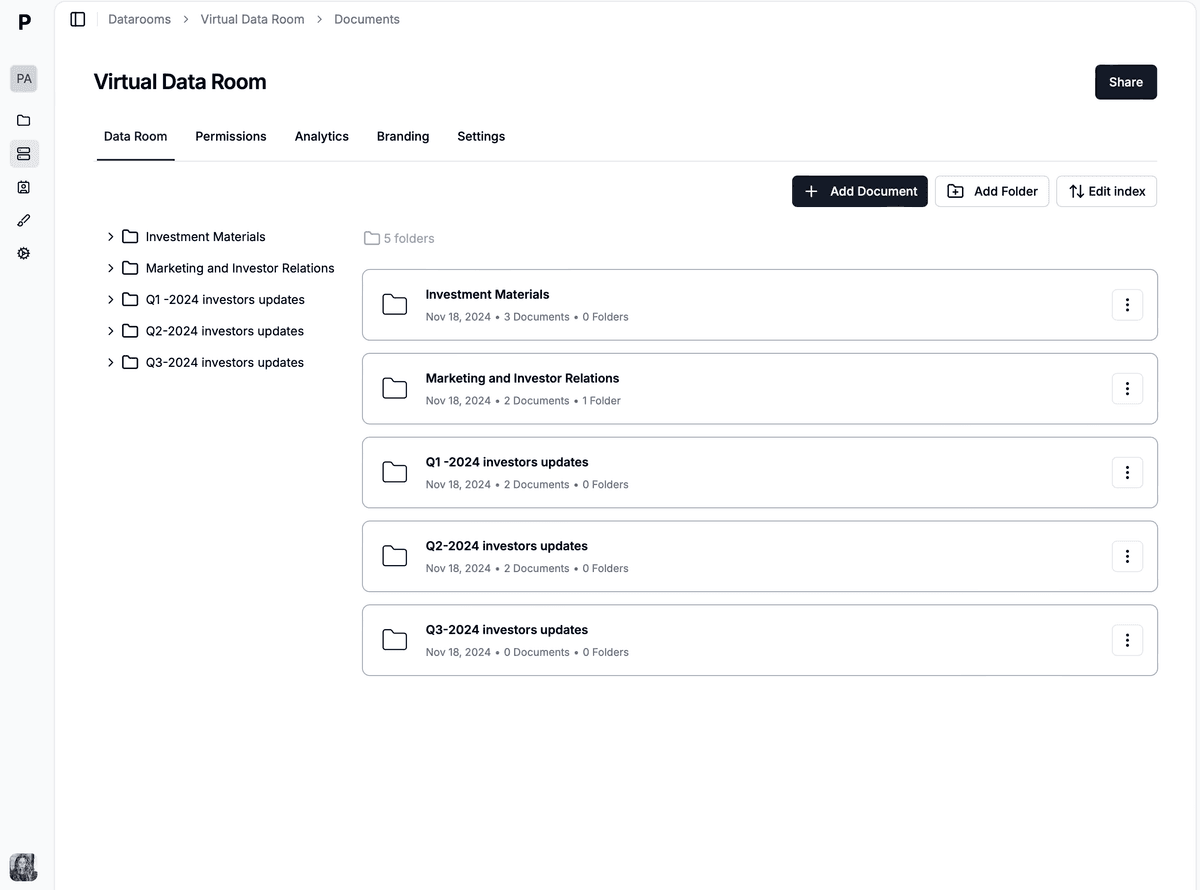
One room, five folders in front, contracts behind a second link.
The memo has a deadline. A partner who likes the Tuesday meeting wants the exhibits the same day. Five files that already match the deck are the difference between a memo this week and a memo after you have rebuilt the model under pressure.
Two audiences, even at one firm. The partner needs the five files. Counsel, if the round gets there, needs contracts. A teaser link and a diligence link are the only way to send both without sending both to everyone. A consumer file share has one permission.
The deck is part of the checklist. a16z's first file is the pitch deck. If that deck is a tracked link, you can see who reached the metrics slide before you decide who gets the room. Page-by-page analytics are how a list of 40 intros becomes a list of 11.
You will raise again. Speedrun's deal includes a right to invest in later rounds, and a direct seed often comes with the same expectation. The files you name properly now are the files a later process starts from. The ones that lived in email are the ones you rebuild.
Create the room with folders 01 to 05 matching the five files, plus 06 Legal, empty except for IP assignments and any signed safes. Number them so they sort. Name files with the company and the date, and mark actuals in the file name. "Fieldnote-PnL-actuals-through-Aug26.pdf" does not get confused with a forecast.
Drag the tree in once. During a raise you will add a file when someone asks. Automatic file indexing on Data Rooms Plus keeps that addition in the index instead of in a "see also" email.
The deck link is the teaser: overview only, no watermark, expiry at the end of the process you are actually running. The diligence link is the five files, with email verification on, dynamic watermarking on, and download off on the financials. The counsel link, if you need it, is folder 06 plus the five files, named allowlist, view only.
Granular permissions are set per link, so nobody creates an account to open a PDF. Forced signup is a common reason a partner never opens the room.
| Link | Folders | Controls |
|---|---|---|
| Deck | Pitch deck only | No verification, expires when the process ends |
| Partner | The 5 files | Email verification, watermark, no download on financials |
| Counsel | 5 files plus legal | Named allowlist, view only |
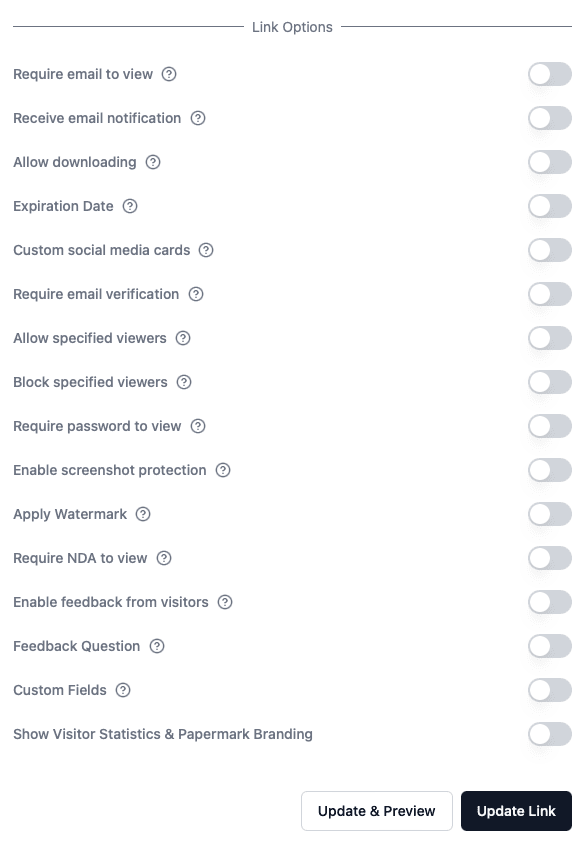
The partner link and the counsel link are the same room with different doors.
Run the room on your domain, with your logo and one sentence on what the reader is looking at. Custom domains and branding are on the Data Rooms plan. A partner opening a link on your domain is looking at a company. A partner opening a random vendor URL is looking at a file dump. Details are on custom branding.
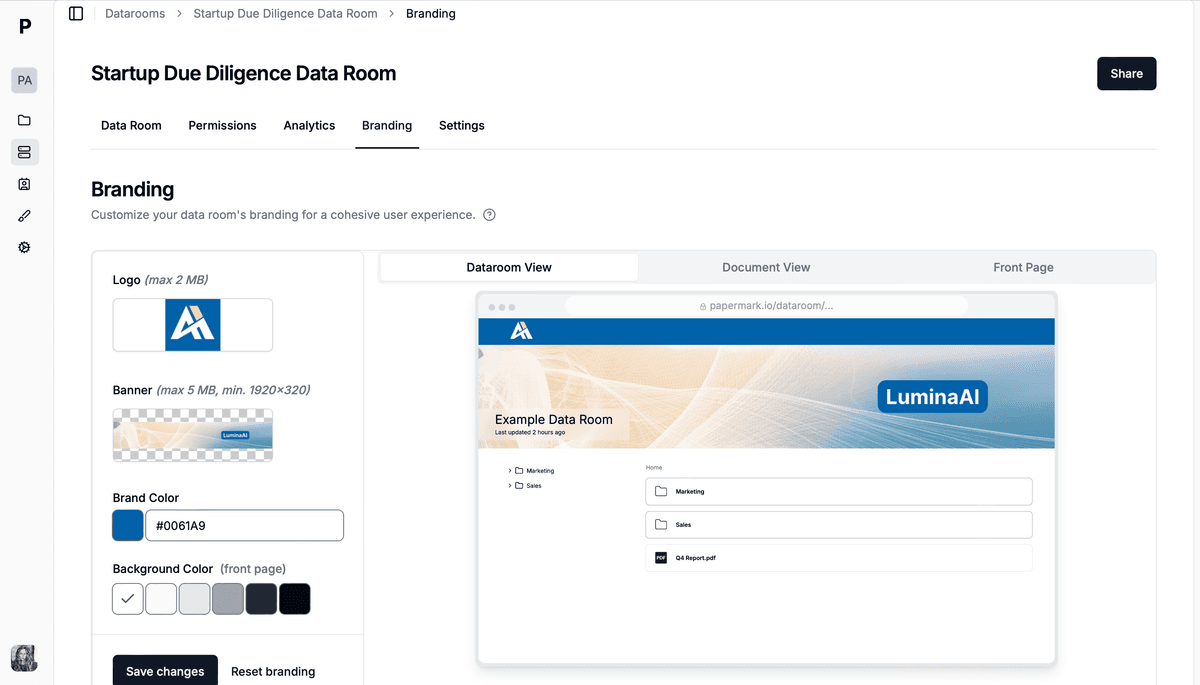
Branding is a few minutes, and it is the first screen every partner sees.
Share the deck from the same account as the room. See who reached the traction slides, who came back, and who forwarded the link. Then see who opened retention more than once. That third signal is the one that usually shows up before anyone says they are taking it to the partnership.
How to track activity on your pitch deck covers how to read the deck half. The room half is the same idea at file level: time on the P&L, time on cohorts, almost no time on the cap table means the ownership slide already answered the question.
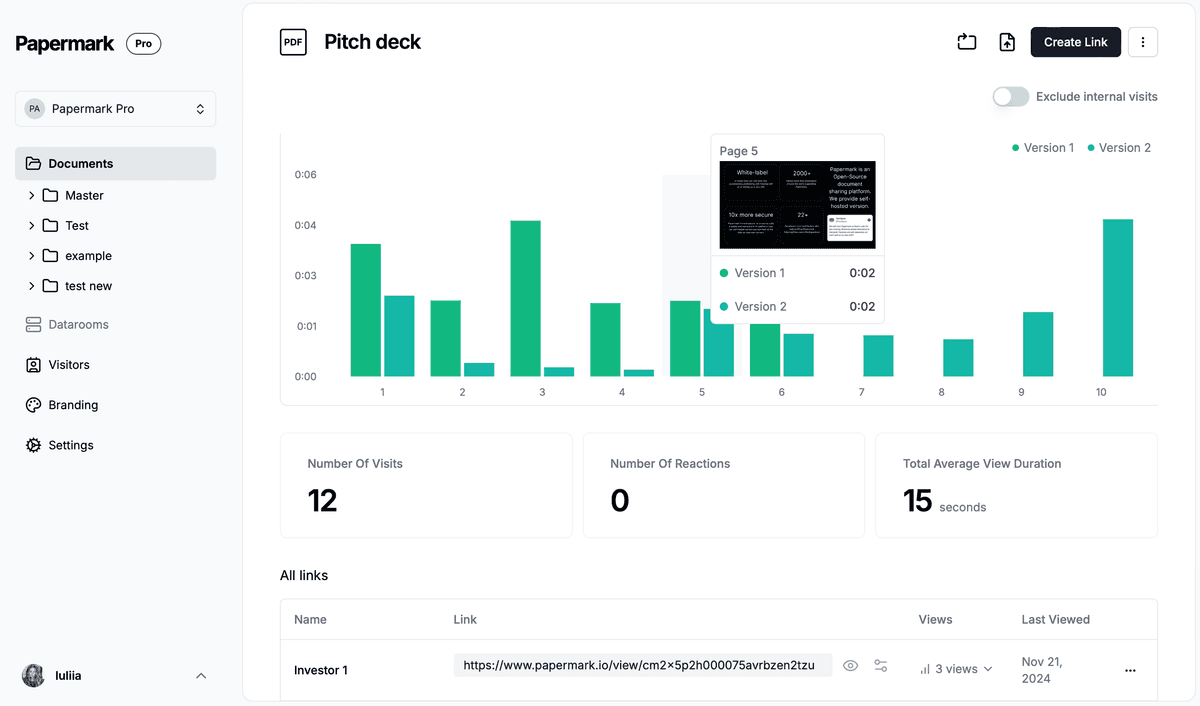
Per-slide timing is how a list of intros becomes the list that receives the five files.
Revoke the diligence link when you stop raising. Keep the room. Data room freeze archives it as an immutable export with a certificate, which is the record of what a partner actually saw. The next round starts by copying the five files forward, not by searching an inbox.
The free plan is €0 and covers document sharing with basic analytics, which is enough to send the deck. Full data rooms start on the Data Rooms plan at €99/month with a 7-day free trial: 3 team members, unlimited data room visitors, unlimited storage, a custom domain, dynamic watermarking, NDA agreements, granular permissions, and the public API, CLI, and MCP server. Data Rooms Plus at €249/month adds 5 team members, the Q&A module, the audit log, automatic file indexing, SOC 2 Type II, and ISO 27001. Premium at €549/month adds 10 team members and AI redaction. Data Rooms Unlimited at €999/month drops per-seat charges and includes AI redaction. AI redaction is Premium and Unlimited only.
For a seed process measured in a few months, €99/month is a few hundred euros against a round. The comparison that matters is the week you do not spend reconciling two versions of ARR after a partner has already seen both.
No credit card required.
Data room checklist 2026 with 40 essential documents for M&A, fundraising, and due diligence, staged by deal type, plus what buyers actually open first.
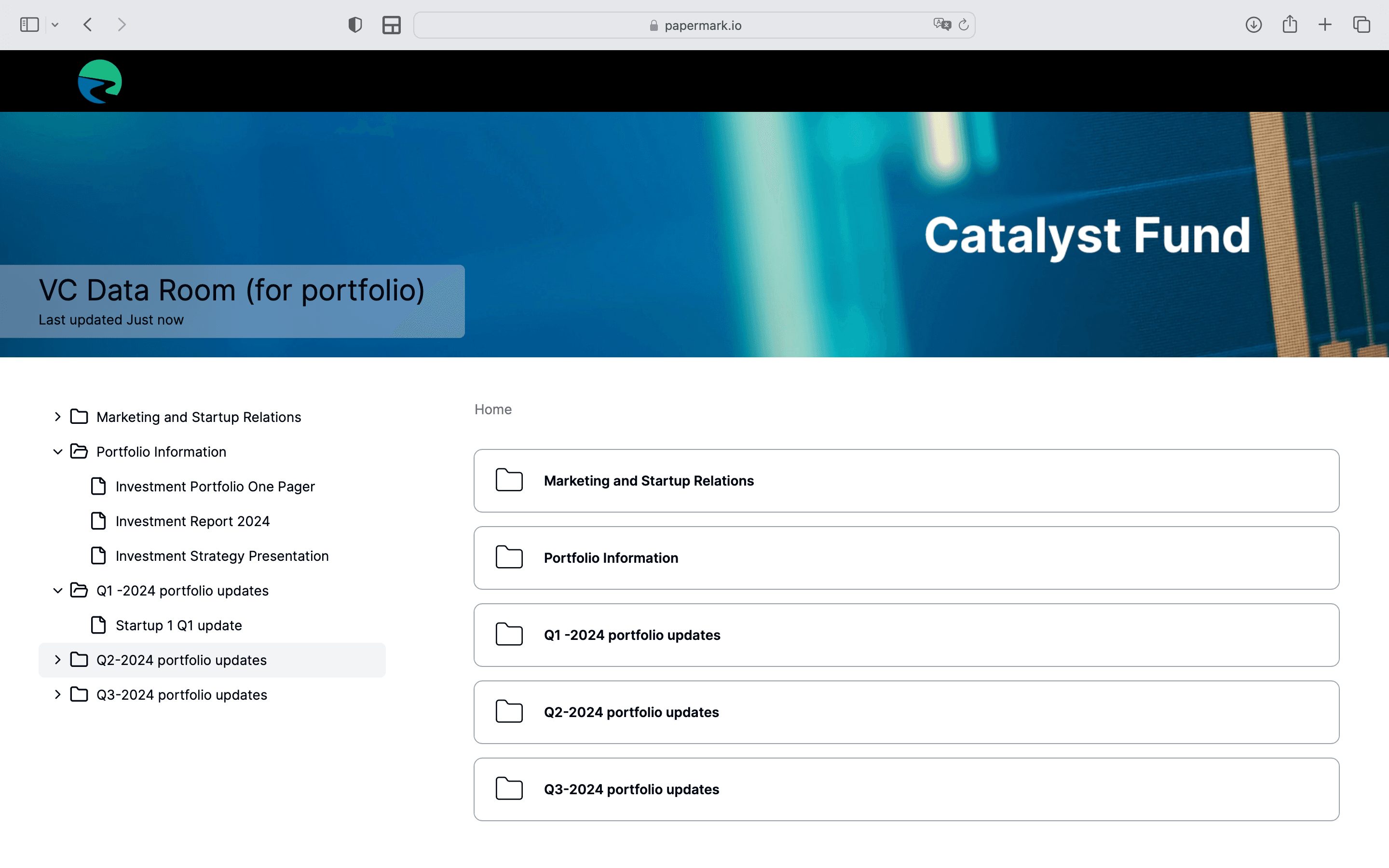
The complete venture fund data room checklist for 2026 - fund legal documents, performance history, PPM, LPA, ESG, and best practices for LP fundraising.

A data room for Antler fundraising in 2026: 12 documents for the investment committee, why terms change by city, and the published UK structure of up to £500k.