





datarooms
Data room for Antler fundraising in 2026: 12 files for the IC
A data room for Antler fundraising in 2026: 12 documents for the investment committee, why terms change by city, and the published UK structure of up to £500k.
A data room for Plug and Play fundraising is really two rooms. One is for the corporate partner who might run a pilot. The other is for an investor, if a cheque happens at all. Papermark is a secure, fully customizable, and developer-friendly data room for modern dealmakers. This guide covers what goes in each, and why the batch itself is not a financing.
Most accelerators hand you a standard SAFE and a demo day. Plug and Play hands you corporations. The data room that wins is the one a security reviewer and a business sponsor can both open, without seeing your raise.
A data room for Plug and Play fundraising is a controlled way to support two conversations that should not share a folder. A corporate innovation team wants to know if a pilot is safe and useful. An investor, later, wants to know if the company is ownable and the numbers match. Plug and Play's batch is the introduction. It is not, by itself, the round.
That is different from a virtual data room built for a buyer, and different from a data room for Techstars startups, where a published $220,000 investment creates a cap-table event on day one. Here the cap table might not change at all during the 3 months.
Build the pilot room before the first corporate meeting. Build the investor room when a fund asks for it. Teams that build only the investor room show up to a pilot call with a fundraise deck and no answer on where customer data would sit.
Plug and Play's announcement for its first Silicon Valley batches of 2026 says startups take part in mentor-led work and curated introductions, and can secure pilots, proofs of concept, and potential investment, all without equity requirements. Read that last clause twice. A place in the batch does not sell shares.
The firm also runs an in-house venture effort, and it has invested in companies from its network. That is a separate yes or no. There is no public standard amount for "being in the batch," so this guide will not invent one. If a cheque is offered, the instrument and the number belong in the investor room only after you have them in writing.
The practical fundraising path is indirect. A pilot with a known corporation is the proof an outside seed fund wants to see. Sometimes that fund is introduced through the batch. Sometimes it is not. The data room should let you send the pilot story without sending your ownership.
| Conversation | What they decide | Equity |
|---|---|---|
| The batch | Whether you join a 3-month program | None required, per the 2026 announcement |
| A corporate pilot | Whether to run a proof of concept | A contract, not a SAFE, unless you negotiate one |
| An investor | Whether to write a cheque | Only if a term sheet exists |
Eight documents. Each one answers a question a corporate reviewer asks before legal will look at a pilot.
Deck. The problem, the product, and who else uses it. Ten to fifteen slides. This is the leave-behind, not the room.
Security and data note. Where data is stored, whether you are SOC 2 or working toward it, what you will not collect during a pilot, and who on your team can see their data. One to two pages. A 40-page policy no one has read is worse than a short note you can defend.
Pilot scope. What you will do in 6 to 8 weeks, what you need from them, and what "done" means. Corporations stall when this is a verbal promise.
Architecture sketch. A single diagram. Their security reviewer wants to see the boundary between their systems and yours.
References. Two names, with permission, or a written case if you cannot share names yet. One is enough if it is real.
Insurance and company. A certificate if you have one, and incorporation. Some vendors will not start without both.
Mutual NDA. Your paper or theirs. The data room can require acceptance before the other files open, which is cleaner than an email attachment they lose.
Pricing for the pilot. A one-page commercial note. Keep it out of the deck you also send to investors, or you will anchor a fundraise to a pilot price.
| Pilot file | The question it answers |
|---|---|
| Deck | What do you do, and for whom |
| Security note | Where would our data sit |
| Pilot scope | What happens in 6 to 8 weeks |
| Architecture | What touches our systems |
| References | Who has used this |
| Insurance and charter | Are you a real vendor |
| NDA | Can we open the rest |
| Pilot pricing | What does a proof of concept cost |
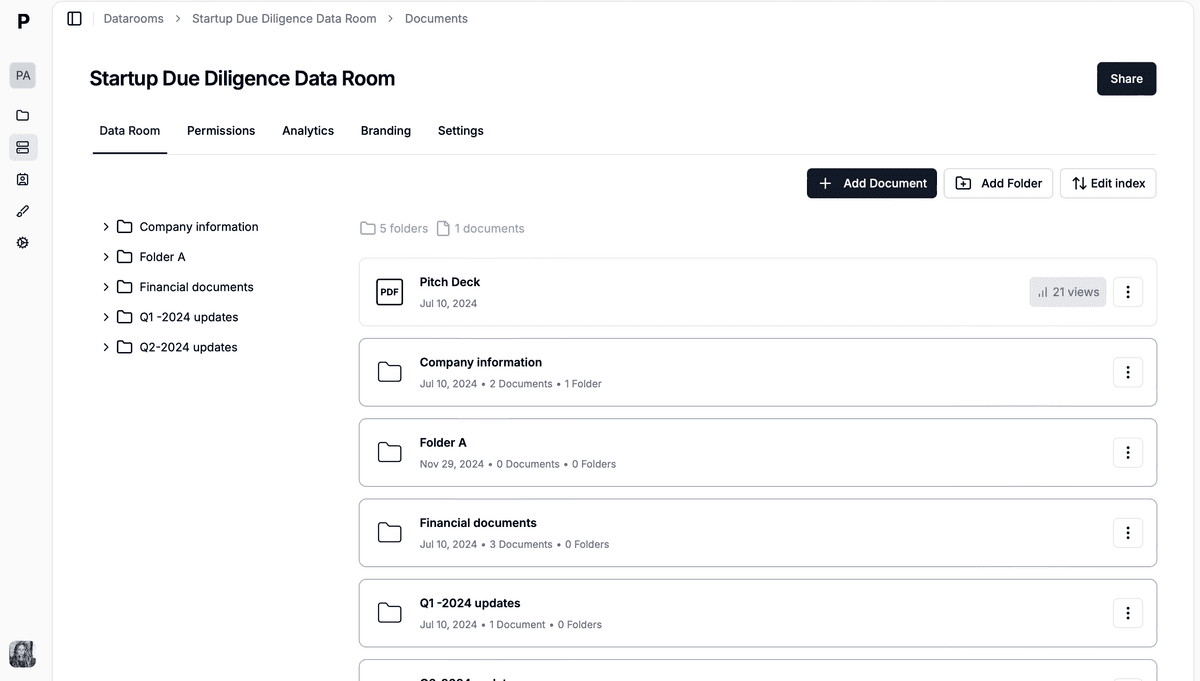
The corporate folder is a vendor room. The investor folder stays closed until there is a cheque to discuss.
Open this only when an investor asks. Eight more documents: cap table, monthly revenue or a clear pre-revenue note, burn and runway, IP assignments, customer or pilot list, the deck you use for funds (without the pilot price), a use-of-funds page, and any SAFEs already signed.
Do not include the corporation's security questionnaire responses in the investor link. Those answers were given to one company. Do not include the investor cap table in the pilot link. A procurement manager does not need your ownership, and sending it looks like you are raising on their letterhead.
| Link | Files | Never include |
|---|---|---|
| Pilot | The 8 corporate documents | Cap table, SAFEs, fundraise deck |
| Investor | The 8 seed documents | Their security answers, pilot price |
The startup data room checklist is the longer version of the investor half. Use it when the cheque is real. If the cheque comes as a standard SAFE, the data room for YC startups shows the investor room at that stage. Until then, the pilot half is the data room that matches the program.
Ledgerline is a hypothetical payments company in a Plug and Play batch. A bank's innovation team asks for materials after an intro. Ledgerline sends the pilot link: deck, security note, a 6-week scope, and an NDA gate. Four people at the bank open it. The security reviewer spends the longest time on the architecture page. The business sponsor reads the scope. Nobody asks for the cap table, because it is not there.
Three weeks later an angel who heard about the pilot asks for "the data room." Ledgerline does not forward the bank link. They send the investor link: cap table, burn, IP, and a deck that mentions the pilot without the bank's internal notes. The angel is one reader. The bank's four readers never see him.
Worked scenario. Share of reading time on the pilot link only. The investor link was a different send, to one angel.
No equity changed hands in the batch. The pilot contract, if it comes, is a customer agreement. The angel is a separate conversation with a separate link.
One folder for everyone. The bank and the angel are different jobs. A shared drive makes them the same permission.
Putting a hoped-for investment amount in the deck because other accelerators publish one. Plug and Play's announcement is explicit that equity is not required. A made-up cheque is a fact you will have to walk back.
Sending security answers you wrote for one corporation to the next corporation. Each pilot link should be its own, so you can revoke one without closing the other.
Waiting to write the security note until procurement asks. In a 3-month batch, that ask comes in week 2, and the teams who already have the page get the second meeting.
A data room for your Plug and Play process is two links over one account. Papermark is a secure, fully customizable, and developer-friendly data room for modern dealmakers, with page-by-page analytics, dynamic watermarking, unlimited data room visitors, and transparent pricing (open-source and self-hosting available). An NDA on the pilot link is the feature that matches how corporations actually open a vendor's files.
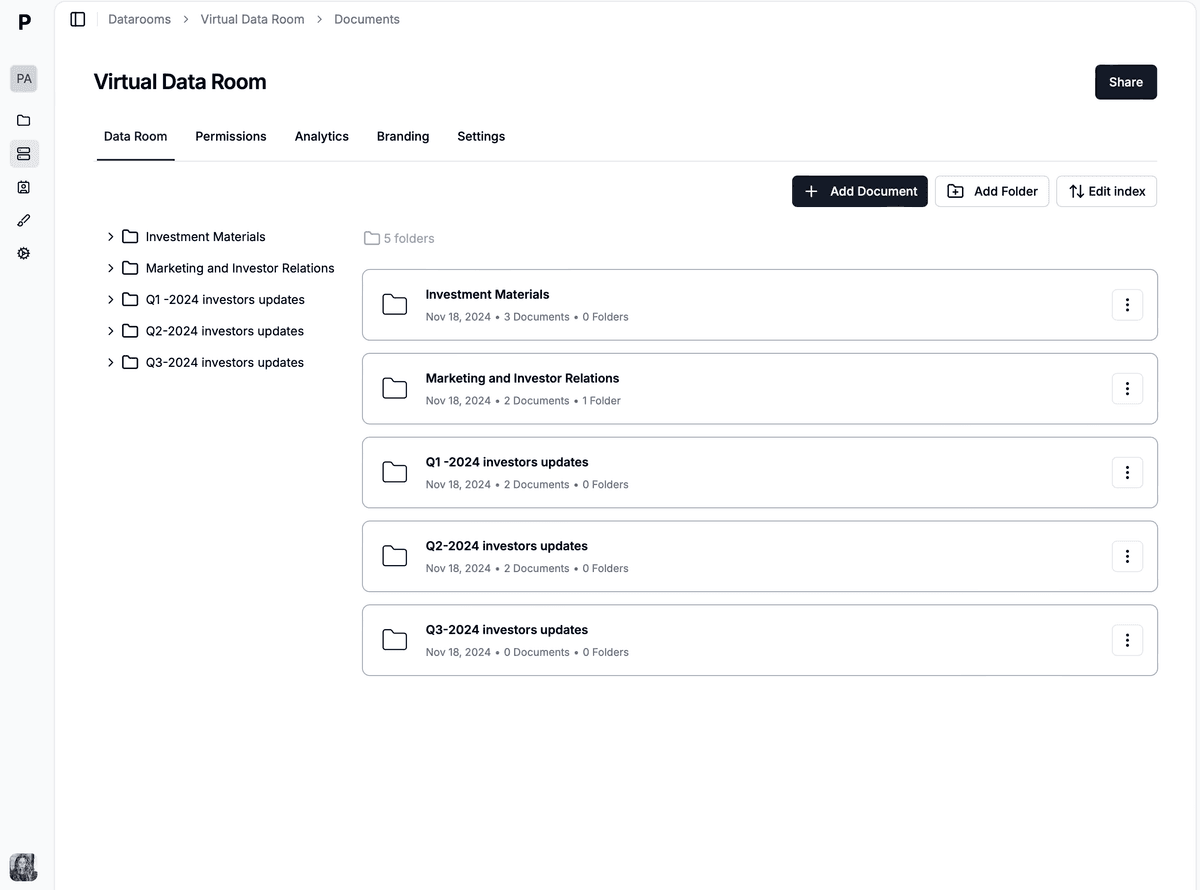
Same account. The bank does not see the cap table.
Corporations buy differently from funds. They want scope, security, and a price for a pilot. Funds want ownership and burn. One PDF cannot be both.
The batch does not sell equity. Your data room should not look like a demo-day raise unless you are actually raising.
You will run more than one pilot conversation. Each corporation gets its own link, so you can see who read the architecture page and you can turn one off. Page-by-page analytics are how you tell the reviewer from the sponsor.
An investor may still appear. When they do, the second link is already built. You do not scramble a cap table into the same folder the bank is using.
Eight files, named so a reviewer knows what they are. Put the NDA on the link, not as a loose PDF they can skip. Automatic file indexing matters less at 8 files than at 80, and it matters as soon as a second corporation asks for a variant.
Granular permissions and dynamic watermarking per link. Watermark with their email. Expire the link at the end of the pilot discussion, not "never." A second corporation gets a new link even if the files are the same.
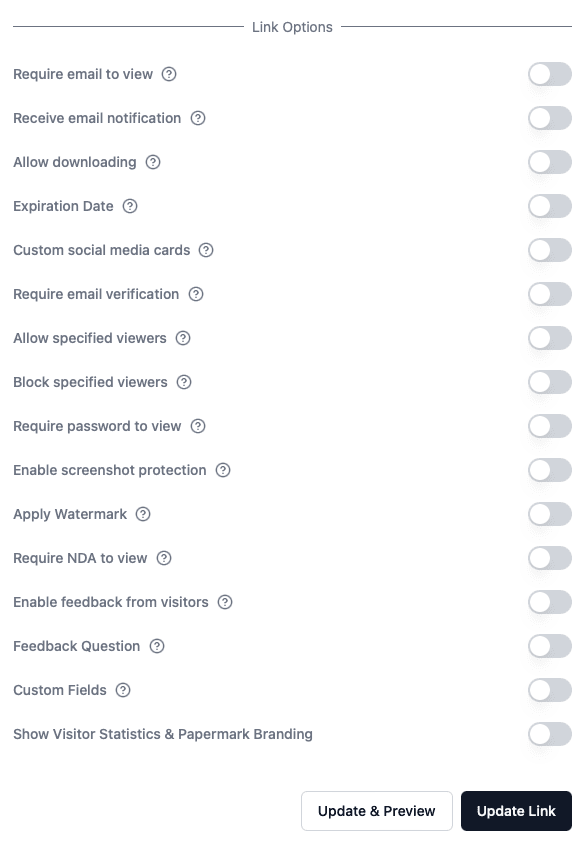
Each corporate reader gets a link you can close without closing the others.
The page they open should be your company. Custom domains are on the Data Rooms plan. See custom branding.
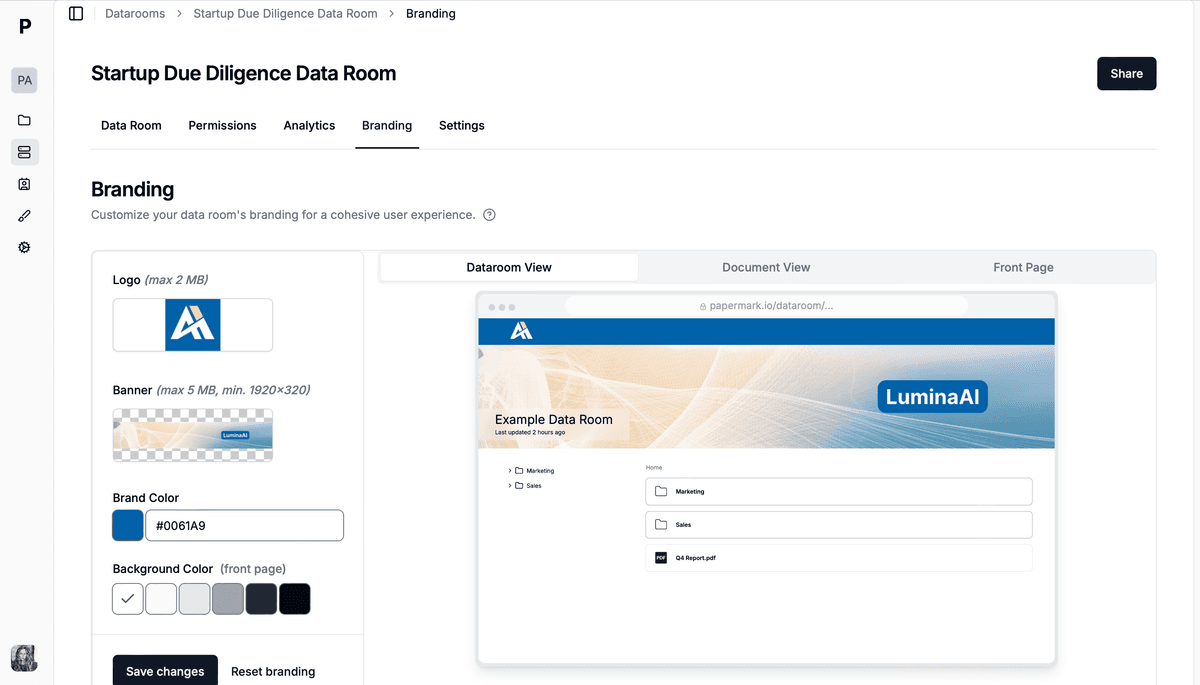
You are the vendor in this meeting. The link should say so.
Duplicate nothing by hand. The investor folders already sit beside the pilot folders, unpublished on that link. When a fund asks, you turn the link on. When either conversation ends, you revoke that link and leave the files. Data room freeze is for the moment a pilot contract or a round actually closes.
Sending a deck is free. The dual room is €99/month on the Data Rooms plan, 7-day trial, 3 team members, unlimited data room visitors, NDA on the link, and the public API, CLI, and MCP server. Plus at €249/month adds the audit log, which is the right upgrade if a corporation asks who opened the security note. AI redaction is Premium at €549/month and Unlimited at €999/month, not the €99 plan.
No credit card required.
A data room for Antler fundraising in 2026: 12 documents for the investment committee, why terms change by city, and the published UK structure of up to £500k.
A data room for Entrepreneur First fundraising in 2026: 10 documents for a brand-new company, the offer of up to $250,000, and the 8% post-money SAFE.
A data room for Seedcamp fundraising in 2026: 18 documents for a process that aims to finish in two weeks, and a first cheque usually between $350k and $1.25M.