BlogPrivate EquitySearch fund tools in 2026: the deal stack from sourcing to close, with prices
Search fund tools in 2026: the deal stack from sourcing to close, with prices
·11 min read
Marc Seitz
The best search fund tools cover seven stages, not just sourcing: on-market listings (BizBuySell, Axial), off-market databases (Grata, SourceScrub), the Searchfunder community, a CRM (HubSpot or Airtable), an Excel model with SBA 7(a) debt sizing, a diligence data room such as Papermark, and an investor room for updates. A self-funded searcher can run the whole stack for under $300 a month.
Quick recap
A search fund deal stack has 7 stages: raise capital, source, track, value, diligence, finance, and report to investors.
On-market sourcing: BizBuySell (free to browse, Edge about $24.95/month), DealStream, and Axial (success fee on closed deals for buy-side members).
Off-market sourcing: Grata, SourceScrub, Inven or PitchBook on custom quotes, plus Apollo (about $59/month) and LinkedIn Sales Navigator (about $119.99/month) for owner outreach.
Community: Searchfunder, about $19/month on annual billing, for deal sharing, investor intros and searcher benchmarks.
CRM: a spreadsheet or Airtable for self-funded searchers; HubSpot, Affinity or DealCloud as volume grows.
Diligence: a quality of earnings provider ($15,000 to $25,000 below $3M of EBITDA) plus a data room. Papermark is a flat $99/month with unlimited data rooms, so the investor room and every target room sit on one plan.
Financing: an SBA 7(a) lender list for self-funded deals (loans up to $5 million), or equity from search investors for traditional funds.
The median traditional search runs about 20 months and only about half end in an acquisition, so per-deal tool pricing charges you for the deals that die.
No credit card required.
1. The search fund stack at a glance
Most lists of search fund tools are lists of sourcing tools. That is the first half of the job. A searcher also has to raise the search capital, track hundreds of owner conversations, model a deal a lender will finance, run diligence with a QoE firm, a lawyer and a lender at once, and then report to investors for years. The stack below follows that whole path, from the first investor call to the post-close update.
The right tools depend on the search model. A traditional search fund raises a median of about $550,000 of search capital from around 13 investors (Stanford GSB 2026 Search Fund Study) and can afford a paid database. A self-funded searcher pays for everything personally, usually leans on SBA 7(a) debt, and should spend on the two or three tools that actually find deals. Our search fund guide covers the models and the returns in detail.
Stage
Self-funded pick
Traditional pick
Price model
Raise search capital
Not needed
Papermark investor room with custom domain
$99/month flat
On-market sourcing
BizBuySell, DealStream
BizBuySell, DealStream, Axial
Free to $24.95/month; Axial success fee
Off-market sourcing
Apollo, LinkedIn Sales Navigator
Grata or SourceScrub
$59 to $120/month; databases on quote
Community
Searchfunder
Searchfunder
About $19/month billed annually
CRM and pipeline
Google Sheets or Airtable
HubSpot or Affinity
Free to per-seat
Valuation and modeling
Excel LBO template
Excel, plus Capital IQ or PitchBook via investors
Microsoft 365
Diligence and QoE
Papermark data room plus QoE firm
Papermark Data Rooms Plus for Q&A, or DealRoom
$99/month flat; QoE $15,000+
Financing
SBA 7(a) lender list
Search investors, senior debt, seller note
Lender fees at close
Close and investor reporting
DocuSign, archived data room
DocuSign, investor room for updates
Per sender; same data room plan
Third-party prices are monthly list prices reported in November 2026 and change often. Check each vendor before you buy.
On-market sourcing means businesses that are already for sale, usually through a broker. It is the fastest way to see live deals and the most competitive, because every other buyer sees the same listing. Most self-funded searchers start here; traditional search funds use it as one channel among several.
BizBuySell
BizBuySell is the largest US marketplace for small businesses for sale, with listings from brokers and owners. Browsing is free. BizBuySell Edge, the paid buyer tier, adds earlier alerts and listing history, and sells at about $24.95/month on monthly billing (about $239.95 a year on annual billing). Most listings are under $5 million of price, which suits self-funded and SBA-financed searches.
DealStream
DealStream is a broader listings marketplace covering businesses, real estate and financing requests. It is useful as a second feed alongside BizBuySell, particularly for niche or regional businesses, and is free to browse.
Axial
Axial is a members-only network where advisers and brokers bring lower-middle-market deals to buyers. Axial's own FAQ describes a success-fee model for buy-side members, charged on a Lehman scale only when a buyer closes a deal first found on the platform. Deals tend to be larger than BizBuySell's and are mostly banker-run, so expect a CIM, a process letter and a data room.
Listing aggregators
Aggregators and AI tools that scrape broker sites into one feed, such as Kumo, save hours of manual browsing. They do not create new deal flow; they make the on-market channel faster to cover.
3. Off-market databases and outreach: Grata, SourceScrub, Inven, Apollo
Off-market sourcing means finding owners who have not decided to sell and contacting them directly. It is slower, but the deals are less competitive and the searcher often becomes the only buyer in the conversation. A typical traditional searcher contacts 1,000 to 3,000 owners over a search; our search fund guide's worked scenario reaches 2,400 owner contacts, 61 management calls and four LOIs.
Grata and SourceScrub are the databases searchers mention most. Both index private, founder-owned companies by sector, size and location, and both sell on custom quotes. Inven and PitchBook cover similar ground, with PitchBook stronger on sponsor-backed companies. A paid database earns its cost when the searcher has a defined thesis and an 18 to 24 month search ahead; for a self-funded searcher testing several industries, it is often too early.
Apollo (about $59/month per user on monthly billing) and LinkedIn Sales Navigator Core (about $119.99/month) are the low-cost alternative. They give contact data and a way to reach owners at scale, and many self-funded searchers run their whole outbound program on these two plus a mail-merge.
4. Searcher community: Searchfunder
Searchfunder is the online community for searchers, search investors and lenders. Members share deals they have passed on, ask for lender and QoE referrals, find investors, and compare notes on terms. Searchfunder's pages list membership at about $19/month on annual billing, with month-to-month rates listed between $29 and $79 depending on the page you read.
For a self-funded searcher, Searchfunder often replaces a paid advisory network: the lender and attorney introductions alone are worth the fee. For a traditional search fund, it is a way to stay visible to the investor community between updates. Neither use replaces a disciplined sourcing process, but both shorten the time from LOI to a financed close.
5. CRM and pipeline: spreadsheet, Airtable, HubSpot, Affinity
A searcher's CRM tracks hundreds of owner conversations through a long funnel, and the discipline matters more than the tool. The stages most searchers track are: on radar, owner call, NDA signed, CIM or financials received, IOI, LOI, diligence, and closed or dead. Each record needs the source, the last touch and the next action.
A Google Sheet works for the first few hundred contacts. Airtable (free plan, paid seats at about $24/month on monthly billing) adds views, forms and automations without code. HubSpot has a free CRM and paid Sales Hub seats from about $20/month, and is the most common upgrade when outreach sequences need to sit next to the pipeline. Affinity and DealCloud are built for private equity firms and make sense for sponsored search programs running several searchers at once. Our CRM for private equity guide compares them.
6. Valuation and modeling: Excel, SDE vs EBITDA, SBA 7(a) debt sizing
Valuation for a search fund deal happens in Excel. Most searchers adapt an LBO template: three years of historical financials, an adjusted earnings line, a debt schedule and a returns table. For businesses under about $1 million of profit, sellers and brokers quote seller's discretionary earnings (SDE), which adds back one owner's salary; above that, buyers and lenders use EBITDA. Mixing the two is one of the most common modeling errors in small-business acquisitions.
Debt sizing drives the model for self-funded deals. An SBA 7(a) loan can fund up to $5 million, usually needs a buyer equity injection of around 10 percent, and is sized on debt service coverage, so the lender's view of normalised earnings sets the price you can pay. Traditional search funds use senior bank debt and often a seller note, with the equity coming from search investors who exercised their right to fund the deal. Capital IQ or PitchBook access, often through an investor, helps with comparable multiples; the Stanford study's median purchase multiple for 2024 to 2025 was 6.2x EBITDA.
7. Due diligence and QoE
Diligence is where the search stack usually breaks. After the LOI, the searcher is coordinating a quality of earnings firm, a lawyer, a tax adviser, an insurance reviewer and a lender, all asking the seller for documents at the same time. A seller running a business while this happens will stop cooperating if the process is chaotic.
Do search funds need a virtual data room?
Yes, once more than one adviser is involved. Some guides argue that a VDR is the wrong answer for a small deal because VDRs are enterprise-priced. That was true when the only options were per-project quotes in the tens of thousands of dollars. A flat-priced data room at $99/month costs less than one hour of QoE work and replaces email attachments with one controlled file. For a self-funded searcher, the room also keeps the seller's customer list and payroll out of personal Gmail inboxes, which is usually what the owner asks about first.
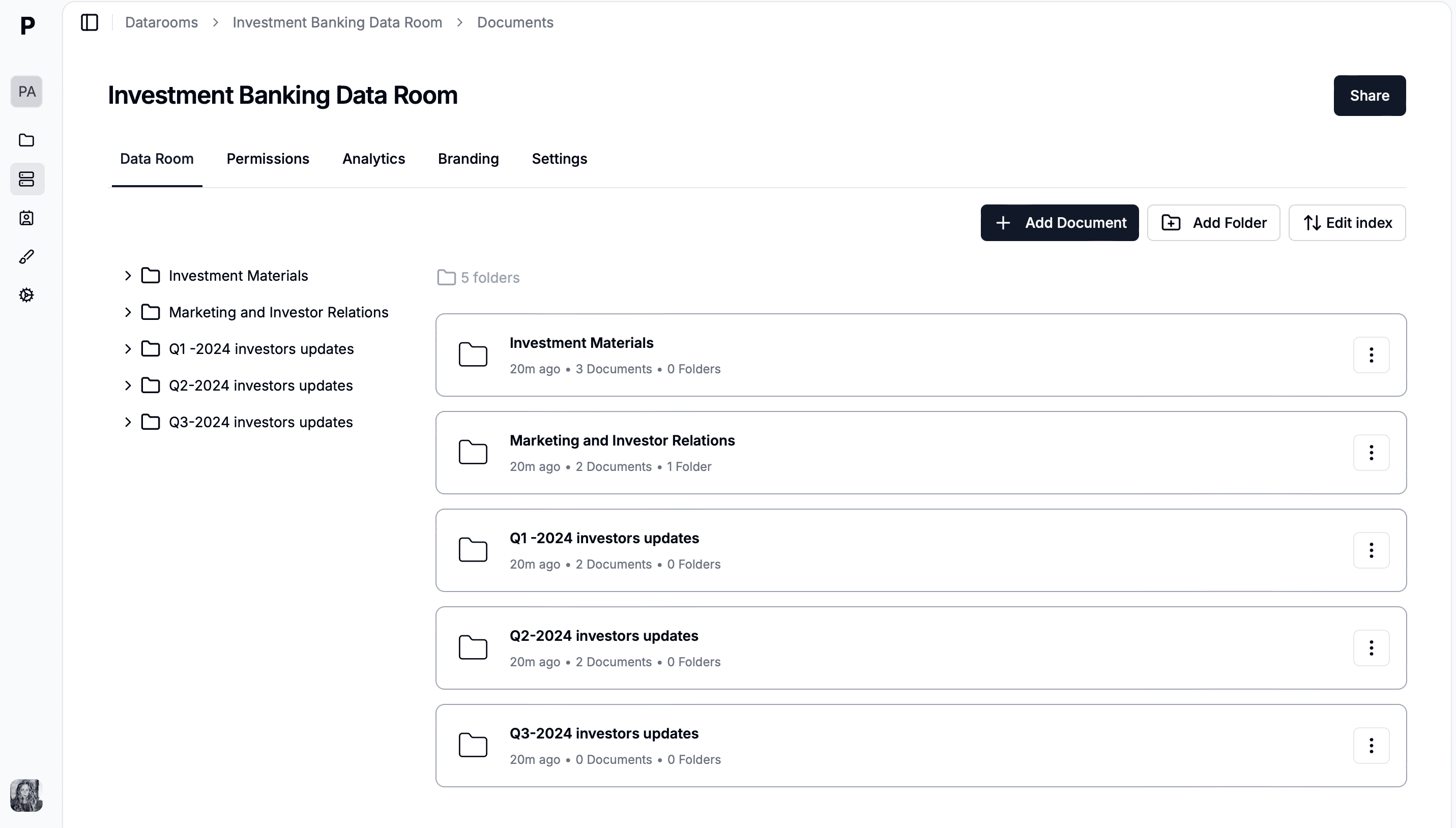
A searcher sets up the room once per target: a link for the QoE firm with the general ledger and financials, a link for the attorney with contracts and corporate records, a view-only, watermarked link for the lender, and a file request so the seller can upload missing exports directly. If the deal dies, the links are switched off and the next target gets a new room at no extra cost. Our small business due diligence checklist covers what goes in each folder.
Data room options compared for small-business deals
Capability
Email and Drive
Papermark
DealRoom
Datasite
Cost model
Free
From $99/month, unlimited rooms
$25,000/year platform
$25,000+/year, quote
Separate link per adviser
NDA before access
Check with vendor
Dynamic watermark
Page-level analytics
Check with vendor
Buyer Q&A
(Data Rooms Plus)
File requests from the seller
(request lists)
Setup time
Minutes
Minutes
Days
Days
DealRoom is the data room most often named for search fund diligence, and its pipeline and request-list features help a corporate development team running several buys a year. For a searcher closing one deal, the $25,000/year platform fee is the wrong shape. Our DealRoom review covers that trade-off.
8. Investor updates and the search capital raise
Traditional searchers use a data room before they ever look at a company. The search capital raise means sending a private placement memorandum, a target profile and unit documents to 30 to 40 prospective investors, and knowing who actually read them. A branded investor room with per-investor links and page-level analytics turns that raise into a ranked follow-up list.
The same room stays open for the whole search. Quarterly updates, deal pipeline summaries and, eventually, the acquisition materials for investors deciding whether to fund the deal all go there. After close, it becomes the investor reporting room for board packs and annual financials. The data room section of our search fund guide walks through that setup step by step.
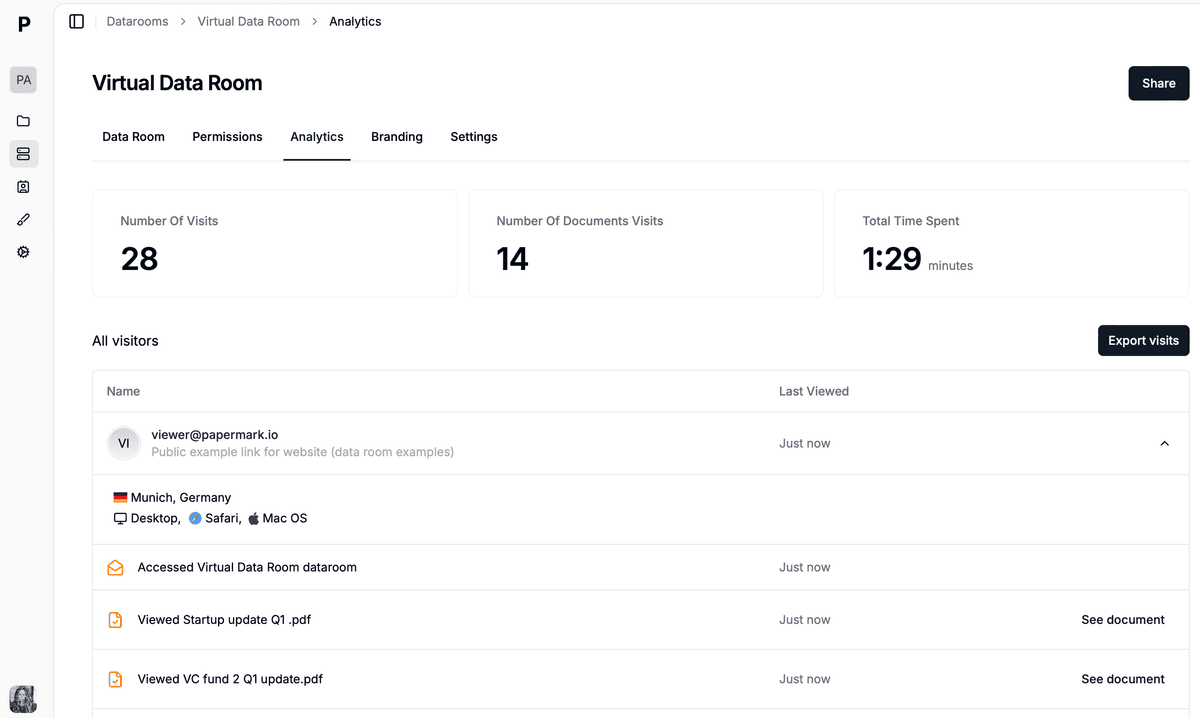
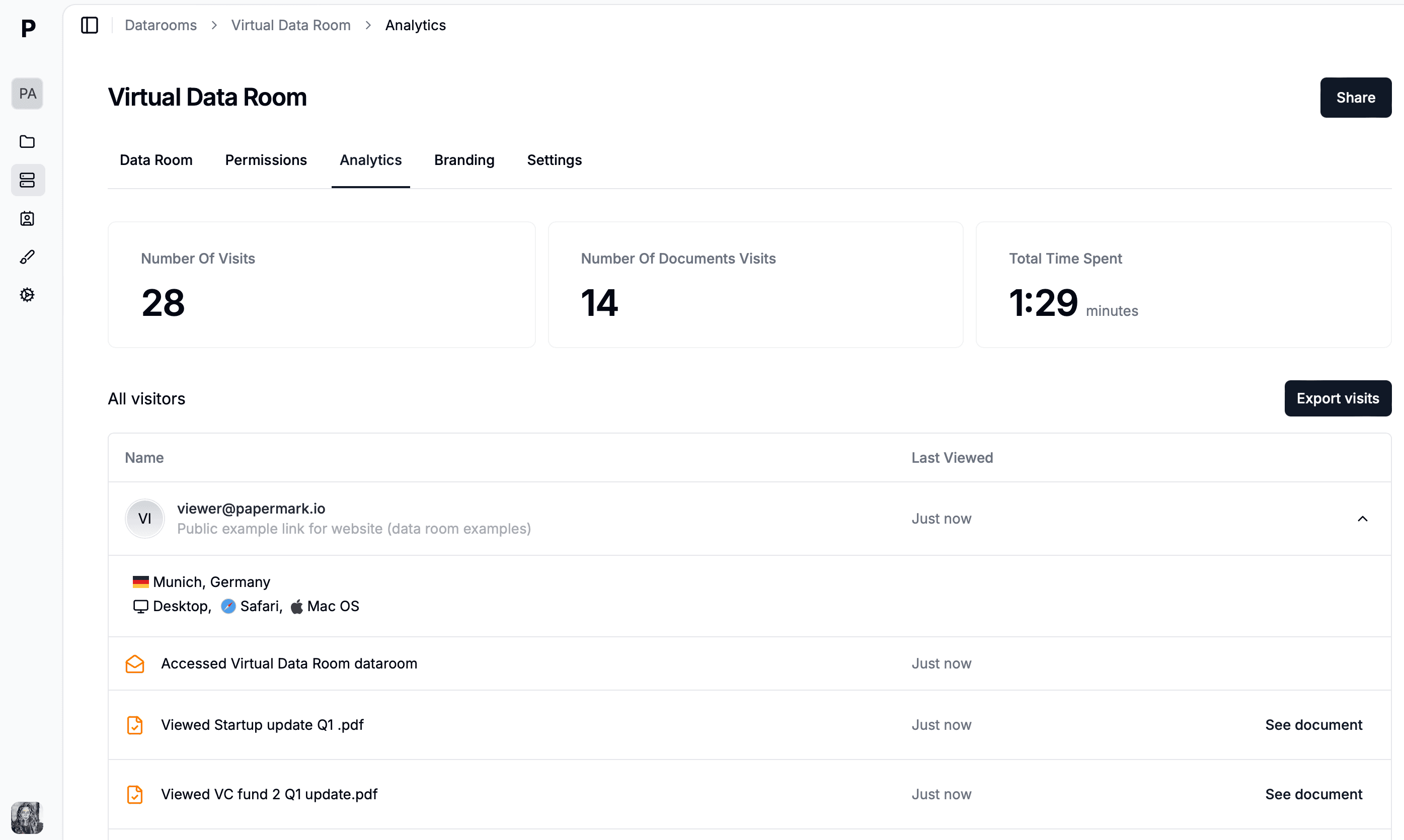
Per-investor analytics show who read the memorandum during the search capital raise.
9. Stacks by searcher type
The three common search models need different stacks. The tables below show a realistic monthly bundle for each, using the monthly list prices above. Quote-based tools are marked as quotes.
Self-funded searcher (under $300/month)
Tool
Purpose
Monthly cost
BizBuySell Edge
On-market listings and alerts
About $24.95
LinkedIn Sales Navigator Core
Owner outreach
About $119.99
Searchfunder
Community, lender intros
About $19 (annual billing)
Google Sheets or Airtable free
CRM
$0
Papermark Data Rooms
Diligence rooms per target
$99
Total
About $263
Traditional search fund
A traditional searcher adds a paid off-market database (Grata or SourceScrub on quote), Apollo for sequencing, HubSpot Sales Hub for the pipeline, and Axial for banker-run deals on a success fee. The data room line is the same $99/month plan, because one subscription covers the investor room and every target room. If the searcher wants buyer-side Q&A and an audit log for the investor committee, Data Rooms Plus adds both.
Sponsored search or small private equity
A sponsor running several searchers centralises the expensive tools: one database contract, Affinity or DealCloud for a shared pipeline, and Capital IQ or PitchBook seats. Each searcher gets their own data rooms under the sponsor's Papermark account, on the sponsor's custom domain, so investors and sellers see the sponsor's brand.
10. Worked scenario: a self-funded searcher's 24-month tool budget
Daniel Okafor is a hypothetical self-funded searcher looking for a commercial HVAC services business in Texas with $1 million to $2 million of EBITDA. He keeps his day job for the first six months and plans an SBA 7(a) loan for 80 to 90 percent of the price.
He subscribes to BizBuySell Edge and Searchfunder from day one and runs Sales Navigator for all 24 months. Apollo runs for 12 months during his heaviest outreach. His CRM is a free Airtable base with nine stages. Papermark runs for the full 24 months: he opens a room for each of three targets that reach LOI, switches off the links on the two that die, and the third becomes the closing room his lender, QoE firm and attorney work in.
Line item
Months
Cost
BizBuySell Edge at $24.95
24
$599
Searchfunder at $19 (annual billing)
24
$456
LinkedIn Sales Navigator at $119.99
24
$2,880
Apollo at $59
12
$708
Airtable
24
$0
Papermark Data Rooms at $99
24
$2,376
Total software over 24 months
$7,019
Self-funded search: $7,019 of software over 24 months
$7,01924 months
Outreach (Sales Navigator, Apollo)3588 · 51%
36 months of seats combined
Data room (Papermark)2376 · 34%
3 target rooms, one plan
Listings and community1055 · 15%
BizBuySell Edge, Searchfunder
Worked scenario. Outreach is the biggest software line; the data room that covers three targets is about a third of the total. The QoE report on the deal that closes, roughly $15,000 to $25,000, is paid at the deal, not from the tool budget.
The total is less than a third of a single QoE report. The tool that saved the most time was the one that cost nothing extra per target: when the second LOI fell apart on customer concentration, Daniel switched off the links and opened the next room the same afternoon.
11. Data room for your search fund acquisition
A data room for a search fund does two jobs: an investor room during the raise, and a diligence room for each target after the LOI. Both are covered by one subscription when the data room has unlimited rooms. If you are still comparing providers, our best virtual data rooms comparison covers pricing models across the main options.
Papermark is a secure, fully customizable and developer-friendly data room for modern dealmakers, with unlimited data room visitors, so you never pay per investor, lender or adviser.
Step 1: build the investor room
Upload the private placement memorandum, target profile and unit documents, and share one link per investor with email verification. Put the room on your own custom domain so a first-time fund reads as institutional.
Step 2: open a room per target after the LOI
Create a new room for each live target and drag in the seller's files. Unlimited data rooms mean a dead deal costs nothing beyond the time.
Step 3: scope a link per adviser
Give the QoE firm, attorney, tax adviser and lender their own links with granular permissions, and turn on dynamic watermarking on customer and payroll folders. Gate each link with an NDA the seller approves.
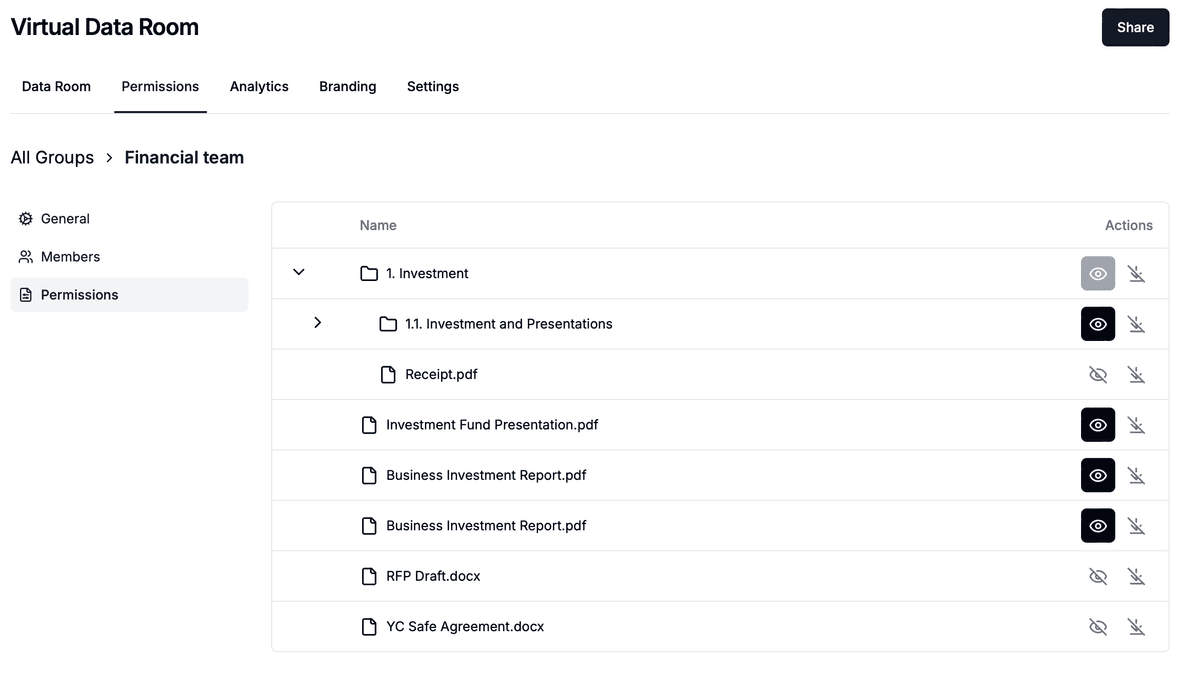
The QoE firm, attorney and lender each see a different slice of the same seller files.
Step 4: collect missing files and answer questions
Use file requests so the seller uploads missing exports directly into the right folder. On Data Rooms Plus, advisers ask questions through Q&A inside the room, and answers can stay private or be published to everyone.
Step 5: shut down or freeze
When a deal dies, revoke every link in one click so the seller's files are no longer reachable. When it closes, use data room freeze on Data Rooms Plus to lock the room into a downloadable archive for your investors and lender.
Papermark is our #1 VDR provider for M&A transactions right now. In two deals we used custom branding, dynamic watermarking, and granular permissions.
The Data Rooms plan is $99/month with a 7-day free trial and includes 3 team members, unlimited data rooms, unlimited data room visitors, unlimited documents, a custom domain, dynamic watermarking, NDA agreements and granular file-level permissions. Data Rooms Plus adds Q&A, the audit log and data room freeze. Papermark also has a public API, CLI and MCP server for searchers who want to script room setup, and AI redaction on Premium and above.