Investment banking software in 2026: the deal stack bankers actually run
·13 min read
Marc Seitz
Investment banking software is not one product. Bankers run a deal on a stack of 6 to 8 tools: Excel and PowerPoint for models and the CIM, Capital IQ, FactSet or PitchBook for market data, a CRM such as DealCloud or Affinity for the buyer list, a virtual data room such as Papermark, Datasite or Intralinks for diligence, and DocuSign to close. This guide maps each tool to the deal stage where it does the work, with prices and a separate stack for boutique banks.
Quick recap
Modeling and presentations - Excel and PowerPoint, usually with an add-in such as Macabacus, UpSlide or think-cell. Every bank, every deal.
Market data and research - Capital IQ, FactSet, Bloomberg or PitchBook for comps, precedent transactions and buyer lists. Per-seat, quote-based.
CRM and deal management software - DealCloud, Affinity, Salesforce Financial Services Cloud or 4Degrees to track relationships, NDAs and IOIs.
Virtual data room - Papermark from $99/month with unlimited data rooms, or Datasite and Intralinks on per-project quotes. Used from CIM distribution through confirmatory diligence.
Buyer outreach - Outlook or Gmail sequences, Apollo and LinkedIn Sales Navigator to reach the long list.
Project management and request lists - Excel trackers, Asana or Monday, or the request list inside the data room.
E-signature and closing - DocuSign or Adobe Acrobat Sign for NDAs, the LOI and the purchase agreement.
Collaboration and records - Microsoft 365 or Google Workspace, Teams or Slack, with archiving that meets FINRA books-and-records rules for US broker-dealers.
No credit card required.
1. What software do investment bankers use to run a deal?
The short answer is a layered stack, not a single platform. An analyst builds the model in Excel, pulls comparable companies and precedent transactions from Capital IQ or FactSet, and turns the result into a teaser and a confidential information memorandum in PowerPoint. The associate keeps the buyer universe, NDAs and indications of interest in a CRM. Once buyers sign NDAs, the CIM and then the full diligence file move into a virtual data room, and the deal closes on e-signature.
Each layer is sold by a different vendor, and no single product has replaced the stack. M&A software vendors that market themselves as "end to end", such as DealRoom or Intapp DealCloud, still sit next to Excel and a data room in practice. That is the point arvya.io makes about "one deal, six systems", and it matches what bankers report: the integration work happens through exports, links and shared folders, not one database.
The layer that touches the most outside parties is the virtual data room. A sell-side mandate commonly involves 10 to 30 prospective buyers, each with 3 to 6 advisers, so the data room is where security, permissions and the audit trail matter most. It is also the layer with the widest price range, from flat subscriptions to per-project quotes in the tens of thousands of dollars.
#
Layer
What bankers use it for
Common tools
Price model
1
Modeling
LBO, DCF, merger models
Excel, Macabacus, think-cell
Per-user license
2
Presentations
Pitch books, teaser, CIM
PowerPoint, UpSlide, Macabacus
Per-user license
3
Market data
Comps, precedents, buyer lists
Capital IQ, FactSet, Bloomberg, PitchBook
Per seat, quote-based
4
CRM and pipeline
Relationships, NDAs, IOIs
DealCloud, Affinity, Salesforce FSC, 4Degrees
Per seat, quote-based
5
Virtual data room
CIM distribution, due diligence, Q&A
Papermark, Datasite, Intralinks, iDeals, Firmex
Flat from $99/month or per project
6
Project management
Workstreams, request lists
Excel trackers, Asana, Monday, DealRoom
Per user
7
E-signature
NDAs, LOI, SPA signing
DocuSign, Adobe Acrobat Sign
Per sender
8
Collaboration
Email, chat, file storage
Microsoft 365, Google Workspace, Slack
Per user
2. Software used at each stage of a deal
The cleanest way to understand investment banking software is to follow a sell-side mandate from pitch to close. Each stage has one or two tools that carry the work, and the virtual data room appears earlier than most people expect: it is already in use when the CIM goes out, not only when diligence starts.
A typical lower-middle-market or mid-market sell-side process runs 4 to 8 months from engagement letter to signing. The table below maps each stage to the software that does the work and to the output the stage produces.
Stage
Timing
Main software
Output
1. Origination and pitch
Before mandate
Capital IQ or PitchBook, DealCloud, PowerPoint
Pitch book, engagement letter
2. Valuation
Weeks 1 to 4
Excel, FactSet or Capital IQ, Macabacus
Model, valuation range
3. Marketing
Weeks 4 to 10
PowerPoint, CRM, data room with NDA gating
Teaser, CIM, IOIs
4. Due diligence
Weeks 10 to 20
Virtual data room with groups, Q&A, analytics
LOIs, confirmatory diligence
5. Negotiation and closing
Weeks 20 to 30
Word, DocuSign, data room freeze
Signed SPA, archived record
Origination
Origination is relationship work. Bankers use a CRM to track coverage conversations and a data platform such as PitchBook or Capital IQ to find companies that fit a sector thesis or a sponsor's mandate. The output is a pitch book in PowerPoint and, if the pitch lands, an engagement letter.
Valuation
Valuation happens in Excel. The analyst builds a three-statement model, a DCF and, for sponsor buyers, an LBO, and benchmarks them against trading comps and precedent transactions pulled from FactSet or Capital IQ. Add-ins such as Macabacus speed up formatting and auditing, and think-cell handles the football field chart that ends up in the CIM.
Marketing: teaser, CIM and management presentation
Marketing is where the data room starts. The teaser goes out by email to a long list of 50 to 150 buyers. Buyers who sign the NDA get the CIM, and sending it as a tracked, NDA-gated data room link instead of a PDF attachment tells the banker which buyers actually read it. Our guide to CIM distribution covers that step.
Due diligence
Due diligence is the stage the virtual data room was built for. Short-listed bidders get scoped access to financial, legal, commercial and HR folders, ask questions through Q&A, and the banker watches page-level analytics to see which bidder is working hardest. See M&A due diligence software for 15 platforms compared.
Negotiation and closing
Lawyers negotiate the purchase agreement in Word, signatures happen in DocuSign, and the data room is frozen and archived as the record of what was disclosed. That archive matters long after the fee is paid, because warranty claims turn on what the buyer could see.
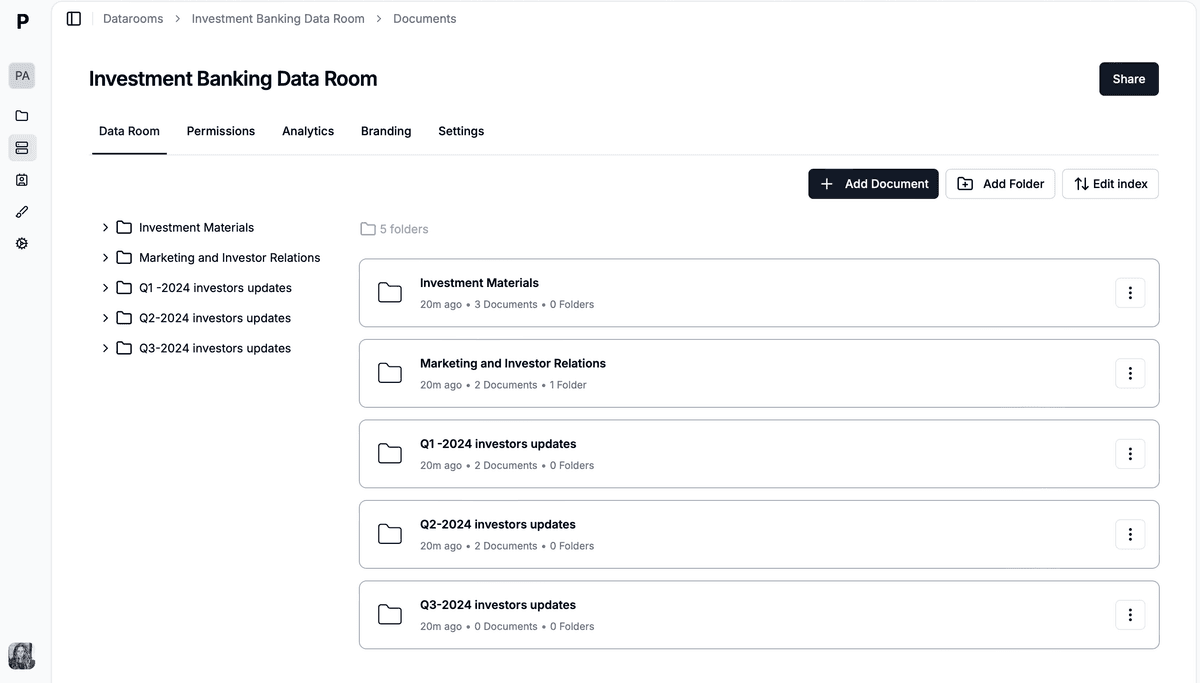
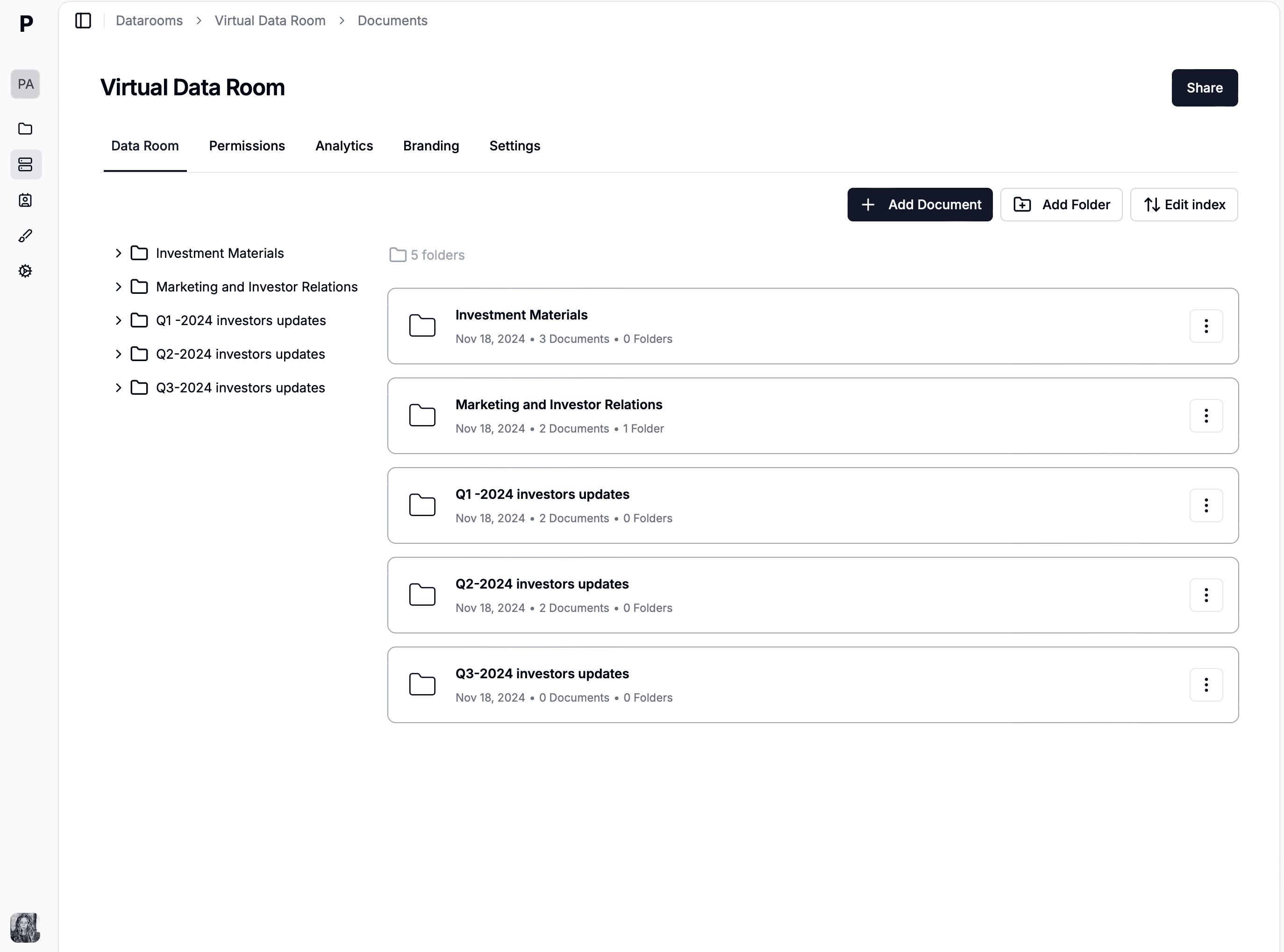
An investment banking data room organised by workstream, ready for CIM distribution and due diligence.
3. Modeling and presentation: Excel, PowerPoint, Macabacus, UpSlide, think-cell
Excel is still the core of investment banking software, and nothing in 2026 has displaced it. Every valuation, every LBO and every merger model is built in a workbook, because bankers need full control of the formulas and buyers expect to receive a model they can audit. The same goes for PowerPoint, which carries the pitch book, the teaser, the CIM and the management presentation.
What changes between banks is the add-in layer. Macabacus adds keyboard shortcuts, formula auditing and Excel-to-PowerPoint linking. UpSlide focuses on branded templates and keeping numbers in a deck linked to the model. think-cell is the standard for waterfall, Marimekko and football field charts. All three are per-user licenses, and most banks pick one or two rather than all three.
AI drafting tools now sit on top of this layer. Teams use them to draft first versions of CIM sections, summarise management interviews, or check a model for broken links. They speed up the first draft, but the numbers still come from the model and the banker still owns the document.
4. Market data: Capital IQ, FactSet, Bloomberg, PitchBook
Market data platforms supply the comparable companies, precedent transactions and buyer lists behind every valuation. S&P Capital IQ and FactSet are the most common in M&A advisory, Bloomberg is more common on capital markets desks, and PitchBook is strong on private companies, sponsors and venture-backed targets.
All four are sold per seat on annual contracts with quote-based pricing, and they are often the largest software line in a bank's budget. Smaller boutiques commonly hold one platform rather than two, and some share seats across a deal team. Grata and SourceScrub are used alongside them to build long lists of private, founder-owned companies that the big databases cover thinly.
The output of this layer flows into two places: the valuation model, and the buyer list in the CRM. That buyer list later becomes the list of data room invitations, which is why the CRM and the data room should be set up to share the same names.
5. CRM and pipeline: DealCloud, Affinity, Salesforce, 4Degrees
Deal management software for banks is usually a relationship CRM adapted to M&A. Intapp DealCloud is the most common at larger banks and private equity firms, Affinity uses relationship intelligence from email and calendars, Salesforce Financial Services Cloud is used by banks that already run Salesforce, and 4Degrees targets smaller teams. Pricing is per seat and quote-based for all four.
For a sell-side mandate, the CRM tracks the buyer universe and each buyer's stage: contacted, teaser sent, NDA signed, CIM received, IOI submitted, management meeting, LOI. Our CRM for private equity guide compares the main options in detail.
The CRM and the data room overlap at one point: knowing whether a buyer actually engaged. A CRM records that the CIM was sent. The data room records whether the buyer opened it, which pages they read and for how long. Bankers who connect the two get a far better read on which IOIs are real.
6. Virtual data rooms: Papermark, Datasite, Intralinks, iDeals, Firmex, DealRoom
The virtual data room is the layer of the investment banking software stack that outsiders touch. It holds the CIM, the financials, the contracts and the HR file while several bidders review them, and it records every view for the deal file. Bankers judge a VDR on four things: per-bidder permissions, security controls, the Q&A workflow, and how pricing scales across concurrent deals.
Datasite and Intralinks are the incumbents at bulge-bracket banks and on large auctions, both quote-based, with Datasite starting around $25,000+ per year and Intralinks ranging from about $4,000 to $25,000+ per year. iDeals and Firmex serve the mid-market on quotes (Firmex around $625/month). DealRoom combines a data room with M&A project management and starts at $25,000 per year on its own comparison page. Our best virtual data rooms for banking article compares them in depth, and the wider market is covered in best virtual data rooms.
#
Data room
Starting price
Pricing model
Best for
1
Papermark
$99/month
Flat, unlimited data rooms
Boutiques and mid-market banks running several mandates
2
Datasite
$25,000+/year
Quote, per project
Large advisor-led auctions
3
Intralinks
$4,000 to $25,000+/year
Quote
Banking and capital markets
4
iDeals
Quote
Quote
Mid-market M&A
5
Firmex
~$625/month
Quote
Mid-market, legal-led deals
6
DealRoom
$25,000/year
Annual platform fee
Corporate development teams
What bankers need from a VDR
A banker's requirements follow the process. Each bidder needs its own group and link so that bidders never see each other's folders or activity. Every link should require email verification and an NDA before anything opens. Sensitive folders need view-only access with a dynamic watermark showing the viewer's email, IP and time. Bidder questions need a Q&A channel where answers can go to one bidder privately or to all bidders at once. At signing, the room needs to be frozen into an archive.
Per-project vs flat pricing
Per-project pricing made sense when a bank ran a handful of large deals a year and passed the VDR cost to the client. It breaks for banks running several mandates at once, because every new mandate becomes a new quote and a new procurement step. A flat subscription with unlimited rooms turns the data room into fixed overhead. On Papermark, three mandates or ten cost the same subscription. Our virtual data room cost guide breaks down both models.
7. Deal execution and closing: DocuSign, Acrobat, Teams and Slack, trackers
The execution layer is where most of the day-to-day coordination happens. Bankers run workstream trackers in Excel or a project tool such as Asana or Monday, chat with the deal team in Teams or Slack, and keep version control on the purchase agreement in Word with the lawyers.
Request lists deserve a note. Buyers send diligence request lists of 200 to 500 items, and tracking them in a spreadsheet emailed back and forth is one of the most common sources of delay. Many teams now run the request list inside the data room, where each request links to the document that answers it.
Closing runs on e-signature. DocuSign and Adobe Acrobat Sign handle NDAs at the start of the process and the SPA at the end. The last step is freezing the data room into an archive, which on Papermark is available on Data Rooms Plus and above.
8. Bulge bracket vs boutique investment bank tech stack
A bulge-bracket bank and a five-banker boutique use the same categories of investment banking software, but the products and the budget differ sharply. The large bank has enterprise contracts for everything, an internal IT team, and clients who expect Datasite or Intralinks by name. The boutique needs each tool to earn its seat, because the software budget comes out of the partners' pockets.
Layer
Bulge bracket
Boutique pick
CRM
DealCloud or Salesforce FSC
Affinity, 4Degrees or DealCloud
Market data
Capital IQ, FactSet and Bloomberg
Capital IQ or PitchBook (one)
Modeling
Excel with internal templates
Excel with Macabacus
Presentations
PowerPoint with UpSlide or think-cell
PowerPoint with UpSlide
Virtual data room
Datasite or Intralinks per project
Papermark flat, unlimited rooms
Outreach
CRM plus email
Apollo and LinkedIn Sales Navigator
Project management
Internal tools
Asana or the data room request list
E-signature
DocuSign enterprise
DocuSign
Collaboration
Microsoft 365 with archiving
Microsoft 365 or Google Workspace
The boutique investment bank tech stack, layer by layer
A boutique running sell-side deals needs eight layers and should be ruthless about the price of each. CRM and buyer universe: DealCloud fits larger boutiques; Affinity or 4Degrees fit lean teams that want relationship data without a long implementation. Track NDAs and IOIs per buyer, not just contacts. Market data: one platform, usually Capital IQ or PitchBook, plus Grata for founder-owned targets. Modeling and presentations: Excel with Macabacus and PowerPoint with UpSlide.
Virtual data room: this is the layer where boutique economics differ most. Per-deal VDR pricing hurts a bank running 3 or more concurrent mandates, and passing a five-figure VDR fee to a lower-middle-market client is a hard conversation. Papermark's unlimited data rooms from $99/month let the boutique give each client a branded room on its own custom domain without a new contract. Keep Datasite or Intralinks as an option for the rare client that requires them.
Buyer outreach and NDA tracking: Apollo (about $59/month per user on monthly billing) and LinkedIn Sales Navigator Core (about $119.99/month) build the long list. NDA gating on the data room link, plus per-buyer analytics, replaces the NDA tracking spreadsheet. Project management and request lists: Asana or Monday, or the request list inside the data room. E-signature: DocuSign. Collaboration and compliance records: Microsoft 365 or Google Workspace, with an archiving tool if the boutique is a FINRA-registered broker-dealer, because FINRA Rule 4511 and SEC Rule 17a-4 require business communications to be preserved.
Pricing the stack: a four-banker boutique running six mandates
The table below is an illustrative estimate for a four-banker boutique running six sell-side mandates a year. Quote-based tools are shown as ranges reported by buyers, and the per-project VDR line assumes $15,000 per deal, which is at the lower end of what legacy providers quote for a mid-market process.
Line item
Assumption
Annual cost (estimate)
CRM
4 seats, lean CRM
$5,000 to $15,000
Market data
1 to 2 seats, one platform
$15,000 to $30,000
Excel and PowerPoint add-ins
4 users
$2,000 to $5,000
Outreach
2 Sales Navigator, 2 Apollo seats
About $4,300
Data room, per project
6 deals at $15,000
$90,000
Data room, Papermark flat
Data Rooms plan, unlimited rooms
$1,188
E-signature and Microsoft 365
4 users
$2,000 to $4,000
On these assumptions, the data room swings the total stack by more than any other line. Moving Q&A and the audit log in-house with Data Rooms Plus still keeps the data room in the low thousands per year rather than the tens of thousands.
9. How the tools connect: CRM to data room to e-signature
The investment banking software stack works best when each tool hands off cleanly to the next. The buyer list starts in the CRM. When a buyer signs the NDA, the banker creates that buyer's group and link in the data room. Engagement data from the data room, such as which pages of the CIM a buyer read, goes back to the coverage banker before the IOI call. At signing, documents move to DocuSign and the room is frozen.
Papermark supports that hand-off through a REST API and webhooks for view, download and open events, a built-in Slack integration for real-time notifications, and an MCP server and CLI for scripted room setup. There is no native HubSpot or DealCloud connector; teams sync engagement into a CRM with webhooks plus Zapier, Make or n8n. That is a realistic setup for a boutique: a new data room link per buyer in minutes, and a Slack alert when a bidder opens the financials folder.
A data room for investment banking has to handle several bidders, several stages of disclosure and several concurrent mandates at once. That is the layer where Papermark sits in the stack, and it is built so a banker can stand up a room for a new mandate the day the engagement letter is signed.
Papermark is a secure, fully customizable and developer-friendly data room for modern dealmakers. The steps below follow how a sell-side banker uses it from CIM to close.
Step 1: open one room per mandate
Create a data room for the mandate and drag in the folder tree: marketing materials, financials, legal, commercial, HR, tax. Unlimited data rooms on every plan mean a new mandate never triggers a new contract, and unlimited data room visitors mean you never count bidder seats.
Step 2: gate the CIM with an NDA
Send the CIM as a data room link with NDA gating and email verification, so the NDA is accepted before the first page loads and every acceptance is logged. Put the room on your bank's custom domain with your branding so bidders see your firm, not a vendor.
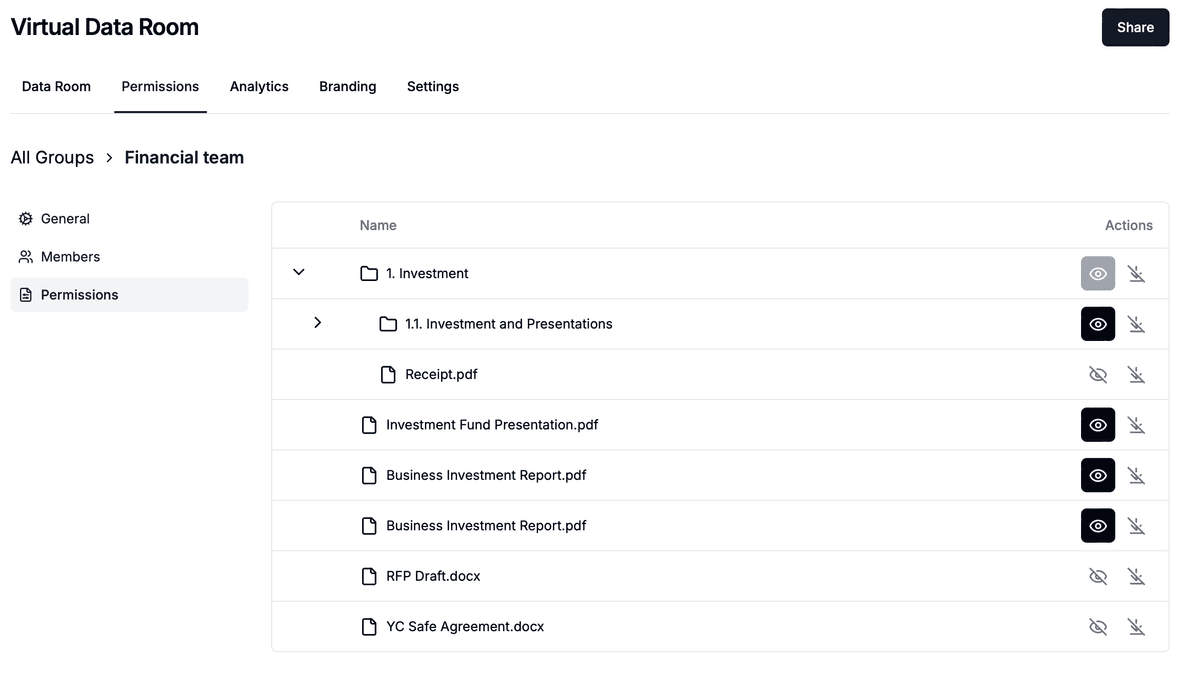
One permission group per bidder keeps every bidder's access and activity separate.
Step 3: create one group per bidder
Add each bidder as its own group with folder-level permissions. Stage-1 bidders see the CIM and summary financials; short-listed bidders get the full diligence folders. Moving a bidder to the next round means changing the group's access, not rebuilding the room.
Step 4: protect and track the sensitive folders
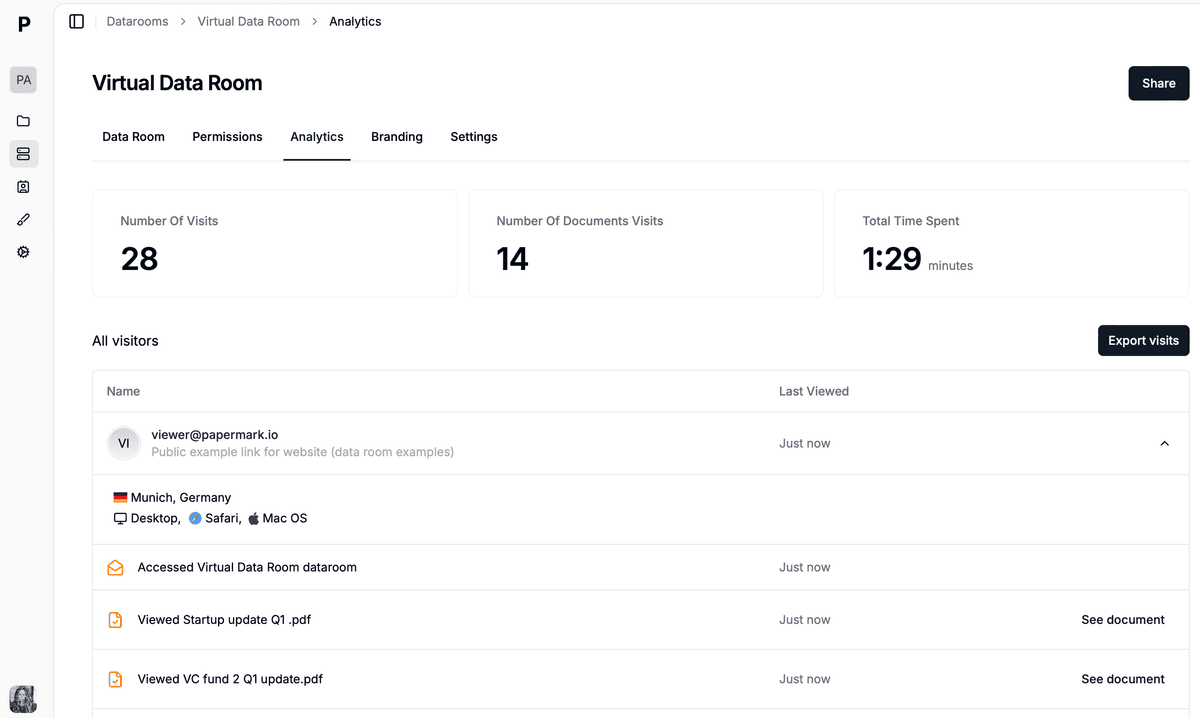
Switch customer contracts, payroll and pricing to view-only with dynamic watermarking showing the viewer's email, IP and time. Page-by-page analytics show which bidder read which pages and for how long, so you know which IOIs are backed by real work.
Per-bidder analytics show who is doing the work before the IOI arrives.
Step 5: run buyer Q&A and freeze at signing
On Data Rooms Plus, bidders submit questions privately inside the room, your team reviews before anything is published, and you answer one bidder privately or publish the answer to all as an FAQ. At signing, freeze the room into an archive for the deal record. Our guide to due diligence Q&A covers the full workflow.
Papermark is our #1 VDR provider for M&A transactions right now. In two deals we used custom branding, dynamic watermarking, and granular permissions.
The Data Rooms plan is $99/month with a 7-day free trial and includes 3 team members, unlimited data rooms, unlimited data room visitors, unlimited documents, a custom domain, dynamic watermarking, NDA agreements and granular file-level permissions. Data Rooms Plus adds 5 team members, the Q&A module, the audit log and data room freeze. Premium adds AI redaction and SSO. There are no per-page or per-project fees.