
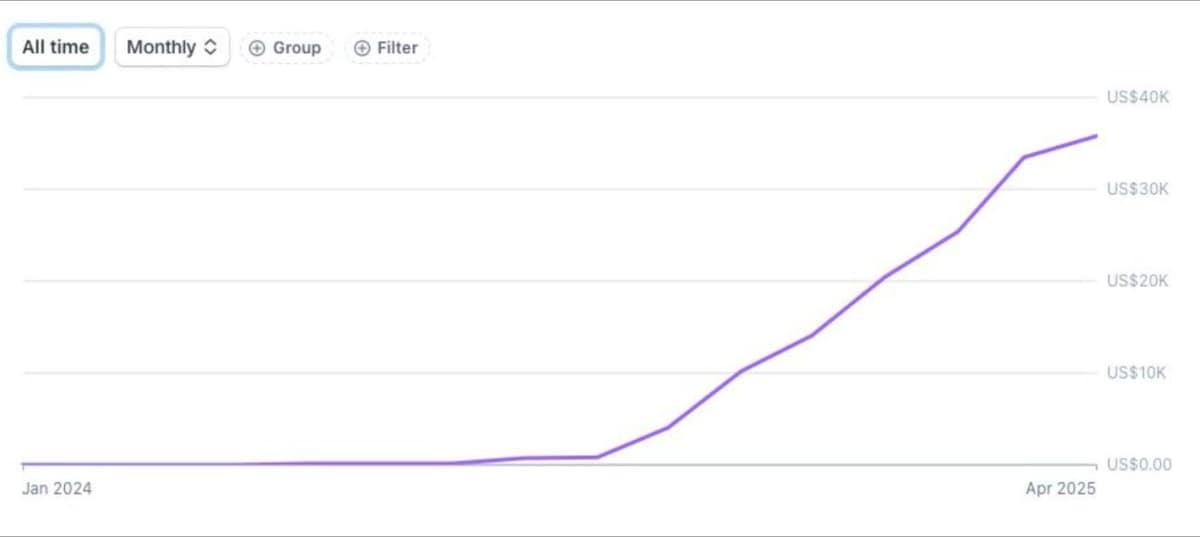
We just crossed $500k ARR for Papermark.
At the start of the year we set ourselves a public goal: grow Papermark to $1M ARR in 2025. Three months in, we are halfway there.
Half a million is a number we did not dare to say out loud a year ago. We are still two founders, still fully bootstrapped, and still replying to every support request ourselves. What changed is what people use Papermark for.
1. Data rooms became the reason people pay
More and more customers moved from sharing single documents to running whole deals in Papermark data rooms. A founder raising a round, an advisor running a sale process, a team going through due diligence: they all need many files, many viewers and clear rules about who sees what.
That is where a secure, modern data room makes the difference, and it is where most of our new revenue comes from.
In practice, that means folders for each part of the deal, file-level permissions for each party, an NDA before access, watermarks on every page and page-by-page analytics. All of it is self-serve, without a sales call.
2. What we shipped this quarter
New features for deal teams. Webhooks and in-document Q&A for data rooms both shipped this spring, and file requests are next. See the changelog.
Around them, the first quarter of 2025 brought, step by step:
February
- Custom fields on the access screen: ask visitors for their company, role or anything else before they enter, and see the answers in your analytics.
- A new data room admin layout, with content, permissions, analytics, branding and settings each in their own place.
- Video file support, with a built-in player and analytics for every view.
March
- An automatic index file for data rooms: a list of every file in the room, so large rooms stay easy to navigate.
- Global branding across links and rooms, with the option to change it for a single data room.
- A simpler way to add team members, so colleagues can help manage documents and rooms.
- Moving folders inside a data room with drag and drop.
- New webhook triggers for links and documents, so your own tools can react when something is created.
April
- Q&A conversations, so viewers can ask questions next to the document and you can answer from your dashboard.
Each of these came from a customer asking for it.
Taken together, these releases change what a data room is for. It is no longer just a folder with a link. You can see who a visitor is before they enter, hand them a clear index of the room, answer their questions in one place and connect it all to the tools you already use.
3. The channels that got us here
We shared our full growth story on Indie Hackers. In short:
- The first customers came from people we knew, near-daily posts on X, Product Hunt launches, Reddit and Dev.to.
- From there, SEO took over. Comparison pages like Papermark vs DocSend reach people who are already looking for a better tool, and they convert well.
- Building in public keeps bringing new users every month, and keeps us accountable to the goal.
Being open source helped too. It brought early trust and links from developers, which made our SEO work much stronger later.
4. What we learned
Focus on the use case that pays. Data rooms for fundraising, M&A and due diligence are where customers feel the most pain, so that is where we put most of our time.
Speed still matters most. We ship small improvements every week, and a data room should be ready to share in minutes, not days.
And channels compound. A launch or a post brings a few users. A good comparison page keeps bringing the right people every month, long after we wrote it.
5. How we found our first customers, then grew with search, step by step
This is the process we described on Indie Hackers, in the order we did it.
- Start with people you know. Our first customers came from people we knew. It is the smallest step, and every other step builds on it.
- Post on X almost every day. Short updates on what we built and what we learned. This is where building in public started for us.
- Launch on Product Hunt. Papermark became #1 Product of the Day in September 2023, and Papermark AI followed in December as #2.
- Share in communities. We posted on Reddit and Dev.to, where developers and founders were already talking about document sharing.
- Write pages for people who are already searching. Comparison pages like Papermark vs DocSend and DocSend alternatives answer a question someone has right before they switch tools.
- Keep sharing the numbers. Monthly updates bring new users and keep the goal in front of us.
Each step built on the one before. The early launches and posts brought the first links and the first users. Those links made our search pages stronger, and search now brings people who already need a data room.
6. How to set up a data room for your deal
Everything above is live today. This is how a deal team can put it to work.
- Create a data room from the welcome screen. See how to create a data room.
- Build your folders and upload files. Move folders around until the structure matches your deal.
- Turn on the index file so every visitor gets a clear list of what is inside. See automatic file indexing.
- Set permissions by group. Investors, buyers and advisors each see only their files. See groups and granular permissions.
- Set up the access screen. Require email verification, add custom fields and ask for an NDA before access.
- Enable Q&A so questions stay next to the documents. See Q&A conversations.
- Share the link and follow every view, page by page.
7. What's next
The second $500k. We will keep building for deal teams, keep publishing what works, and keep sharing our numbers in public.
If you are preparing a fundraise or a deal, see our plans and pricing or start a data room in a few minutes.