14 Best Business Brokers in Philadelphia: Fees and Deal Sizes 2026
·12 min read
Marc Seitz
This guide lists 14 business brokers in Philadelphia, from Main Street intermediaries who sell HVAC shops and restaurants to Conshohocken investment banks running auctions for companies worth tens of millions. Every firm is real, sits in or around the metro, and links to its own site.
Philadelphia is an unusual market to sell into because the metro does not stop at the city line. Buyers and brokers treat Bucks, Chester, Delaware and Montgomery counties, plus South Jersey and northern Delaware, as one deal market. A machine shop in Warminster and a Center City staffing firm often face the same short list of acquirers.
The regional economy leans on healthcare and life sciences, specialty manufacturing, professional and IT services, food distribution and the construction trades. Hospital systems, pharma along the Route 202 corridor and a dense base of family-owned industrial suppliers mean plenty of strategic buyers already live here, and a local strategic usually pays more than a generalist search fund.
Comparing more than one metro? The M&A advisors database holds every firm we have researched and opens filtered to Philadelphia, so you can line these 14 up against each other on deal size and sector.
Quick list of business brokers in Philadelphia
Fairmount Partners: West Conshohocken bank running middle market sell-side mandates.
Delancey Street Partners: Conshohocken bank advising founder-led companies on sales.
Mufson Howe Hunter & Company: Philadelphia bank covering business services and manufacturing.
Falcon Capital Partners: Radnor firm known nationally for healthcare services and health IT deals.
Griffin Financial Group: Stevens and Lee affiliate, strong in banks, insurance and industrials.
Marks Baughan: Conshohocken technology bank focused on legal and compliance software.
The Bridlebrook Group: Broomall intermediary with CBI and M&AMI credentials in house.
Sunbelt Network of Pennsylvania: Blue Bell office covering suburban Main Street sales.
Transworld of Center City Philadelphia: Franchise-backed brokerage handling franchise resales.
Inbar Group: Center City brokerage serving eastern Pennsylvania sellers.
CrossRoads Business Brokers: Lower middle market advisory with IBBA award recognition.
Murphy Business ChesMont: Chester and Montgomery county office with appraisal work in house.
Aria Business Advisors: Chestnut Street brokerage selling small and middle market companies.
First Choice Suburban Philadelphia: Plymouth Meeting office covering five counties.
How to get yes from business brokers in Philadelphia
Good brokers turn down more sellers than they sign. A Delaware Valley intermediary who closes six or eight deals a year cannot spend nine months on a company with unreconstructed books, so the screening happens before the engagement letter, not after.
What earns a yes is boring preparation. Three years of accrual-basis financials that tie to your tax returns, a written schedule of owner add-backs with receipts behind each one, a customer list with no single account above roughly 20 percent of revenue, and a clean corporate record. Brokers read customer concentration first because it is the fastest way for a buyer to renegotiate price later.
Brokers also notice how you hand over information. A zipped folder of PDFs tells them you will do the same thing with buyers, which is how confidential financials reach a competitor. Sharing the same material as a permissioned link you can revoke gives you a record of who opened what. Our comparison of the best virtual data rooms covers what matters once the process starts.
Have this ready before the first call:
Three years of profit and loss statements plus year-to-date
Federal tax returns matching those statements
An add-back schedule with documentation for each item
A customer revenue breakdown showing concentration
Property lease, equipment leases and key contracts
An organisation chart showing who runs the business without you
No credit card required.
Papermark is our #1 VDR provider for M&A transactions right now. In two deals we used custom branding, dynamic watermarking, and granular permissions.
Philadelphia has no shortage of people who will list your business. The work is separating intermediaries who run a real process from those who post a teaser and wait. Deal-size fit does most of the filtering, because a firm that sells $600,000 landscaping companies has no buyer list for a $12 million contract manufacturer.
IBBA or M&A Source membership: Both publish standards of practice and run continuing education.
CBI or M&AMI credential: Ask which individual holds it, not just whether the firm claims it.
Pennsylvania Business Brokers Association: The state body whose members co-broker with each other.
Deal-size band: Ask for the smallest and largest deal closed in two years.
Sector specialisation: Healthcare, industrial manufacturing and IT services each have their own buyer universe here.
Fee structure in writing: Retainer, success fee formula, minimum fee and tail period on one page.
Local buyer network: Ask how many buyers sit within 50 miles. Regional strategics are why you hire local.
FINRA registration: Matters when the sale is structured as a stock sale rather than an asset sale.
References from closed deals: Ask for two sellers who closed and one whose deal collapsed.
Realistic timeline: A credible broker says six to twelve months, not sixty days.
How to approach business brokers in Philadelphia
Treat the first round as a two-way interview. You are testing whether the firm can reach the buyers who would pay most, and they are testing whether you are ready. Approaching several firms at once is normal, and nothing you send before an engagement letter should name your customers.
Start with a blind summary: industry, revenue band, earnings band and county, with no company name.
Ask for a written opinion of value before signing, including the comparables behind the range.
Interview at least three firms, including one Main Street brokerage and one lower middle market bank.
Ask who actually runs your deal, since the person pitching rarely manages the buyer calls.
Compare marketing plans, not commission rates: how many buyers get contacted and how many are strategics.
Check the tail clause: twelve to twenty-four months is normal, but the buyer list should be finite.
Agree how buyer information is shared, including NDA gating, watermarking and access control.
Get the exclusivity term in writing: six to twelve months, with a clean exit if nothing happens.
#
Firm
Typical deal size
Focus sectors
1
Fairmount Partners
Middle market
Healthcare, industrials, technology, consumer
2
Delancey Street Partners
Middle market
Business services, healthcare, industrial
3
Mufson Howe Hunter
Middle market
Business services, consumer, manufacturing
4
Falcon Capital Partners
Lower middle market and up
Healthcare services, health IT, technology
5
Griffin Financial Group
Middle market
Banks, insurance, industrials, retail
6
Marks Baughan
Growth and middle market
Legal and compliance software
7
The Bridlebrook Group
Main Street to lower middle market
Profitable privately held companies
8
Sunbelt Network of Pennsylvania
Main Street
Service, retail, distribution
9
Transworld of Center City Philadelphia
Main Street
Independent businesses, franchise resales
10
Inbar Group
Main Street to lower middle market
Manufacturing, distribution, services
11
CrossRoads Business Brokers
$1M to $100M in sales
Healthcare, home services, manufacturing
12
Murphy Business ChesMont
Main Street to lower middle market
Services, retail, light industrial
13
Aria Business Advisors
Small and middle market
Generalist across the metro
14
First Choice Suburban Philadelphia
Main Street
Generalist and franchise sales
1. Fairmount Partners
Fairmount Partners is one of the larger independent investment banks in the Mid-Atlantic and works exclusively with middle market and emerging growth companies. It runs sell-side M&A, private placements, fairness opinions and valuations from West Conshohocken.
Deal size: Middle market sell-side and capital raises
Sectors: Healthcare, life sciences, industrials, consumer, business services
Notable: Registered broker-dealer; more than 320 completed transactions
2. Delancey Street Partners
Founded in 2012, Delancey Street Partners advises chief executives, entrepreneurs and boards of high-growth middle market companies. It handles sell-side and buy-side M&A, growth capital and recapitalisations, and is a common choice for founder-led businesses wanting a competitive process.
Deal size: Middle market M&A and growth capital
Sectors: Business services, technology, healthcare, industrials, infrastructure
Mufson Howe Hunter has advised middle market companies from Philadelphia since 2004, with senior bankers who each carry decades of transaction experience. Founder Michael Mufson previously built a Philadelphia bank that Janney Montgomery Scott acquired.
Deal size: Middle market M&A and capital placement
Sectors: Business services, consumer and retail, life science tools, manufacturing
Notable: Founded 2004; affiliate is a FINRA and SIPC member
4. Falcon Capital Partners
Falcon Capital Partners was founded in 2000 and has built a national reputation in healthcare services and health information technology, including revenue cycle management. It provides sell-side M&A, strategic advisory and capital financing.
Deal size: Lower middle market through middle market
Sectors: Healthcare services, health IT, technology, commercial and industrial
Notable: Founded 2000; publishes healthcare and HCIT sector reports
5. Griffin Financial Group
Established in 1996, Griffin Financial Group sits inside the Stevens and Lee platform, which pairs the bank with affiliated legal, insurance and advisory firms. It handles M&A, financing and strategic consulting for healthy and distressed businesses alike.
Deal size: Middle market M&A, financing and restructuring
Sectors: Banks and insurance, industrials, business services, retail, real estate
Location: Reading, PA, serving the Philadelphia region
Notable: Founded 1996; part of The Stevens and Lee Companies
6. Marks Baughan
Marks Baughan is a Conshohocken technology bank founded in 2004 that advises growth companies in software and technology services, concentrated in the legal and compliance sector. A London office widens the buyer pool for software sellers.
Deal size: Growth and middle market technology transactions
Sectors: Legal and compliance technology, software, technology services
Notable: Founded 2004; offices in Conshohocken and London
7. The Bridlebrook Group
The Bridlebrook Group has represented Delaware Valley owners since 2003 and is selective, favouring well-run and profitable firms. Its managing partners combine legal and brokerage backgrounds across confidential sales, valuation and seller representation.
Deal size: Main Street through lower middle market
Sectors: Generalist across profitable privately held companies
Notable: Founded 2003; partner holds CBI and M&AMI, member of IBBA, M&A Source and PBBA
8. Sunbelt Network of Pennsylvania
The Blue Bell office is the Pennsylvania arm of Sunbelt, one of the largest brokerage networks in the world. It works mainly with suburban Philadelphia Main Street sellers and can co-broker into Sunbelt's national buyer base.
Deal size: Main Street businesses
Sectors: Service, retail, distribution and light manufacturing
Notable: President Steven A. Rosen is an attorney and Certified Business Intermediary
9. Transworld Business Advisors of Center City Philadelphia
Transworld combines conventional brokerage with franchise resale and development, so the Center City team sees both independent operators and franchisees looking to exit. A Philadelphia listing also reaches buyers registered with offices in other states.
Deal size: Main Street businesses and franchise resales
Sectors: Independent small businesses, franchise resales, service businesses
Notable: Part of a network with more than 250 offices globally
10. Inbar Group
Inbar Group runs its Pennsylvania practice from Two Liberty Place in Center City and covers the eastern half of the state, from Allentown to Lancaster. It suits an owner who wants a broker physically in the city.
Deal size: Main Street through lower middle market
Sectors: Manufacturing, distribution, services, hospitality and retail
Notable: Philadelphia office at 50 South 16th Street
11. CrossRoads Business Brokers
CrossRoads works the lower middle market, describing its clients as companies with $1 million to $100 million in sales, and avoids the restaurant and small retail end. It charges nothing until closing, which is unusual at that deal size.
Deal size: Companies with $1M to $100M in sales
Sectors: Healthcare, senior care, manufacturing, HVAC, B2B services
Notable: IBBA Platinum Chairman's Circle Award and M&A Source Platinum Club Award in 2021
12. Murphy Business ChesMont
The ChesMont office covers Chester and Montgomery counties for Murphy Business, one of the larger North American brokerage networks. It also offers valuation and machinery and equipment appraisal, useful if your shop carries capital equipment.
Deal size: Main Street through lower middle market
Notable: Network appraisers work to USPAP standards
13. Aria Business Advisors
Aria works with owners of small and middle market businesses from an office on Chestnut Street, covering Center City, West Chester and the Montgomery, Bucks and Delaware county suburbs. The practice combines valuation, buyer outreach and deal execution.
14. First Choice Business Brokers Suburban Philadelphia
The Plymouth Meeting office serves Bucks, Chester, Delaware, Montgomery and Philadelphia counties as part of a national network operating since 1994. Services run from opinion of value through buyer vetting and transaction management.
Deal size: Main Street businesses
Sectors: Generalist, franchise resales and small business sales
Notable: Network operating since 1994; IBBA and International Franchise Association member
Why you need secure document sharing in a Philadelphia sale
A broker-run sale in Philadelphia means contacting a few dozen to a few hundred buyers, and only a handful will ever be serious. Diligence pulls three years of returns and an add-back schedule, hospital system and pharma supply agreements, quality records and tooling schedules for a machine shop, route and customer contracts for a food distributor, staffing and IT services master agreements with rate cards, payroll, plus leases across the city and the four suburban counties.
The parties asking for those files are frequently competitors sitting a township away. Buyers and brokers treat Bucks, Chester, Delaware and Montgomery counties plus South Jersey and northern Delaware as one deal market, so the strategic acquirer for a Warminster machine shop is usually another Delaware Valley shop quoting the same jobs, and the buyer for a Center City staffing firm is a competitor bidding for the same hospital system contracts. Rate cards, tooling lists and named customers are exactly what those parties want, and most of them will never make an offer.
A leak costs you skilled people and contracts in a market this networked. Machinists, project managers and senior recruiters are scarce across the Delaware Valley, and once word reaches them they take the call from the firm one exit up the Blue Route. Hospital systems and pharma procurement teams along the Route 202 corridor put approvals on hold while ownership is uncertain, referral partners hedge, and a landlord or franchisor who hears it before you tell them has leverage in the consent you will need at closing. Email attachments cannot be recalled, cannot be watermarked, and tell you nothing about who actually opened them.
Data room for Philadelphia M&A
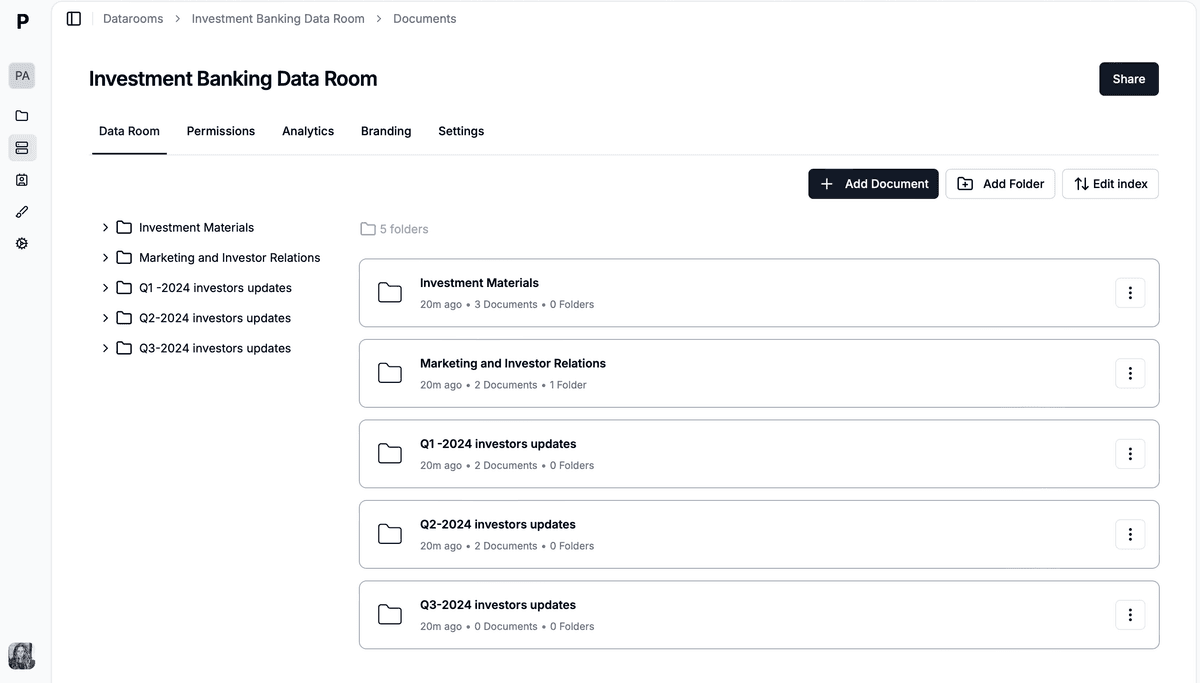
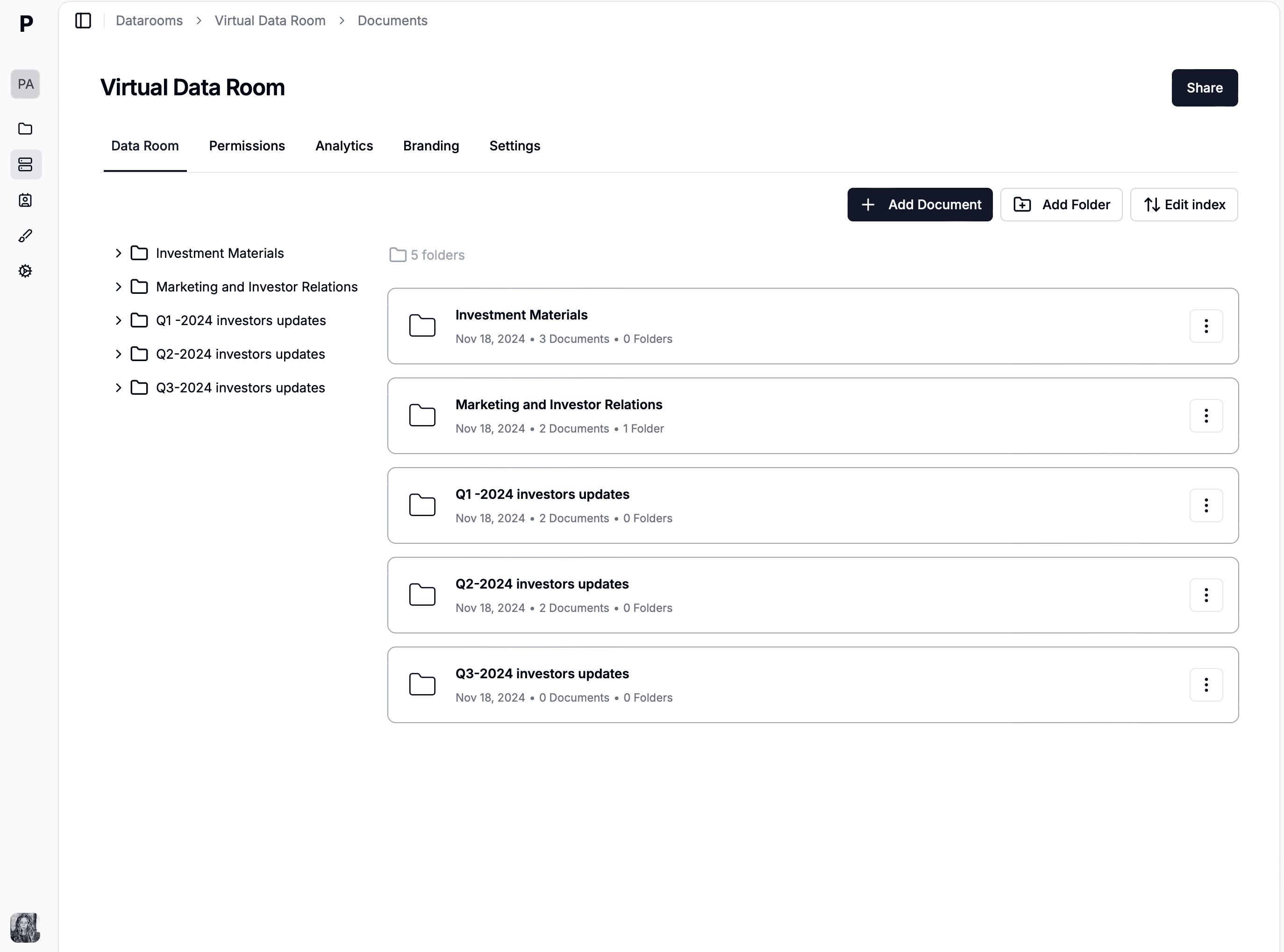
Deal documents organised in a Papermark data room, with NDA gating and per-file permissions before buyers get access.
A data room for Philadelphia M&A is the permissioned workspace that lets a broker keep a wide outreach list across the city, the suburban counties and South Jersey without handing your financials to a competitor. Papermark is a secure, fully customizable, and developer-friendly data room for modern dealmakers, and a secure data room is what keeps the sensitive parts of the file locked while the process runs.
The sequence is simple. The teaser goes out with no company name. Buyers who respond sign an NDA before the confidential information memorandum unlocks, and you can require that acceptance inside the link itself instead of chasing signatures by email. Once the CIM is released, dynamic watermarking stamps each viewer's email address across every page, so a leaked file traces back to whoever leaked it. Granular file-level permissions let you stage the release, keeping customer names and payroll closed until a letter of intent is signed.
The analytics change how a broker works. Page-by-page tracking shows who opened the CIM, how long they spent on the financials and whether they returned. A buyer who spends eleven minutes on the customer concentration page behaves very differently from one who skimmed four pages once. The audit log records every view, download and permission change. You can set this up in a Papermark data room before the first buyer call.
The Data Rooms plan is €149/month, or €99/month billed annually, with a 7-day free trial, and includes 3 team members, unlimited data rooms, unlimited documents, a custom domain, dynamic watermarking, NDA agreements, and granular file-level permissions.
Why Papermark as a data room provider for Philadelphia M&A
Most virtual data rooms were built for bankers and priced for them. Papermark is a secure data room for modern dealmakers, and it is more customizable and more branded than any other VDR on the market.
Security first. SOC 2 Type II, granular file-level permissions, dynamic watermarking on every page, and NDA agreements that sit on the link itself.
Open source and self-hostable. The codebase is public, and Enterprise can run it in your own environment, which matters when a buyer's IT team asks where the documents actually live.
Branded and white-labelled. Custom domain and full white-labelling, so the room carries your firm's name rather than a vendor's.
AI and MCP. 57 typed MCP tools over the Model Context Protocol let Claude, Cursor, ChatGPT or your own code drive the room, plus a REST API for everything else.
Chat with your data room. Papermark AI answers questions across the room and the documents in it, so you are not scrolling a folder tree to find one clause.
Built for Philadelphia deals. Permissions are set per file, so the sensitive parts of the file can stay locked to final bidders while the general file stays open.
Did not find the right business broker in Philadelphia?
If none of these firms fits your size or sector, the other route is approaching buyers directly. Plenty of Delaware Valley companies sell to a regional strategic or a search fund that already knew the owner, with a lawyer running the paperwork.
If none of the fourteen above fits, the M&A advisors database lists every firm we have researched by city and by industry, with deal sizes and sectors side by side. Filter to Philadelphia to compare these against each other, or widen to a nearby metro if the local bench is thin.