BlogData RoomsBest virtual data rooms for banking transactions in 2026: 8 picks
Best virtual data rooms for banking transactions in 2026: 8 picks
·6 min read
Marc Seitz
The best virtual data room for banking transactions in 2026 is Papermark, a secure, fully customizable, and developer-friendly data room for modern dealmakers, with page-level analytics, dynamic watermarking, unlimited data room visitors, and transparent pricing from €99/month (open-source and self-hosting available). This guide compares 8 rooms used when a bank, an arranger, or a borrower has to show a credit file, a CIM, or a facility agreement to several parties at once.
A banking transaction is a permissions problem before it is a storage problem. The coverage officer, the credit committee, lender counsel, and the borrower should not all open the same folder.
Intralinks - custom quote, about $10,000 to $200,000+ per year. Virtual data room used on investment banking and regulated transactions.
Datasite - custom quote, commonly from $25,000/year. Enterprise virtual data room for large M&A and cross-border banking transactions.
DFIN Venue - custom quote, about $5,000 to $25,000 per transaction. Capital-markets data room used on IPOs and SEC-regulated deals.
iDeals - custom quote, commonly from about $500/month, with a 30-day trial. Mid-market virtual data room with fence view and a Q&A module.
Firmex - custom quote, with reported entry rates around $625 to $995/month. Virtual data room used by advisory firms running several deals at once.
Ansarada - quote only. Virtual data room for deal readiness, historically priced from about $479/month on storage tiers.
SecureDocs - from $450/month. Subscription virtual data room for smaller banking transactions.
No credit card required.
What a virtual data room has to do on a banking transaction
A banking transaction moves in stages, and each stage has a different audience. A sell-side mandate starts with a teaser, then a CIM, then a short list that sees contracts and the model. A debt deal starts with a teaser for lenders, then a credit file, then a facility agreement and a security package for the banks that are still in. An IPO file sits with underwriters and counsel for months. The room has to carry all three shapes without emailing a zip file.
Self-serve banking transactions and mid-market deals
2
Intralinks
$10,000-$200,000+/year
Quote only
Not published
Investment banking and regulated transactions
3
Datasite
From $25,000/year
Quote, often per page
4.5/5 (260+)
Large and cross-border M&A
4
DFIN Venue
$5,000-$25,000/deal
Quote per transaction
4.4/5 G2
IPOs and capital-markets deals
5
iDeals
From about $500/month
Quote, 30-day trial
Not published
Mid-market diligence with Q&A
6
Firmex
About $625-$995/month
Quote, subscription or per deal
Not published
Advisory firms with concurrent deals
7
Ansarada
Quote only
Quote, storage-tiered
Not published
Deal readiness and structured Q&A
8
SecureDocs
From $450/month
Published subscription
Not published
Smaller banking transactions
Review scores appear only where a public G2 rating exists with a review count, or, for DFIN Venue, the score the vendor's comparison pages cite. A blank public review base is reported as "Not published".
Four transaction types show up in the same week at a mid-market bank. They do not share one folder structure.
Transaction
Who is in the room
What must stay split
Sell-side M&A
Bidders, bidder counsel, the bank
Stage-1 CIM vs full contracts and the model
Acquisition facility
Arranger, syndicate, both counsel
Credit memo vs borrower customer list
IPO / capital markets
Underwriters, issuer counsel, auditors
Draft S-1 vs workpapers
Regulatory exam
Internal audit, examiners, compliance
Exam request list vs unrelated client files
Build your data room in minutes
No credit card required
Page by page analytics
Unlimited documents & folders
Custom domain & branding
Dynamic watermarks
Granular permissions
NDA & agreements
Activity notifications
SOC 2 & ISO 27001 certified
1. Papermark: virtual data room for banking transactions
Papermark is a secure, fully customizable, and developer-friendly data room for modern dealmakers. Banking teams use it when a transaction has to open the same week counsel asks, without a per-deal quote. Unlimited data room visitors are on every plan. A public API, CLI, and MCP server lets a deal team create rooms, set group permissions, and pull engagement data from a script. Open-source and self-hosting are available when the files have to stay in the bank's own environment.
Papermark is rated 4.9/5 on G2 across 171 reviews. It is used by 70,000+ teams.
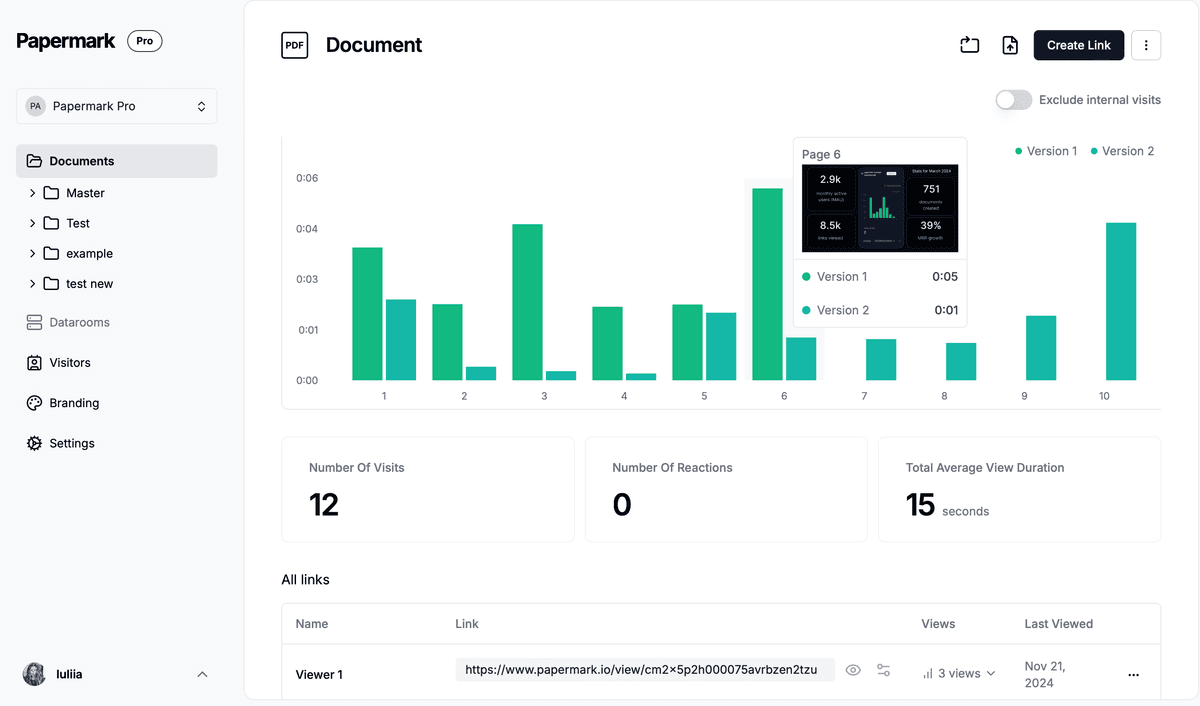
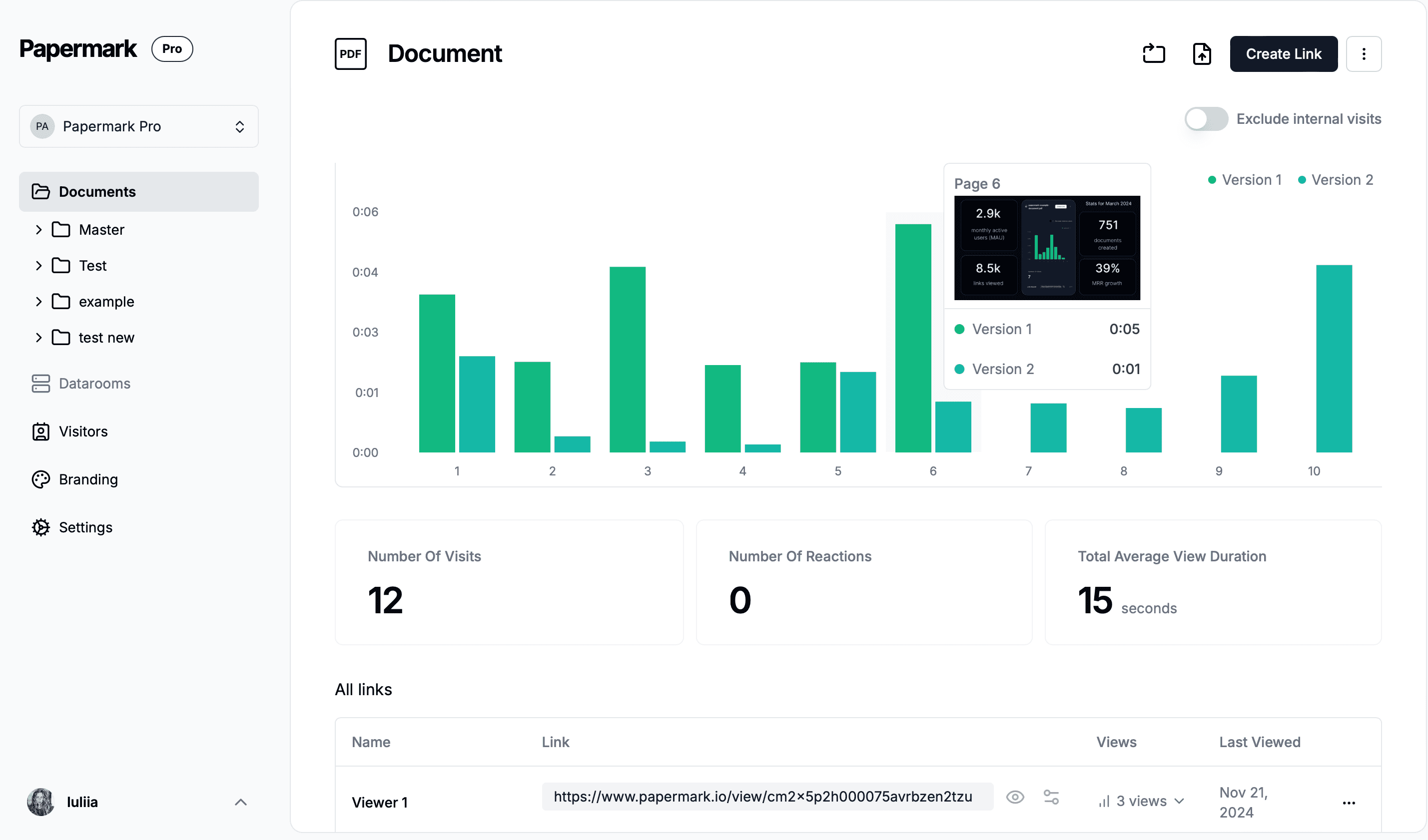
Page-by-page analytics on the transaction
Page-by-page analytics show which lender or bidder read which page.
Page-by-page analytics show which party opened the credit memo, which page they stayed on, and whether a link was forwarded. On a syndicate, that replaces "the bank downloaded the file." The arranger can see which lender read the leverage covenant and which stopped at the cover.
Security for a live credit file
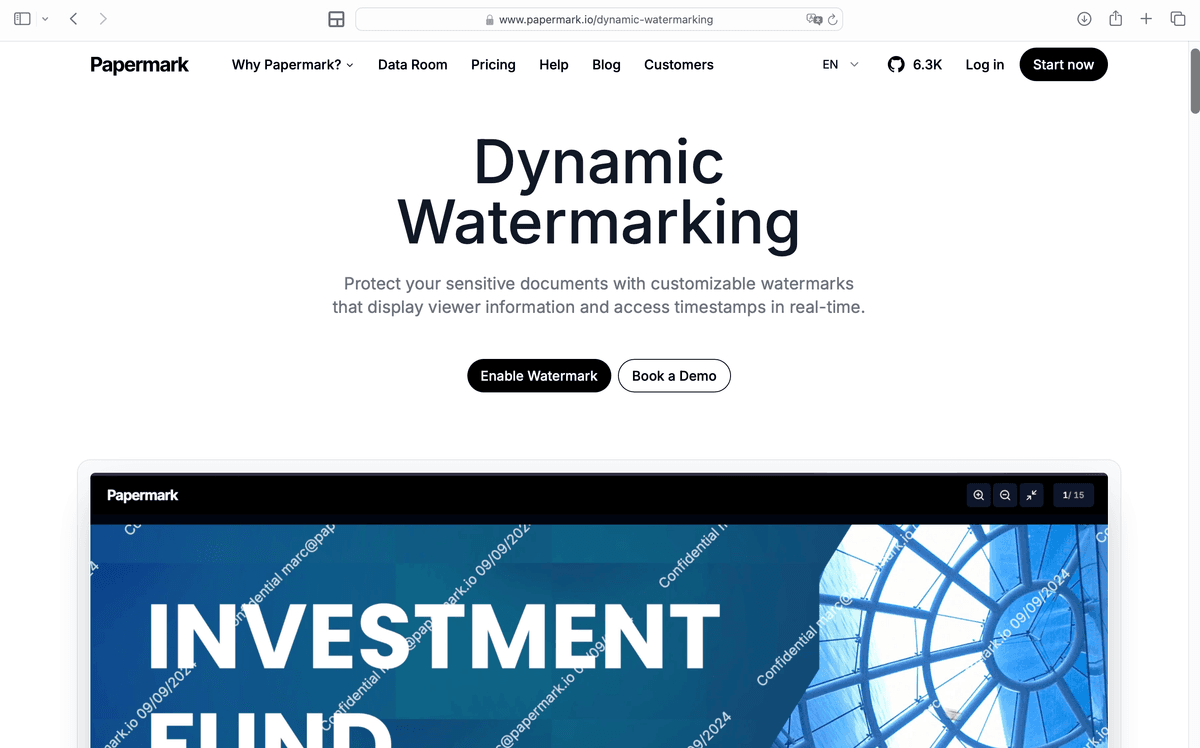
Dynamic watermarking stamps the viewer's email and the time on every page.
Dynamic watermarking prints the viewer's email, IP, and timestamp on each page. Granular permissions keep the borrower customer list and payroll out of a Stage-1 or early-lender group. A one-click NDA sits on the link, so a forwarded URL does not open the room by itself. Files are AES-256 encrypted at rest and TLS-encrypted in transit. Papermark is ISO 27001 certified and SOC 2 Type II audited from Data Rooms Plus (€249/month). AI redaction of names, account numbers, and pricing is on Data Rooms Premium (€549/month) and Data Rooms Unlimited (€999/month) only. It is not on the €99 or €249 tier.
Branding so the room looks like the bank
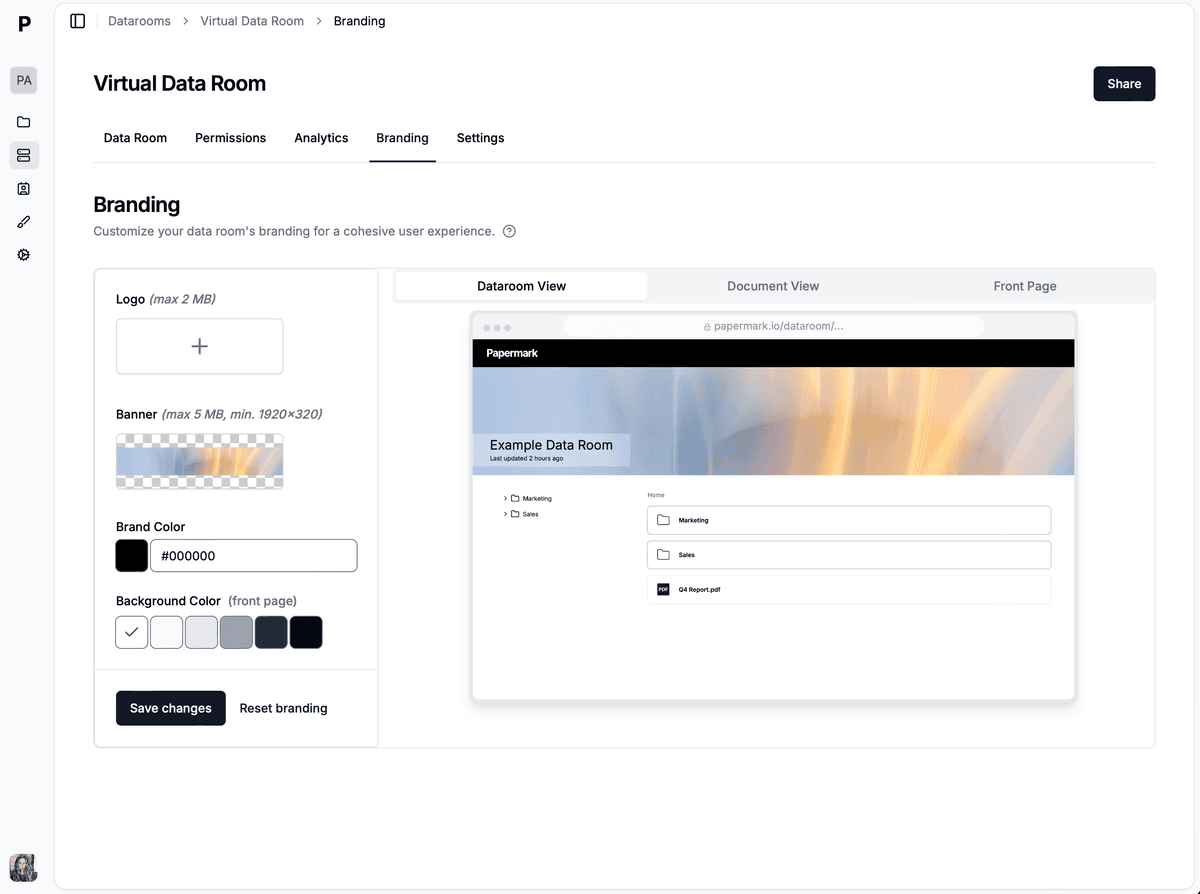
Custom branding so lenders see the bank's name, not a vendor's.
Each transaction can run on a custom domain with the bank's logo, colors, and layout. Custom domains for data rooms are included from the €99/month Data Rooms plan. White-label layouts that remove Papermark branding are on Data Rooms Premium.
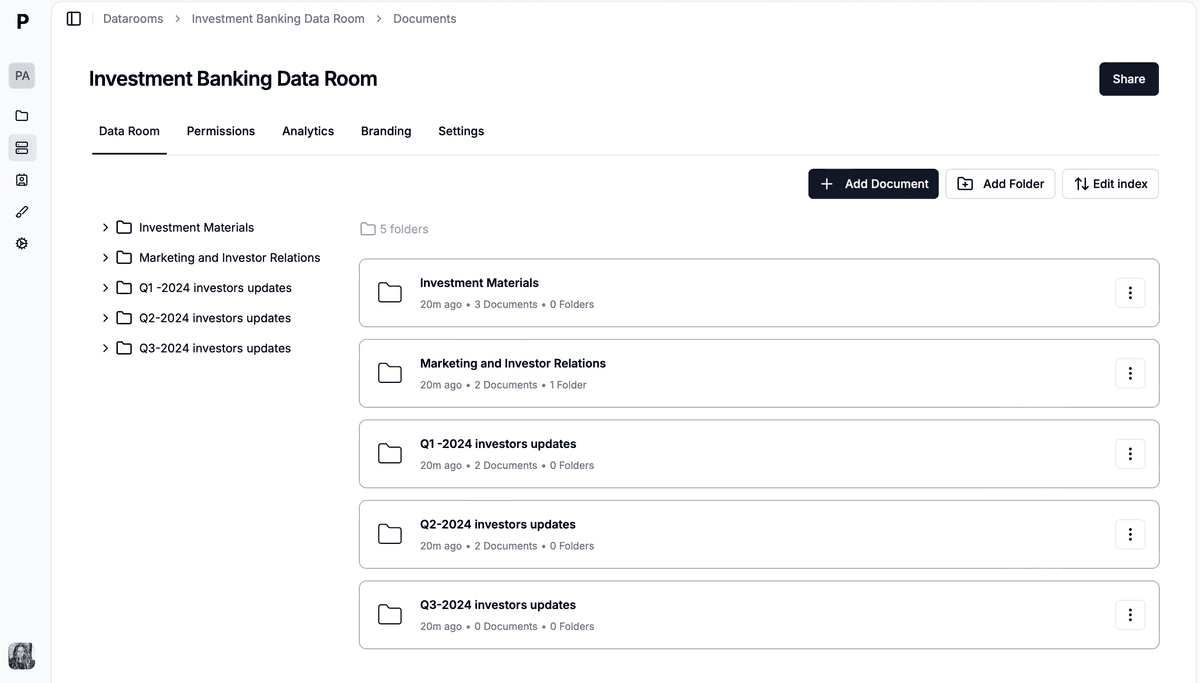
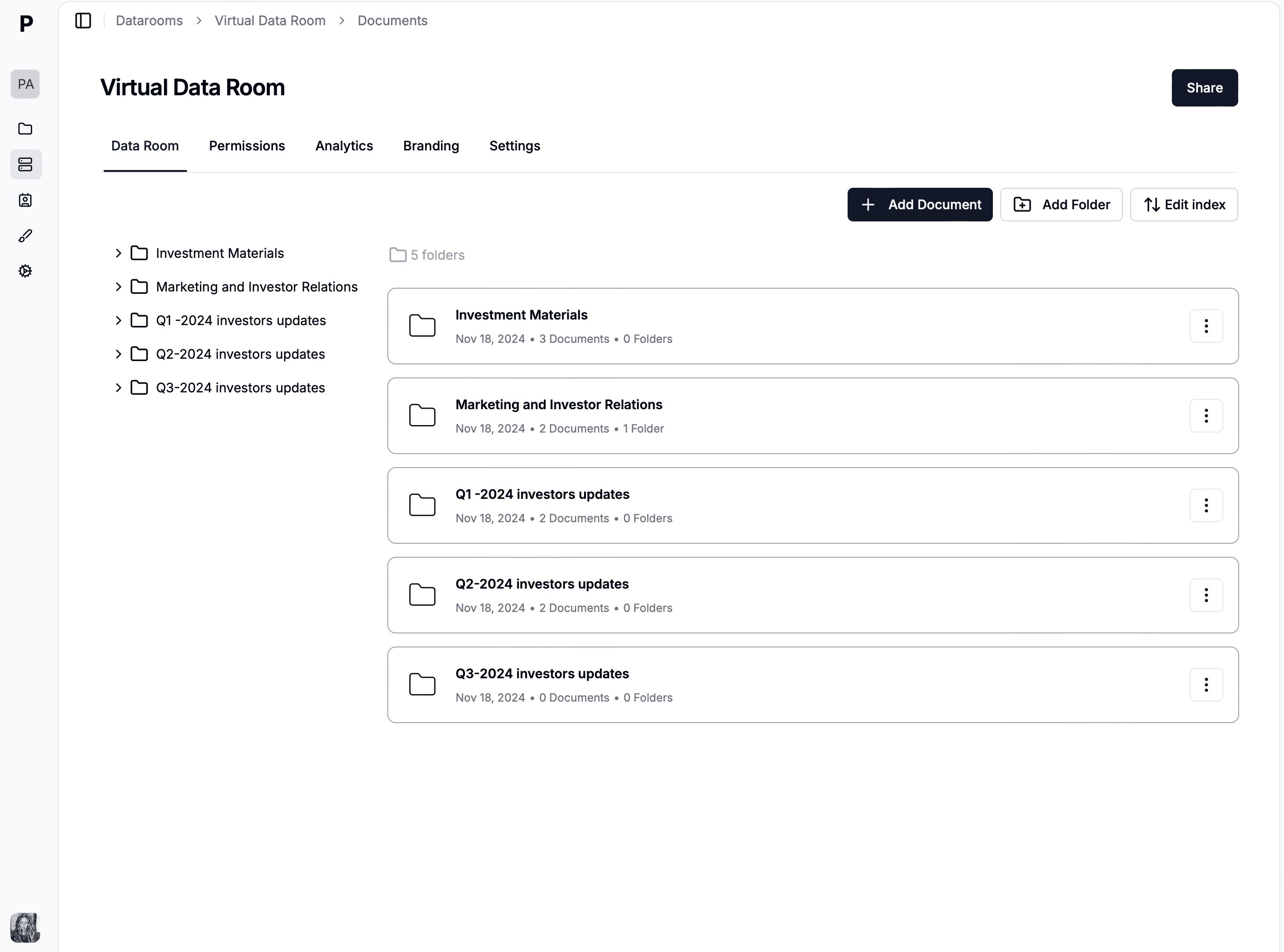
A banking transaction room holds the CIM, the model, and the facility file in separate folders.
What a banking transaction uses
Unlimited data room visitors on every plan, with no per-viewer charge for lenders, bidders, or counsel
Unlimited data rooms, unlimited storage, and no file size limit on Data Rooms, Plus, and Premium
Page-by-page analytics, dynamic watermarking, screenshot protection, and one-click NDAs
Granular file and folder permissions, plus viewer groups for credit, syndicate, and counsel
Q&A with permissions and an exportable audit log on Data Rooms Plus
Public API, CLI, and MCP server for programmatic rooms
AI redaction on Data Rooms Premium (€549/month) and Data Rooms Unlimited (€999/month) only
Paid team seats are separate from visitors. The €99/month plan includes 3 team members (€33/month for each extra seat). Plus includes 5. Premium includes 10. Unlimited team members are the €999/month tier only.
Papermark pricing for a banking transaction
Data Rooms (€99/month billed annually, or €149 month to month): 3 team members, unlimited data room visitors, unlimited data rooms, unlimited storage, custom domain, NDA, dynamic watermark, granular permissions. No AI redaction.
Data Rooms Plus (€249/month billed annually, or €349 month to month): 5 members, plus Q&A, audit log export, file indexing, and SOC 2 Type II. No AI redaction.
Data Rooms Premium (€549/month billed annually, or €699 month to month): 10 members, AI redaction, full API access, SSO on request, white-label layouts.
Data Rooms Unlimited (€999/month billed annually, or €1,499 month to month): unlimited team members, AI redaction, and a self-hosted option.
PayTabs is running a $100M+ acquisition of Amazon Payment Services MENA in a Papermark data room. Dakshaya Singh, Manager, M&A & Strategy at PayTabs, described the room this way:
"We used Papermark extensively to close a $100M acquisition. It's a much better data room than the one we used before."
Intralinks (SS&C) is a virtual data room used on investment banking, IPO, and other regulated transactions. Banks specify it when the counterparty already runs its process there. Setup is typically done with an onboarding specialist, and the contract is a custom quote.
Intralinks includes a Q&A workflow, granular permissions, watermarking, and activity reporting at group, user, and document level. Published compliance materials cite ISO 27701 and GDPR, and information rights management that can restrict a file after download.
Pricing is not published. Reported contracts run from about $10,000 a year on a small implementation to $200,000+ on a large one, with extra charges for storage, users, and extensions. A new process usually waits on the vendor's setup window.
Intralinks vs Papermark: Intralinks is a quote-only banking data room, reported from about $10,000 to $200,000+ per year. Papermark is self-serve from €99/month, with watermarking and permissions on a published plan.
3. Datasite
Datasite is an enterprise virtual data room used by investment banks and law teams on large M&A and cross-border banking transactions. It is a managed engagement: a project team indexes the room, and the contract is quoted per deal. G2 scores Datasite 4.5/5 across 260+ reviews.
Datasite publishes AI-assisted redaction, granular roles, a Q&A module, and activity reporting. Certifications cited on its security materials include ISO 27001, SOC 2, and GDPR. It also supports multi-language document review, which matters on a cross-border syndicate.
The limitation is the commercial model. There is no public price. Industry reports put the legacy per-page rate around $0.40 to $0.85 per page, and large engagements commonly start at $25,000/year. A 10,000-page diligence set at those per-page rates is $4,000 to $8,500 in upload charges before a lender opens a file.
Datasite vs Papermark: Datasite is quoted per deal, commonly from $25,000/year, for large M&A. Papermark publishes the Data Rooms plan at €99/month, with unlimited data room visitors and page-level analytics.
4. DFIN Venue
DFIN Venue is Donnelley Financial Solutions' virtual data room for capital markets: IPOs, SEC-regulated transactions, and bank-led M&A. It is bought as a quoted project, next to Datasite and Intralinks on those deals.
Venue includes AI-assisted bulk redaction, multi-party Q&A, role-based access, MFA, and SSO. DFIN cites SOC 2 Type II, ISO 27001:2022, GDPR, and 24/7 deal support. G2 lists Venue at 4.4/5.
There is no public price. Project quotes typically run $5,000 to $25,000 per transaction. Ongoing subscriptions are reported around $15,000 to $40,000 per year, with overages above the contracted storage and users. Reviewers on Capterra note there is no mobile app.
DFIN Venue vs Papermark: Venue is a capital-markets room quoted at about $5,000 to $25,000 per transaction. Papermark covers a banking transaction from €99/month, with AI redaction on Premium at €549/month when the file needs names and account numbers removed.
5. iDeals
iDeals is a virtual data room used by mid-market M&A teams and finance teams for diligence. It sells three quote-only tiers (Core, Premier, Enterprise) and offers a 30-day trial. Reported entry quotes start around $500/month and move into five-figure annual contracts on the higher tiers.
iDeals includes fence view, granular document permissions, MFA, dynamic watermarking, a Q&A module, and approval workflows. Mobile apps and API access sit on higher tiers. Security materials cite SOC 2 and GDPR. A public G2 review count for the current product is not published here.
The limitation for a bank is the quote. A coverage team that opens several transactions a quarter cannot read the annual cost from a pricing page before the first lender is invited.
iDeals vs Papermark: iDeals is quote-only, commonly from about $500/month, with a 30-day trial. Papermark publishes €99/month with a 7-day trial and unlimited data room visitors on every plan.
6. Firmex
Firmex is a virtual data room used by advisory firms and mid-market banks that run more than one transaction at a time. It is sold as a subscription or per deal. Reported entry rates are about $625 to $995/month. That figure is a subscription fee, not a flat rate for every deal size.
Firmex includes dynamic watermarking, granular permissions, and activity reporting. Public review counts are not cited here. Branding and a self-serve API are narrower than on a published self-serve plan, and a new workspace still goes through the vendor's commercial process.
Firmex vs Papermark: Firmex is quoted, with reported entry rates around $625 to $995/month. Papermark is self-serve from €99/month, with unlimited data rooms on the Data Rooms plan.
7. Ansarada
Ansarada is a virtual data room aimed at deal readiness, with a structured Q&A module and AI-assisted review tools on its published materials. Pricing is quote-only. Older public tiers started around $479/month and scaled with storage, up to plans that reached several thousand dollars a month for larger archives.
Ansarada cites security certifications on its trust materials and is used on M&A processes in Australia, the UK, and North America. The limitation is the same as the other quote-led rooms: a bank cannot see the price of the next transaction until sales replies. Storage-tier pricing also punishes a credit file that includes image-heavy scans of security documents.
Ansarada vs Papermark: Ansarada is quote-only, historically from about $479/month on storage tiers. Papermark includes unlimited storage on the Data Rooms plan from €99/month.
8. SecureDocs
SecureDocs is a subscription virtual data room. Published plans start at $450/month. That is a subscription fee, not a flat fee that covers every add-on. It is the lowest published price on this list after Papermark, and it is aimed at smaller transactions rather than bulge-bracket mandates.
SecureDocs includes watermarking, permissions, and an activity log on the plans it publishes. It does not publish a page-level analytics view of the kind a syndicate lead uses to see which lender read the covenant section. AI redaction and a public API are not part of the entry plan.
SecureDocs vs Papermark: SecureDocs starts at $450/month as a subscription. Papermark starts at €99/month billed annually, with page-by-page analytics and unlimited data room visitors.
One acquisition facility, 36 people in the room
Meridian is a worked example, not a Papermark customer. It is a regional bank arranging a $40 million acquisition facility for a borrower buying a competitor. Six lenders are invited. Two law firms are on the documents. The borrower's CFO and counsel need a folder of their own. The credit committee inside Meridian must not see lender comments, and the lenders must not see each other's term sheets.
Thirty-six people touch the file before signing. Eight are Meridian. Eighteen sit at the six lenders. Six are counsel. Four are on the borrower side.
Meridian: 36 people on one $40M facility
36people
Lender syndicate18 · 50%
Six lenders, separate groups
Arranger deal team8 · 22%
Coverage and credit
Counsel6 · 17%
Arranger and lender counsel
Borrower side4 · 11%
CFO and borrower counsel
Worked scenario. One acquisition facility. Lender groups do not see each other's term sheets.
The credit memo and the model go to credit and to lenders who have signed. The borrower customer list stays with Meridian credit until a lender is in exclusivity. Term sheets live in six folders, one per lender. Email would collapse that split the first time someone hits reply-all.
Folder
Who can open it
Why it is split
Teaser
All invited lenders
Before the NDA, no numbers that identify the borrower
Credit memo and model
Credit, plus lenders after NDA
The ask, the leverage, the sources and uses
Customer and payroll detail
Meridian credit only, until exclusivity
A lender can also be a competitor of the borrower
Term sheets
One folder per lender
Lenders do not see each other's price
Facility and security docs
Counsel and the remaining lenders
Drafting, not the full syndicate
On Papermark that map is group permissions, a watermark on every page, and an NDA on the link. The Data Rooms plan at €99/month billed annually covers the visitors. AI redaction of account numbers, if the credit file needs it before a wider group is invited, waits for Premium at €549/month.
How these 8 rooms were compared
The list is ordered for a banking transaction, not for a general file share. Papermark is first because this is a Papermark article and the price is published. After that, the order follows how often the room shows up on bank-led work: Intralinks and Datasite on live investment-banking and M&A mandates, DFIN Venue on capital-markets transactions, then mid-market rooms a coverage team can actually buy.
Each price is the higher, monthly or per-deal figure where both exist. Annual discounts are not used to make a competitor look cheaper. SecureDocs is quoted from $450/month as a subscription, not as a flat fee. Where a vendor does not publish a price, the figure is the range already used in our data room provider comparison and checked against the vendor's own pages where those pages exist. Ratings are omitted when a public review count could not be confirmed.
A room failed the cut if it cannot split access by party. A shared drive can store a credit file. It cannot keep six lenders out of each other's term sheets and still show the arranger who read the covenant page.