Strategic Alternatives Review 2026: 6 Options and the Leak Risk
·15 min read
Marc Seitz
A review of strategic alternatives is a board-authorised process in which a company, usually with an investment bank engaged, evaluates the paths available to it: continuing as it is, selling, merging, divesting a segment, recapitalising, or going private. It is a decision framework, not a decision.
Quick recap
A strategic alternatives review is a board-authorised evaluation of a company's options, run with a financial adviser and ending in a recommendation rather than an automatic sale.
The six options are the status quo with a sharpened operating plan, an outright sale, a merger of equals, a divestiture or carve-out, a recapitalisation, and a take-private.
An IPO or a spin-off sits alongside those six where a private company or a carve-out has the scale for it.
Announcing is market shorthand for a possible sale: research found roughly 41 percent of announcing companies received a public M&A offer within the year.
Commencing a review is not generally a mandatory Form 8-K event in the United States, so announcing is a board choice.
A review that leads to a transaction runs 4 to 9 months from authorisation to signing, with most sale processes closing in 6 to 8 months.
The board's protection is process: an independent committee where management is conflicted, minutes kept as you go, and a fairness opinion on the consideration.
A data room for a strategic alternatives review differs from a single-buyer room: access is staged across dozens of counterparties, most of whom never bid.
Papermark hosts a data room for a strategic alternatives review with granular permissions, dynamic watermarking, and per-visitor analytics from €99/month.
Boards rarely reach for a strategic alternatives review when things are going well. The phrase surfaces when an activist takes a stake, a refinancing wall approaches, an unsolicited approach lands on the chair's desk, or a sponsor's hold period has run long. What follows is a structured evaluation most management teams have never run, under time pressure and with the market watching.
This guide covers what the review is, what triggers it, the six options and how they compare, how the process runs stage by stage, the leak risk, and the governance record a board builds as it goes.
Running a review means putting confidential material in front of strategic acquirers, financial sponsors, lenders and advisers who must not see each other or, in most cases, the same documents. A data room for a strategic alternatives review handles that with one room and one link per counterparty. Section 9 covers the setup step by step.
1. What is a review of strategic alternatives?
A review of strategic alternatives is a formal process, authorised by a board, in which a company evaluates the realistic paths open to it and decides which creates the most value for shareholders. In practice that means engaging a financial adviser, building a defensible view of standalone value, identifying which counterparties would pay more, testing the market, and returning a recommendation with a record of how it was reached.
The phrase carries a specific market meaning. When a listed company says it is exploring strategic alternatives, investors read it as a signal that a sale is on the table, and the share price usually moves on the announcement alone. Academic work found a meaningful share of announcing companies received a public M&A offer within the following year, which is why the market treats the wording as more than boilerplate. It is still not a commitment: releases state there is no assurance any transaction will result, and boards do conclude that the standalone plan wins.
Three terms get used interchangeably and should not be. A strategic review can mean a portfolio or operating review with no transaction contemplated. A review of strategic alternatives implies transactional outcomes are in scope. A sale process is one possible outcome, and running one commits the company to a defined auction with bid deadlines, which the review preceding it does not.
That distinction sets how much preparation is needed before anything is said publicly: a board that announces without agreed scope, an adviser and a plan for inbound approaches has started a clock it does not control. Our guide to corporate acquisition strategy covers the other side of the table.
2. What triggers a strategic alternatives review
Reviews start for identifiable reasons, and knowing which is driving yours changes how the process runs. A review triggered by an unsolicited approach is a defensive exercise with a counterparty already in the room; one triggered by a refinancing wall is a financing exercise where speed matters more than price discovery. Treating them as the same process is how boards lose control early.
The most visible trigger is activist pressure. An investor accumulates a position, argues publicly that the company is worth more sold or broken up, and threatens a proxy contest. The board can engage, settle with board seats, or show through a credible review that the standalone plan is better. Announcing buys time and signals responsiveness, at the cost of putting the company in play.
The second is a capital structure event: a covenant test the company will fail, a maturity wall 12 to 18 months out, or a downgrade that closes the refinancing market. Each forces the board to consider alternatives it otherwise would not, from a rights issue to a divestiture to a whole-company sale. The constraint is a calendar date, and the review has to conclude before the lenders' patience does.
The third is an unsolicited approach. A credible party makes a proposal, and the board's duty is not to accept or refuse in isolation but to establish whether it beats the alternatives, which means at least a limited market check. It converts to a transaction more reliably than any other trigger, because a motivated buyer already exists.
Three further triggers recur. A sponsor's hold-period clock drives reviews in private-equity-owned businesses, where a fund near the end of its life compares a trade sale, a secondary, a continuation vehicle and an IPO. A failed product or strategy cycle drives them in technology and life sciences, where a clinical readout or a product miss removes the standalone case. And founder or family succession drives them in private companies, where the question is whether to sell, recapitalise and stay, or professionalise and hold. Where management wants to buy the business itself, our management buyout guide covers the conflicts that arise immediately.
3. The 6 options a board actually evaluates
Every review comes back to options that differ on far more than headline price. A board that ranks them by proceeds alone chooses badly, because they differ sharply on how likely they are to close, how long they take, how much disruption they impose, and how much diligence the company must survive.
The first option is always the status quo with a sharpened operating plan, and it is not a null option. A credible standalone case includes a revised plan, a discounted cash flow the board actually believes, and a view of what the market will pay for the equity in two years. If standalone value beats what any buyer will pay today, the review should say so and the board should defend it publicly.
The second is an outright sale to a strategic acquirer or a sponsor: the cleanest exit and usually the highest certainty of value, but the heaviest diligence and most disruption. The third is a merger of equals, rarely between actual equals, which preserves synergy value without one side funding a cash purchase but is slowest and least certain to sign, because of social issues, governance and the exchange ratio.
The fourth is a divestiture or carve-out, which raises capital and sharpens the remaining business without giving up control. It suits a conglomerate discount, but creates a separation workstream a whole-company sale does not: shared systems, transition services, and a standalone cost base to build. The fifth is a recapitalisation, a leveraged dividend, minority stake sale or debt-for-equity exchange, delivering liquidity while keeping the business independent. The sixth is a take-private, where a sponsor or management-led group buys the public equity, removing quarterly reporting pressure but attracting the heaviest governance scrutiny, because insiders sit on both sides.
#
Option
Time to execute
Certainty
Proceeds profile
Diligence burden
1
Status quo with an operating plan
Immediate
High
None today
None
2
Outright sale
4 to 9 months
Medium to high
Full cash at close
Heaviest
3
Merger of equals
9 to 18 months
Low to medium
Stock, realised later
Heavy, mutual
4
Divestiture or carve-out
6 to 12 months
Medium
Partial cash, business kept
Heavy on the segment
5
Recapitalisation
3 to 6 months
Medium to high
Cash out, leverage in
Lender-led
6
Take-private
6 to 12 months
Medium
Full cash at close
Heavy, plus governance
An IPO and a spin-off sit alongside those six where a private company or a carve-out has the scale, and both prepare like a sale, as our IPO data room guide sets out. Disruption is the dimension boards underweight across all of them: a whole-company sale occupies the chief executive, the finance chief and the general counsel for months, exactly when the business must hit the numbers the buyer is underwriting. When two options are close on value, the one that leaves the business running wins.
A review that moves toward a transaction follows a recognisable sequence, and the calendar is the part boards get wrong, because each stage depends on materials that take longer to prepare than anyone budgets for.
The front half is preparation and outreach. The board authorises the review, the company engages an adviser and agrees the engagement letter including the fairness opinion fee, and management and the bank build the materials: an information memorandum, a management presentation, a model, and the documents that populate a data room for a strategic alternatives review. Only then does outreach begin, with an anonymous teaser, then confidentiality agreements and full materials for parties that engage.
The back half is bidding and negotiation. Non-binding indications of interest arrive as ranges and narrow a wide list to a second round. Management presentations follow, then confirmatory diligence, then final bids with a marked-up purchase agreement. The adviser delivers the fairness opinion, the board resolves, and the parties sign. For a public company the proxy then discloses the process, including a background-of-the-merger narrative describing every material meeting.
Stage
What happens
Typical duration
Board authorisation
Scope defined, committee formed if needed
1 to 3 weeks
Adviser engagement
Bank selected, engagement terms agreed
2 to 4 weeks
Materials preparation
CIM, presentation, model, data room populated
4 to 8 weeks
Outreach
Teaser sent, confidentiality agreements signed
3 to 6 weeks
First round
First-tier access, indications of interest
3 to 5 weeks
Management presentations
Shortlist meets management, site visits
2 to 4 weeks
Second round
Confirmatory diligence, full room, expert sessions
Added up, that is roughly four to nine months from authorisation to signing, and sale processes commonly close in six to eight. Reviews ending without a transaction can be shorter, but a board that runs a full market check before staying independent has still done the work.
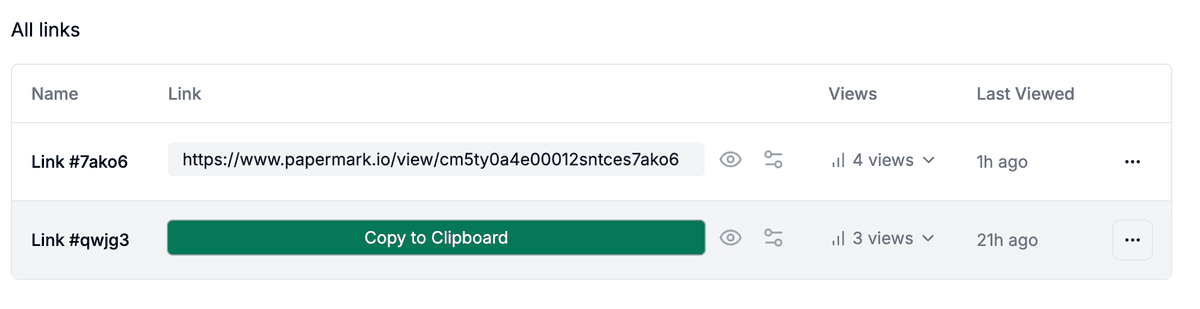
Each counterparty in the outreach funnel gets its own link, so first-round and second-round access can differ over the same underlying room.
Two choices shape the calendar: the width of the outreach list, where a broad auction to 60 parties maximises price discovery and leak risk at once, and whether diligence is staged into two tiers, which is what sell-side due diligence preparation delivers.
5. The leak risk: announcing is itself a decision
The most consequential choice in a strategic alternatives review is whether to announce it. In the United States, commencing a review is not generally a mandatory Form 8-K event, so the board is usually choosing to disclose rather than being compelled to, and there is no default answer.
Announcing brings the process into the open. It invites approaches from parties the adviser would never have contacted, shows responsiveness to an activist, and removes the risk of a selective-disclosure problem later. It also puts the company in play, tells competitors and customers that ownership may change, unsettles employees, and creates a public expectation the board may not meet. Not announcing preserves optionality but demands confidentiality across a widening circle: the board, management, two law firms, a bank, and every counterparty that signs an NDA. Leaks are common and, by most practitioners' accounts, rising, and they arrive mid-process, when the bidder list is widest and nothing is signed.
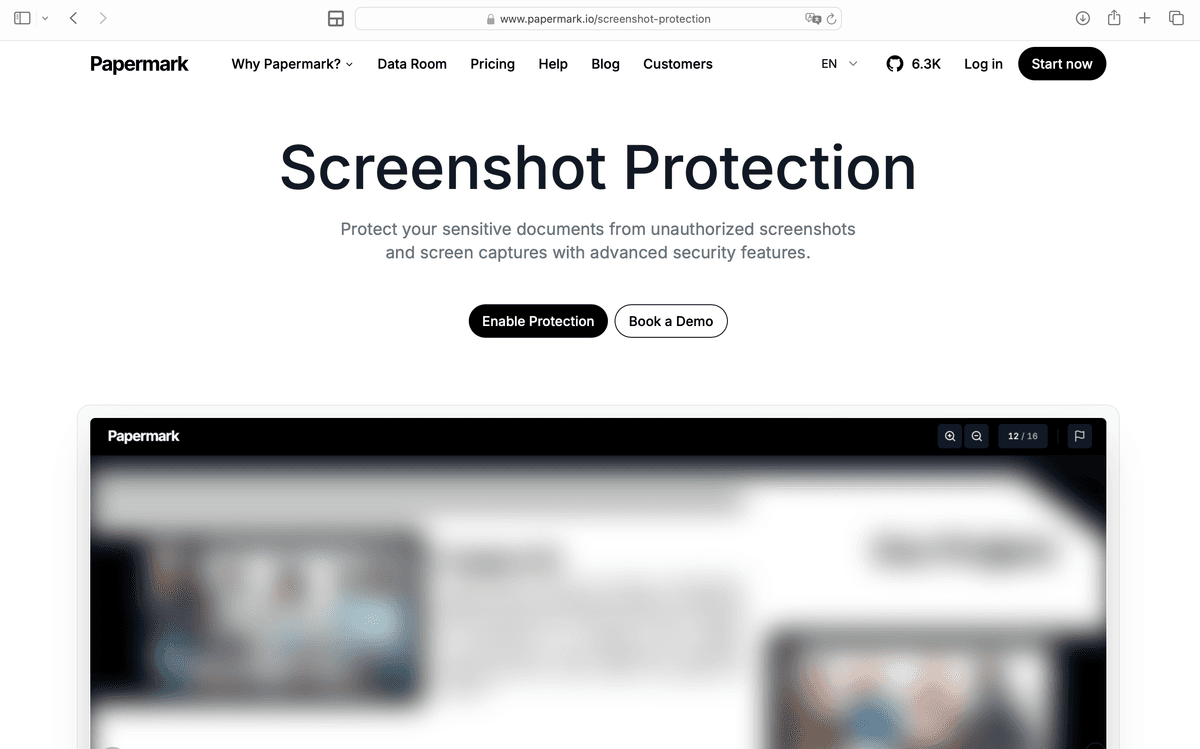
Second-round materials are view-only, watermarked and screenshot-protected, because the bidder list is wide and most of it will never sign.
A leak costs in four ways. Customers delay renewals until they know who will own the contract. Key employees take recruiter calls, and the ones with the most options leave first, exactly the group a buyer is paying for. Competitors use the uncertainty in live sales cycles. And the board loses leverage, because a bidder who knows the process is public knows the company cannot walk away and pretend nothing happened. The controls that reduce that risk are operational rather than legal: an NDA is a remedy after the fact, while the controls below aim at the leak never happening. The employee and customer communication plan belongs in the same list.
Control
What it does
Who owns it
Code name
Documents, invites and threads use a project name, never the company name
Adviser and counsel
Circle of trust
A written list of who knows, updated as it grows
Chief executive and counsel
Clean team and standstill
Cleared group for competitively sensitive data; NDA standstill blocks stock buying
Counsel
Tiered room access
First-round parties see a limited tier; the sensitive tier opens in round two
Adviser and deal team
Dynamic watermarking
Stamps viewer identity on every page so a copy is traceable
Deal team
Staged internal disclosure
Employees told on a planned sequence, not by rumour
Chief executive and HR
Holding statements
Responses for press, customers and employees, drafted in advance
Communications and counsel
6. Governance and the board's duties
In a strategic alternatives review the board is judged on process. Shareholders and courts assessing a transaction afterwards rarely second-guess price in isolation; they ask whether directors informed themselves, whether conflicts were managed, and whether the record shows a genuine effort to test the market. That work is the defence.
The first question is whether management is conflicted. In a take-private, a management buyout, or any deal where executives roll equity into the acquirer, their interests diverge from shareholders' at the moment their information advantage is greatest. The standard response is an independent special committee with its own counsel, its own financial adviser, and real authority to say no. A committee that relies on management's banker offers no protection.
The second is the market check. A board need not run a full auction, but it must have a reasonable basis for believing the deal is the best available, from a pre-signing process or post-signing protections such as a go-shop.
The third is the fairness opinion. A financial adviser, often a different bank from the one running the sale so no success fee attaches, opines in writing that the consideration is fair from a financial point of view, supported by discounted cash flow, comparable company and precedent transaction analyses. What it does not do matters as much: it does not say the deal is the best alternative, recommend how shareholders should vote, or opine on the business decision.
The fourth is the record. Every board meeting needs minutes showing what materials directors received, what alternatives were weighed, and what was decided. For a public company this becomes the background-of-the-merger section of the proxy, read closely by plaintiffs' counsel. Building it as you go, with a per-visitor log of which counterparty received which documents and when, beats reconstructing it a year later from email.
7. Worked scenario: Halvorsen Instruments runs a review
Halvorsen Instruments is a hypothetical listed maker of industrial sensing equipment with $340M of revenue, flat for three years, and a share price that has lagged its sector for six quarters. An activist fund discloses a 6.1 percent stake and argues publicly that it should sell its calibration services division or the whole business. The board resolves to run a strategic alternatives review, forms a committee of four independent directors, and engages an adviser.
The review evaluates all six options. The standalone plan implies a value the board believes but cannot deliver for two years. A carve-out of calibration services would raise capital but leaves a shared ERP, a shared salesforce and an 18-month transition services agreement. A merger of equals is attractive on synergies and poor on the exchange ratio. The committee authorises a dual path: test the market for the whole company while preparing the carve-out as a fallback.
Outreach goes to 64 parties, 29 strategic acquirers and 35 sponsors, under the code name Project Fjord. Forty-six decline at the teaser stage or refuse the standstill. Eighteen sign confidentiality agreements and get first-round access to a limited tier of 190 documents. Five submit indications of interest, and four enter the second round, where the full room of 620 documents opens.
Project Fjord: the outreach funnel
64parties contacted
Declined at the teaser stage46 · 72%
Never signed a confidentiality agreement
Signed an NDA, no indication of interest13 · 20%
Received first-round access to 190 documents
Submitted an indication of interest5 · 8%
Four progressed to the second round
Worked scenario. Only 5 of 64 contacted parties reached an indication of interest, which is why first-round access is a limited tier rather than the full document set.
Two final bids arrive in month seven: a sponsor at a 31 percent premium to the undisturbed price, contingent on financing, and an all-cash strategic offer at a 26 percent premium with no financing condition and a clean regulatory path. The committee takes a fairness opinion from a second bank, negotiates a 30-day go-shop into the strategic offer, and recommends it. The go-shop produces no superior proposal. Authorisation to signing takes eight months, and the proxy's background section runs to eleven pages, built from the committee's minutes and the room's access log.
8. Common mistakes in a strategic alternatives review
The most expensive mistake is announcing before the company can run a process. An announcement starts a clock the board does not control, and if the information memorandum, the model and the data room are six weeks from ready, the company spends those weeks in play with nothing to show.
The second is treating the standalone plan as a formality. Without a defensible standalone case the board has no benchmark, and every bid looks acceptable against an already depressed share price. The standalone number is the only thing that lets a board credibly walk away, which is also the only thing that makes bidders move.
The third is running a wide outreach list with a single tier of access. Contacting 60 parties is legitimate for price discovery, but giving all 60 the same view sends contracts, pricing and employee data to dozens of firms, most of which compete or advise competitors. Access should widen as commitment does, not before.
The fourth is letting management run a process in which management is a bidder. Once executives contemplate a rollover, the committee needs its own advisers and its own document control, as our guide to selling to private equity explains.
The fifth is keeping no record as you go. Reconstructing who saw what and when, a year after signing, from an inbox and a shared drive is where a well-run process starts to look like a badly run one, as the M&A due diligence process guide sets out.
Manage due diligence with a virtual data room
No credit card required
Page by page analytics
Unlimited documents & folders
Permission management
Dynamic watermarks
NDA collection
Real-time alerts
Custom branding
Audit trail
9. Data room for your strategic alternatives review
A data room for a strategic alternatives review is not the same artifact as a single-buyer diligence room. In a bilateral deal one counterparty gets one set of documents and access widens steadily. In a review the room serves a funnel: dozens of parties at the top on a limited tier, a handful in the middle with more, two or three at the end who see everything, none of them aware of each other.
That shape creates three requirements a shared drive cannot meet: access staged by tier and revocable the moment a party drops out, one document set carrying different permissions per counterparty rather than duplicated folders that drift out of version, and every view logged per visitor for the governance record in section 6.
Papermark is a secure, fully customizable, and developer-friendly data room built for modern dealmakers, with page-by-page analytics, dynamic watermarking, and transparent pricing (open-source and self-hosting available).
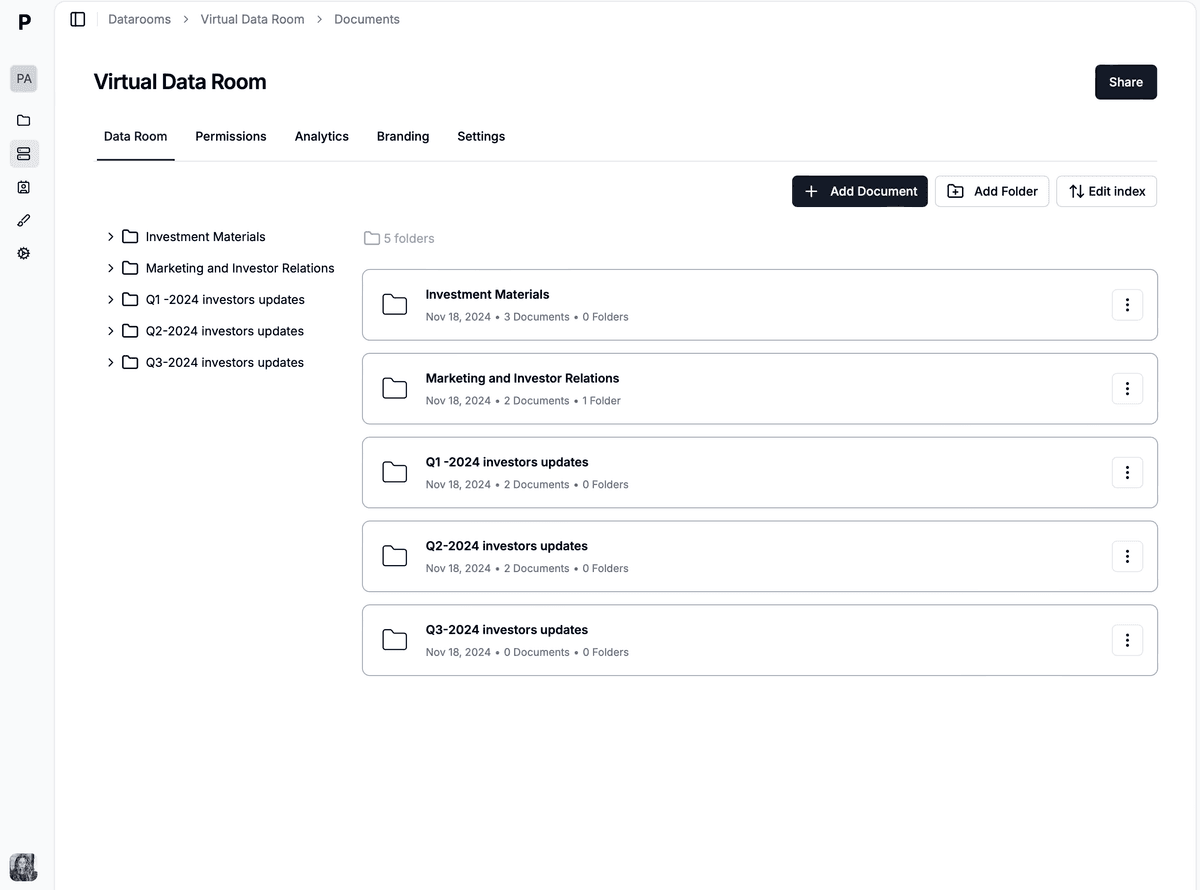
One room, organised so the first-round tier and the second-round tier are separate folders rather than separate rooms.
Why you need a data room for a strategic alternatives review
Most reviews start on a shared drive and move to a proper room around the second round, which is backwards: leak risk is highest in the first round, when the list is widest and commitment thinnest. Four reasons a dedicated data room for a strategic alternatives review earns its place from day one. If you are choosing a platform, our comparison of the best virtual data rooms covers pricing, bidder management and compliance.
The outreach funnel is wide and most of it will never bid. In the worked scenario above, 18 parties signed NDAs and 5 produced an indication of interest. The 13 that went no further still hold whatever you gave them, so the first tier should carry only material you would tolerate a competitor reading, which works only if the platform enforces tiers over one document set.
Access has to be revocable instantly. A party that drops out, an adviser who changes firms, a bidder acquired mid-process by a competitor: each is a reason to cut access today, not at the next milestone. One link per counterparty can be disabled in seconds, which a shared folder of named users cannot match.
Confidentiality controls have to live in the document. An NDA is a remedy after a leak; a page carrying the viewer's email and the time they opened it is a deterrent before one, and the difference between a traceable leak and a regrettable one.
The board needs a record it can hand to counsel. When the proxy background section is drafted, the questions are which parties received which materials, on what dates, and whether anyone saw something they should not have. A per-visitor audit log answers all three; an inbox answers none.
The rest of this section is the setup: five steps to build a data room for a strategic alternatives review that handles all four.
Step 1: build one room with two tiers, not two rooms
Make the first-round and second-round tiers separate top-level folders inside one room. The first holds the information memorandum, market materials, summary financials and an anonymised customer overview; the second holds contracts, pricing detail, employee data, litigation files and the model. Version control holds because everything lives in one place, and the tier a party sees is a property of their link rather than of the file.
Load it in bulk by dragging the folder tree in. Automatic file indexing on Data Rooms Plus maintains the index as documents arrive, which matters because the second-round tier grows through diligence.
Step 2: give every counterparty its own link
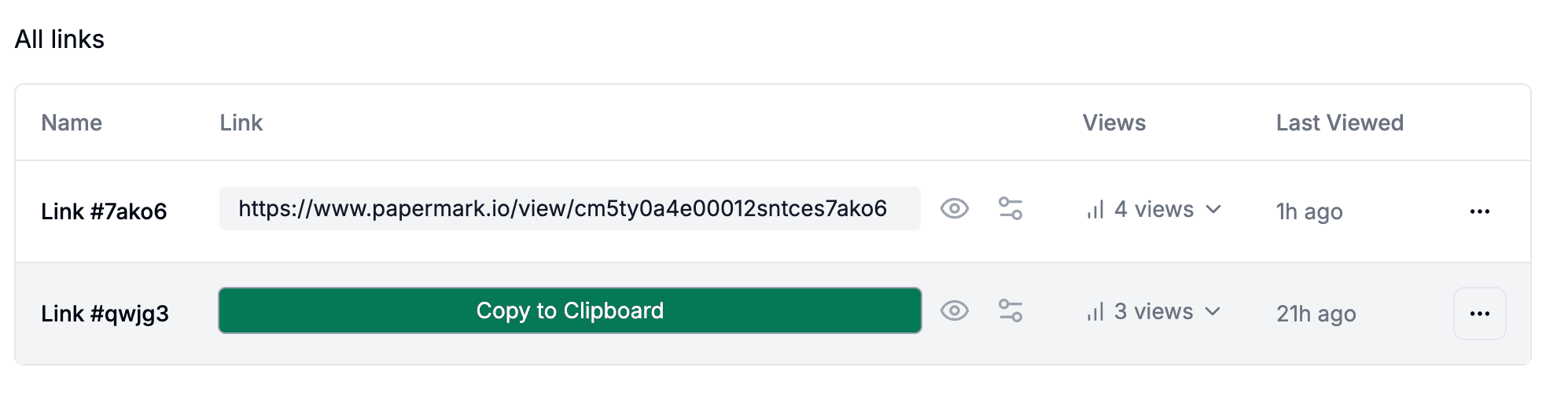
This is where a review differs most from a bilateral deal: sixty-four contacted parties become eighteen live links, each with its own scope, expiry and audit trail.
Counterparty
Tier granted
Rights
First-round bidder or sponsor
First-round tier only
View only, watermarked
Second-round bidder
Both tiers
View and download, watermarked
Competitor bidder, clean team
Both tiers less pricing detail
View only, watermarked
Lender to a bidder
Financial folders only
View only
Company's own advisers
All folders
View and download
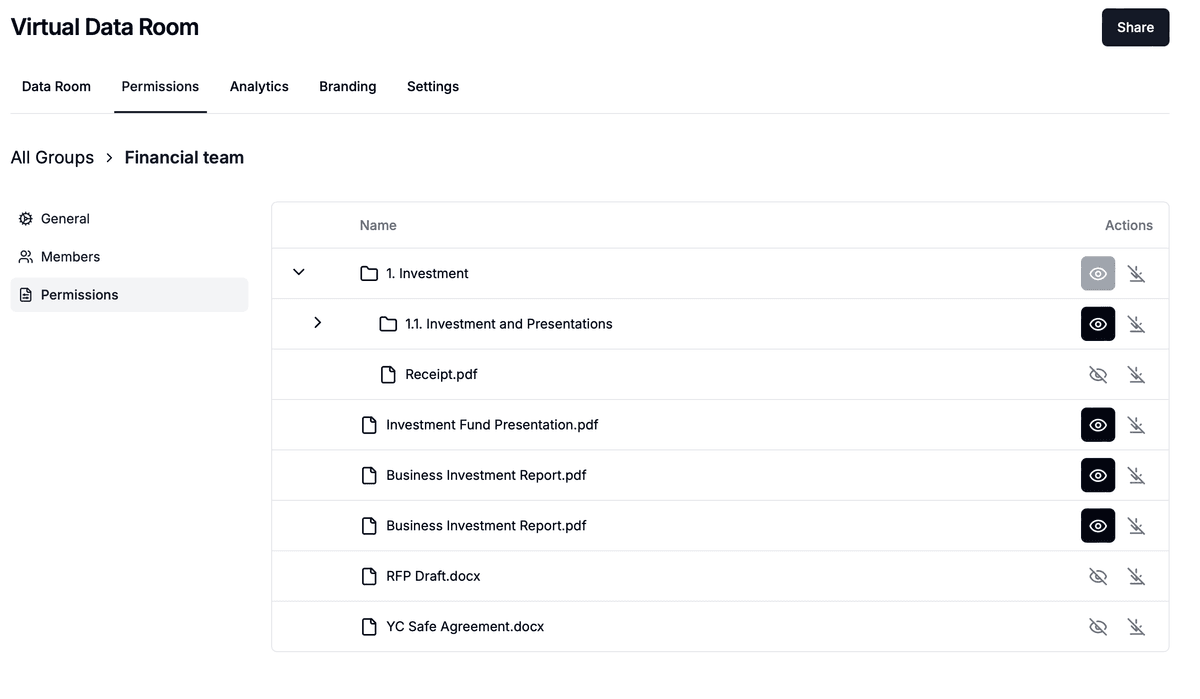
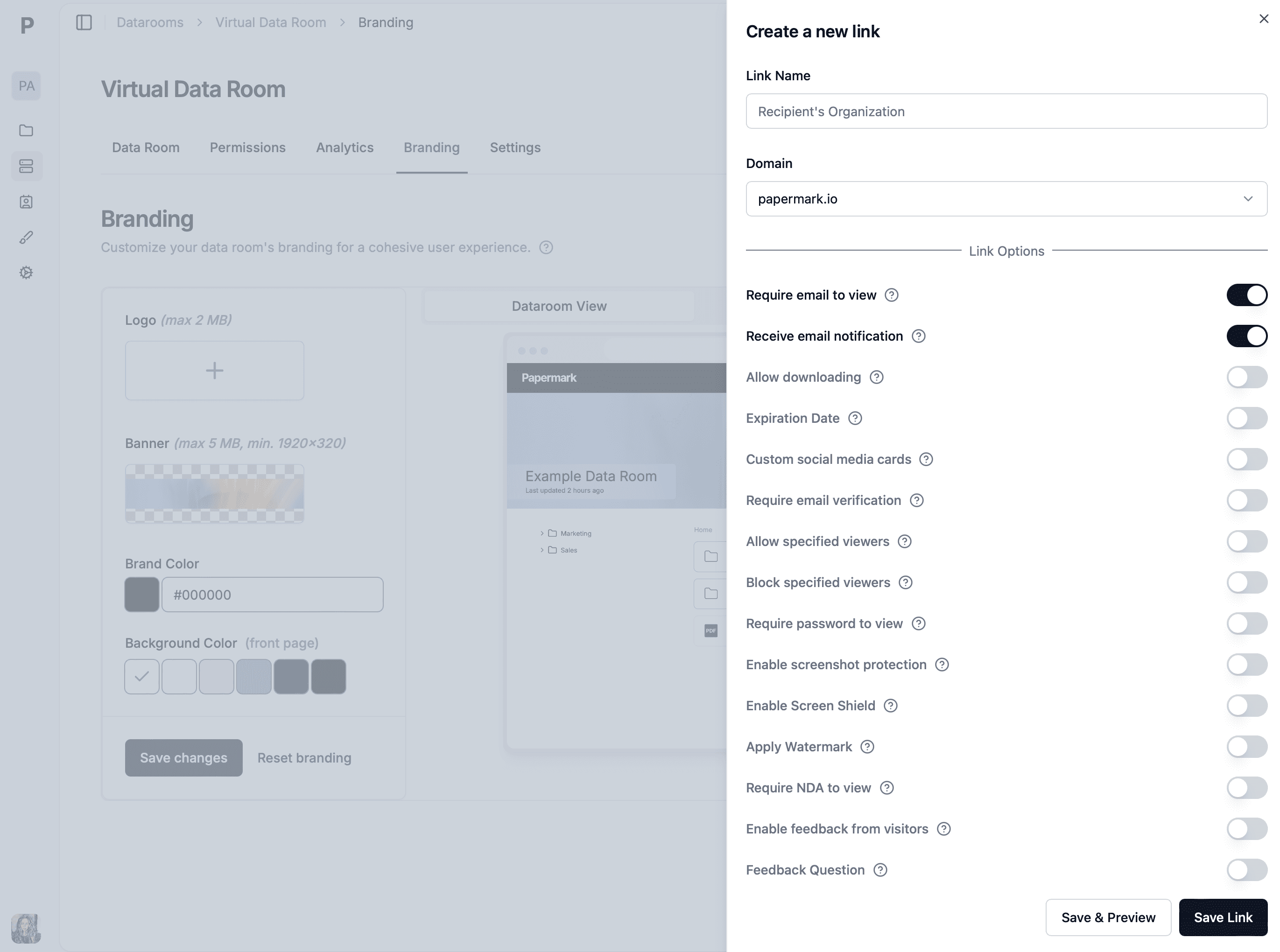
Granular file-level permissions are set per link rather than per user, so each party carries its own folder scope, email allowlist or domain restriction, and download rule. Access is link-based, so no bidder creates an account, removing the friction that makes senior counterparties hand the room to an analyst.
Permissions are set per link, so a first-round sponsor and a second-round strategic bidder see different tiers of the same room.
Step 3: gate the room behind an NDA and watermark what is inside
Turn on NDA agreements so a counterparty accepts the confidentiality terms, including the standstill, before any document renders, with acceptance logged against the version signed. That matters more here than in a bilateral deal, because agreements are negotiated with dozens of parties over weeks and nobody remembers which version each took.
Then enable dynamic watermarking across both tiers, rendering the viewer's email, IP address and timestamp onto every page as it loads, and add screenshot protection on the second-round tier where pricing and employee files sit. The honest limit: a downloaded file is legally treated as read, which is why download stays off on the first-round tier.
Step 4: run Q&A centrally and read the analytics
Diligence questions arrive from four bidders at once and must not cross. The Q&A module attaches each question to the document that prompted it and controls who sees which threads, so one bidder never learns what another is worried about, while general answers publish to everyone. The log exports for the closing file.
Page-level analytics are a live read on intent. A sponsor whose team has spent four hours in the customer contracts folder is building a model; one who opened the memorandum once and never returned will not bid. That signal arrives weeks before the indications of interest.
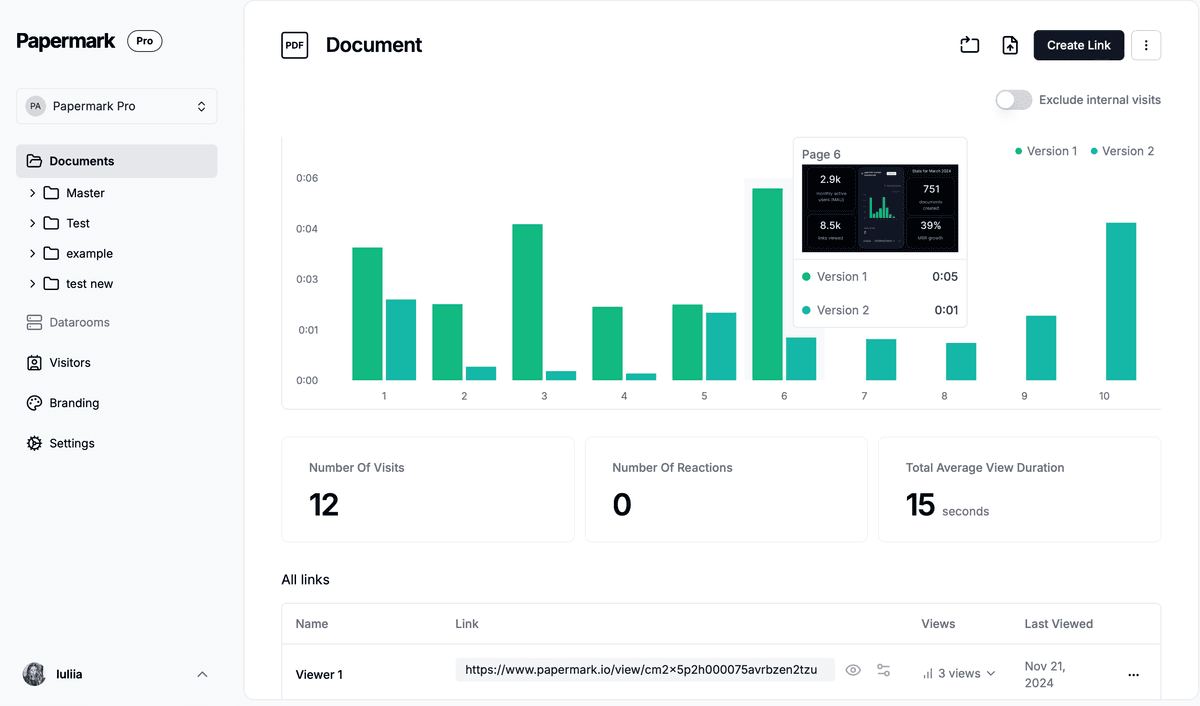
Per-visitor analytics show which counterparty opened which documents and for how long, the earliest signal of who will actually bid.
Step 5: close the process and freeze the record
When the review concludes, disable every link except the winning bidder's and your own advisers'. Data room freeze then makes the room immutable and exports it as an archived ZIP with a certificate, alongside the full audit log of who viewed what and when.
That archive is the governance artefact: if the process is challenged after closing, the record of which documents each of the eighteen counterparties received, and when, is already assembled.
Papermark is our #1 VDR provider for M&A transactions right now. In two deals we used custom branding, dynamic watermarking, and granular permissions.
The Data Rooms plan is €99/month with a 7-day free trial and includes 3 team members, unlimited data room visitors, unlimited data rooms, unlimited documents, custom domain, dynamic watermarking, NDA agreements, and granular file-level permissions. Data Rooms Plus at €249/month adds 5 team members, the Q&A module, the audit log, automatic file indexing, and SOC 2 Type II. Premium at €549/month adds 10 team members, AI redaction, the REST API, SSO and white-labelling. Data Rooms Unlimited at €999/month removes per-seat charges entirely, so teams that add reviewers mid-deal pay one number regardless of headcount, and it carries every Premium capability including AI redaction. Because data rooms are unlimited on every plan, a review with eighteen live counterparties costs the same as one bilateral deal, unlike providers that price per project or per page.