



mergers-and-acquisitions
How to sell a company in 2026: 10 steps from valuation to closing
How to sell a company in 2026: 10 steps from valuation to closing, with timelines, broker fees, asset vs stock sale tax, and when to open a data room.
To prepare a company for acquisition, make it valuable, easy to diligence and transferable, starting 12 to 24 months before you go to market. The core moves are clean monthly financials, less dependence on the founder and top customers, a tidy cap table with signed contracts and IP assignments, a data room built before buyers ask, and advisors hired early. A secure data room such as Papermark holds the result.
Founders usually start thinking about how to prepare a company for sale when a buyer calls. By then, most of the levers that move valuation are out of reach: you cannot create three years of clean monthly financials in a month, or reduce a 35 percent customer to 15 percent in a quarter.
This guide is a 24-month roadmap for founders and owners who want to sell on their own terms. It covers what to fix, in what order, who does it, and how to package it so buyers can confirm it quickly.
Preparing a company for acquisition means removing the reasons a buyer would pay less, delay, or walk away. Every buyer asks three questions: is the business worth what the seller claims, can we confirm it, and will it keep performing after the founder leaves? Preparation answers each of them before the buyer asks.
Value is the earnings or revenue a buyer will pay a multiple on, and how confident it is that they continue. Diligence readiness is how fast and cleanly a buyer can confirm the facts, which depends on records, contracts and the data room. Transferability is whether the business, its customers, its contracts and its IP actually move to the new owner.
Exit planning is the broader term for the same work, often including the founder's personal wealth and tax planning. This guide focuses on the company side. If the sale is closer, our guide to the sell-side M&A process covers the week-by-week sale itself, and our guide to sell-side due diligence covers the pre-launch review.
The acquisition readiness roadmap runs in four overlapping phases. Each produces something a buyer will eventually see, and each depends on the one before it. The timing assumes a founder-led company with a few million to a few tens of millions of revenue; larger or more complex companies should start earlier.
| Months before sale | Actions | Output | Owner |
|---|---|---|---|
| 24 to 12 | Valuation baseline, comparables, fix margins and concentration | Valuation memo and value plan | CEO and CFO |
| 18 to 9 | Monthly closes, add-back file, SOPs, second-line management | Clean monthly financials | CFO and COO |
| 12 to 6 | Cap table clean-up, IP assignments, consents list, QoE scoping, data room built | Data room version 1 | Counsel and CFO |
| 6 to 0 | Advisor engaged, teaser and CIM, buyer list, NDA-gated room live | Letters of intent | Banker and CEO |
Get an independent valuation baseline and look at what similar companies sold for. Identify the two or three factors that would raise your multiple most, often customer concentration, recurring revenue share, or gross margin, and set targets. Twelve months is roughly the minimum for a change to show up in trailing financials.
Move to monthly closes within 15 days, on an accrual basis consistent with GAAP. Start an add-back file. Document how the business runs and build a management layer that can run it without you.
Reconcile the cap table, collect missing IP assignments, list every contract that needs consent on a change of control, and decide whether to commission a sell-side quality of earnings. Build the first version of the data room now.
Engage the advisor, prepare the teaser and CIM, build the buyer list and open the NDA-gated room. Our before signing an LOI checklist covers the last weeks before you accept an offer.
Clean, consistent financials are the single biggest driver of a smooth sale. Buyers price the business on normalized earnings, and every number they cannot confirm becomes either a lower price or a longer diligence period.
Start with the basics: monthly closes within 15 days, accrual accounting consistent with GAAP, and three years of statements reconciled to tax returns. If revenue recognition has changed, document why and restate the history on one basis.
Next, build the add-back file. Add-backs are expenses you argue will not continue under a new owner: the founder's above-market salary, one-off legal costs, a discontinued product. Each one needs evidence, an invoice or a contract, and a reason. A buyer's accountants will test every add-back, and items that do not survive come off EBITDA at the multiple.
Decide whether to commission a sell-side quality of earnings (QoE) report. It typically costs $15,000 to $25,000 below $3M of EBITDA and $25,000 to $50,000 between $3M and $10M, and takes 4 to 8 weeks to draft plus 2 to 3 weeks of review. It pays off when add-backs are significant, when the buyer pool includes private equity, or when the financials have not been audited. See our guide to quality of earnings.
Finally, build 24 months of monthly net working capital history. The buyer will use it to set the working capital peg, and a seller who has done the analysis first negotiates from authorship. The working capital adjustment guide explains the mechanics.
Buyers discount businesses that depend on one person or one customer, because the risk is that revenue leaves with them. Reducing both is slow, which is why it belongs at the start of the roadmap.
Owner dependency. If you hold the key customer relationships, approve every price and are the only person who understands the product roadmap, a buyer will either pay less, insist on a long earnout, or require you to stay for years. Build a second line of management: a head of sales who owns customer relationships, an operations lead with documented processes, and a finance lead who can answer diligence questions without you. Written SOPs for core processes make the business look, and be, transferable.
Customer concentration. A common rule of thumb among buyers is that no single customer should exceed 20 to 30 percent of revenue, and the top 5 should not dominate. If one customer is above that, renew its contract early on a multi-year term, and focus new sales on diversifying. A signed three-year renewal dated before launch is far stronger evidence than a verbal assurance in a management meeting.
Recurring revenue. Contracted or subscription revenue usually earns a higher multiple than project revenue. Converting even part of the base to annual or multi-year contracts in the 12 to 24 months before a sale can lift the valuation.
Legal issues kill more deals than valuation disputes, and most are cheap to fix 12 months out and expensive to fix during exclusivity. Our IP due diligence guide covers the buyer's view in detail.
Reconcile the cap table against board approvals, share certificates and option grant documents. Look for unapproved option grants, missing exercise records, SAFEs or convertible notes that have not been converted, and former founders whose vesting was never documented. Check drag-along rights and investor consent requirements in the shareholder agreement.
List every material contract (customers, suppliers, leases, licenses, loans) and flag those that require consent on a change of control or on assignment. In an asset sale, almost every contract needs to be assigned. In a stock sale, change-of-control clauses still apply. Start conversations with key counterparties early.
Confirm that every founder, employee and contractor who created IP has signed an assignment to the company. A missing assignment from a co-founder who left is one of the most common startup diligence findings. For software companies, run an open-source license scan and document anything under a copyleft license.
An asset sale and a stock sale transfer different things, need different consents and are taxed differently. Buyers often prefer asset deals because they can step up the tax basis and leave liabilities behind; sellers often prefer stock deals for a cleaner exit and, in many cases, capital gains treatment. The choice affects what you prepare.
| Factor | Asset sale | Stock sale |
|---|---|---|
| What transfers | Selected assets and liabilities | The entire legal entity |
| Contract consents | Often required for each contract | Fewer, unless change-of-control clauses apply |
| Seller tax | Possible ordinary income on some assets | Generally capital gains |
| Buyer preference | Often preferred (tax step-up, fewer liabilities) | Simpler transfer |
| Preparation focus | Asset schedules, assignment consents | Cap table, entity history, liabilities |
This is general information, not tax advice. The tax outcome depends on entity type, how the purchase price is allocated across asset classes, and state rules. Ask a CPA to model both structures on your numbers at least 12 months before a sale, because some planning steps take time.
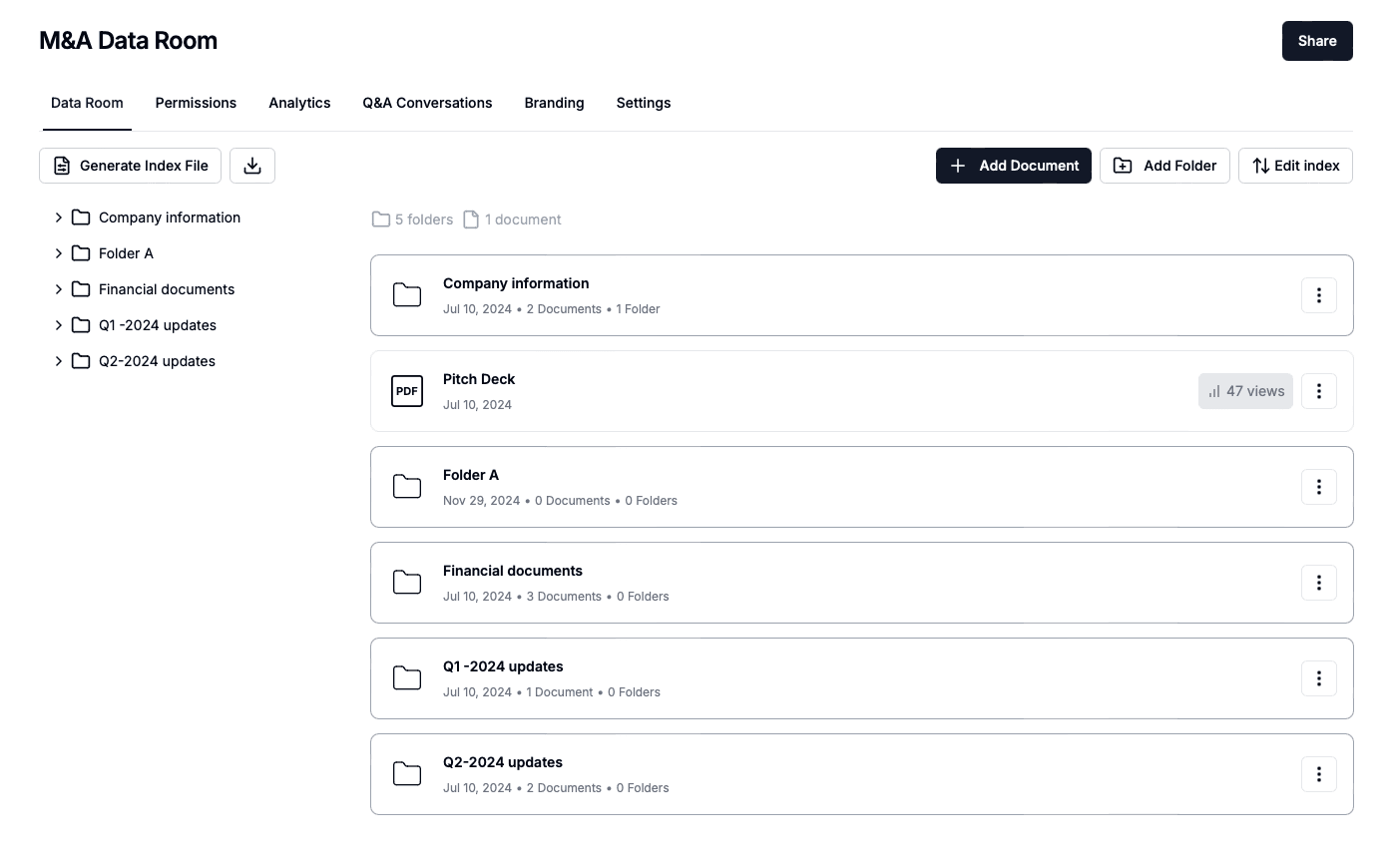
A data room is the secure online workspace where buyers review your documents during diligence. Build it 6 to 12 months before going to market, organized by the workstreams buyers will use: corporate and legal, financial, tax, commercial, HR, IP and technology, and operations. Our guide to data room folder structure and the data room index template give a ready-made structure.
Building early has two benefits. It shows you what is missing while there is still time to fix it, and it means the first buyer request does not land on an empty folder. A mid-market document set commonly runs 400 to 500 files, and assembling it takes 6 to 10 weeks because many documents need something: a signature page, a missing schedule, the current version of a policy.
Plan staged access from the start. Before the LOI, buyers see the CIM and summary financials behind an NDA. After the LOI, the winning buyer gets the detailed contracts, payroll and IP files. For the full list of what buyers will request, see the due diligence request list, and for a comparison of providers, the best virtual data rooms.
Most founders need three advisors to sell a company and should hire them in this order: CPA first, M&A attorney second, banker or broker third.
A CPA or tax advisor comes in 12 to 24 months out, to clean up the financials, model asset versus stock sale outcomes and scope the quality of earnings. An M&A attorney comes in 6 to 12 months out, to run the legal clean-up and later negotiate the LOI and purchase agreement. A banker or business broker comes in 3 to 6 months out to build the buyer list, prepare the CIM and run the process. Sell-side success fees typically run 2 to 5 percent of transaction value; see corporate finance advisory for how fees are structured.
Some founders sell without a banker, usually to a buyer they already know. You still need the attorney and the CPA, and you take on the job of creating competition and keeping deadlines. Our guide to how to sell a company covers both paths.
Valuation for most private companies starts with normalized EBITDA times a multiple. If adjusted EBITDA is $3M and comparable companies sold for 6 to 8 times, the enterprise value range is $18M to $24M. For high-growth software companies, buyers may use a revenue or ARR multiple instead.
What you take home is lower. From enterprise value, subtract debt, transaction fees (advisor, legal, accounting), and any working capital shortfall, add excess cash, then subtract taxes. Part of the price may sit in escrow for 12 to 24 months, and part may be an earnout that depends on future performance.
| Line | Amount |
|---|---|
| Adjusted EBITDA | $3.0M |
| Multiple | 7x |
| Enterprise value | $21.0M |
| Less debt | ($2.0M) |
| Less transaction fees (about 4 percent) | ($0.84M) |
| Less escrow held back (10 percent) | ($2.1M) |
| Cash at close before tax | About $16.1M |
The example is illustrative. The point is that preparation affects each line: a cleaner EBITDA protects the multiple, a prepared working capital analysis protects the peg, and a clean diligence record reduces the escrow and indemnity a buyer asks for.
Use this checklist to track how prepared your company is for acquisition. Each item is something buyers will ask about, and most take weeks or months to complete.
Financial
Legal
Operations
People
Data room
Advisors
Kestrel Labs is a hypothetical B2B software company with $9M of revenue, $1.8M of EBITDA and 55 employees. Its founder, Priya, decides in March of one year that she wants to sell within 18 months.
In the first six months, a CPA moves the company to monthly accrual closes and builds an add-back file. The largest customer is 34 percent of revenue on a one-year contract; the sales team renews it for three years and lands four new mid-sized accounts, bringing the top customer down to 26 percent by month 12. Priya promotes her head of customer success to VP of sales and steps back from key accounts.
In months 7 to 12, an M&A attorney reconciles the cap table and finds two option grants that were never board-approved and a former co-founder with no IP assignment. Both are fixed within eight weeks. The attorney also lists 14 contracts with change-of-control clauses. A sell-side quality of earnings confirms $2.1M of adjusted EBITDA, rejecting one add-back.
In month 12, Priya builds a Papermark data room with seven workstream folders. By month 15 it holds 380 documents, with a pre-LOI tier and a post-LOI tier. A boutique advisor runs the process from month 15; six buyers sign NDAs, three submit LOIs, and the winner's diligence takes 9 weeks instead of the 12 to 16 the advisor had warned about.
The company sells at 8x adjusted EBITDA. Priya's advisor attributes about one turn of the multiple to lower concentration and a management team that could run without her.
Worked scenario. Most of the value was created in the first 12 months, before any buyer was contacted.
A data room for acquisition readiness is the secure workspace where you assemble your diligence documents months before a sale, and where buyers later review them under controlled access. Building it early turns a launch-week scramble into a background task.
Papermark is a secure, fully customizable, and developer-friendly data room built for modern dealmakers, with page-by-page analytics, dynamic watermarking, unlimited data room visitors and transparent pricing. It offers a public API, CLI and MCP server for teams that automate setup, and is open source.
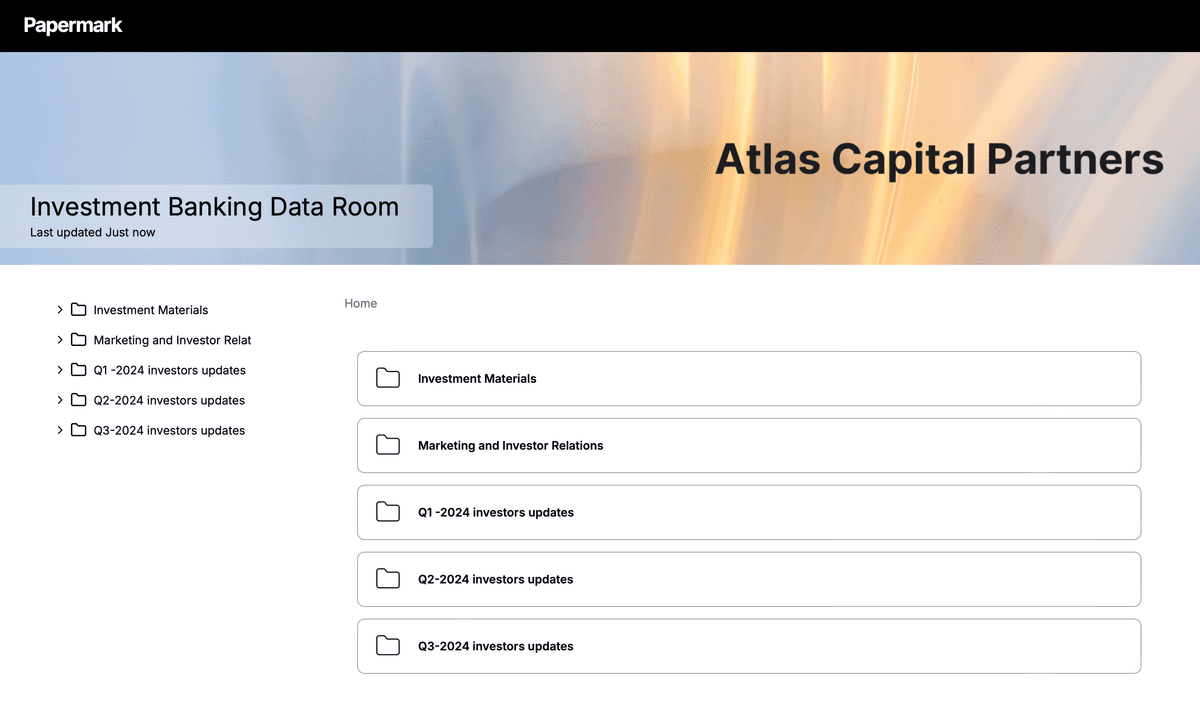
A readiness room built 6 to 12 months before the sale, organized by buyer workstream.
A data room shows you what is missing while you can still fix it. It also lets you control which buyer sees what and when, and keeps a record of everything disclosed, which matters when warranty claims arrive after closing. A shared drive gives you one permission set and no record of who read what.
Create one room with a folder per workstream. Automatic file indexing numbers every document as you upload it, so references stay stable as the room grows from 50 to 500 files.
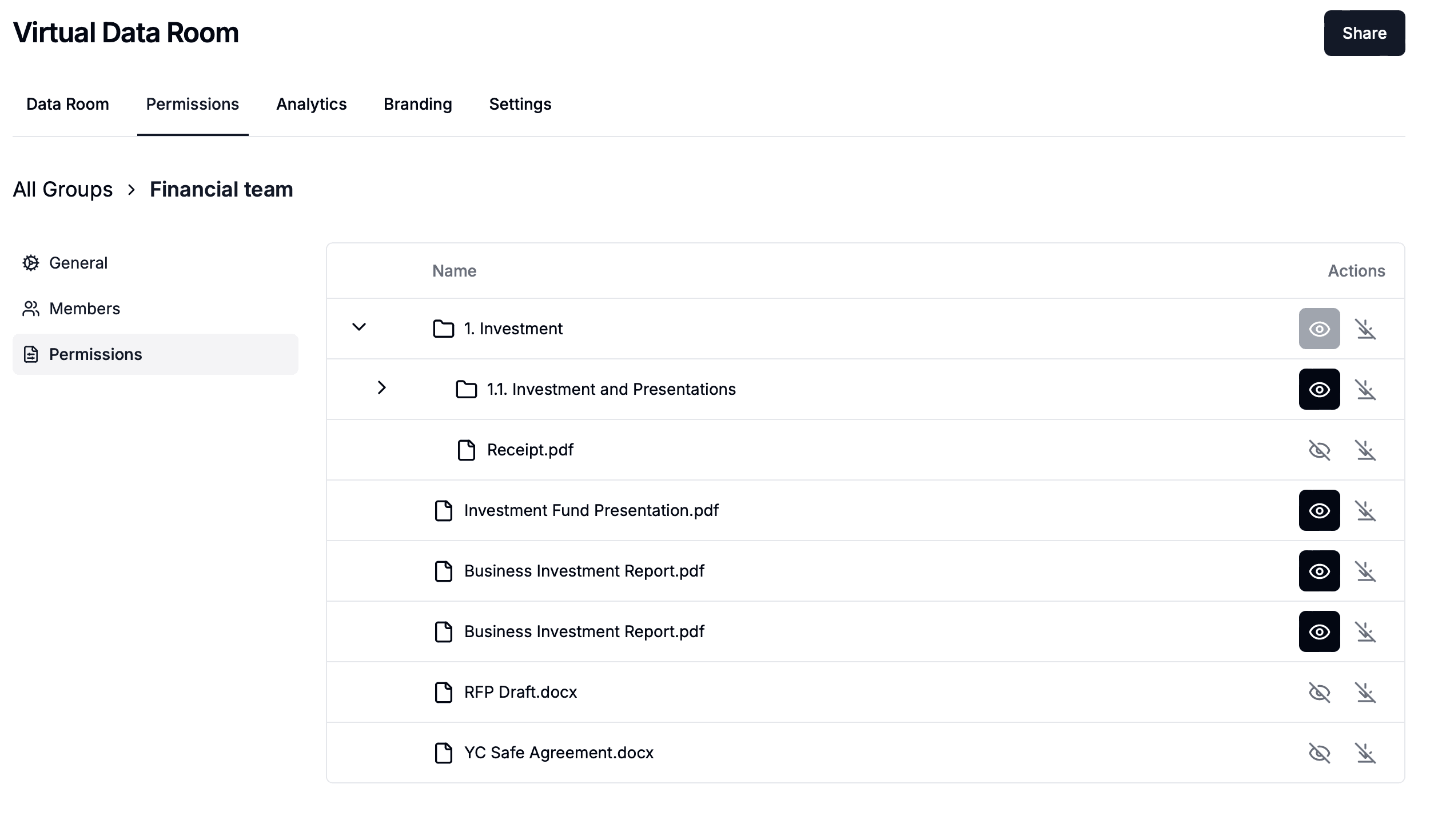
Create a pre-LOI tier and a post-LOI tier, and use granular permissions so each buyer sees only the tier it has reached.
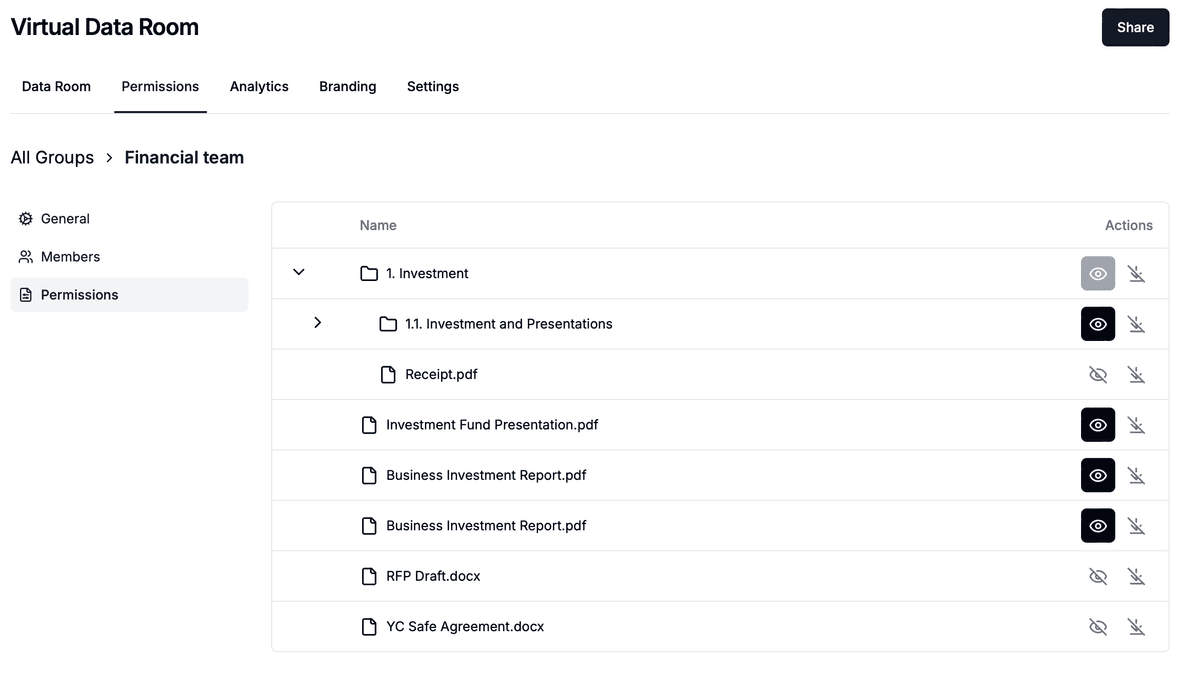
Staged access is set per folder and per buyer group, not by duplicating files.
Require an NDA before any document opens and apply dynamic watermarking to financials and customer data, so every page shows the viewer's email and a timestamp.

Every page a buyer opens carries their identity.
Import a standard diligence checklist into the request list so you can see what is still missing months ahead, and later track buyer requests by status and owner.
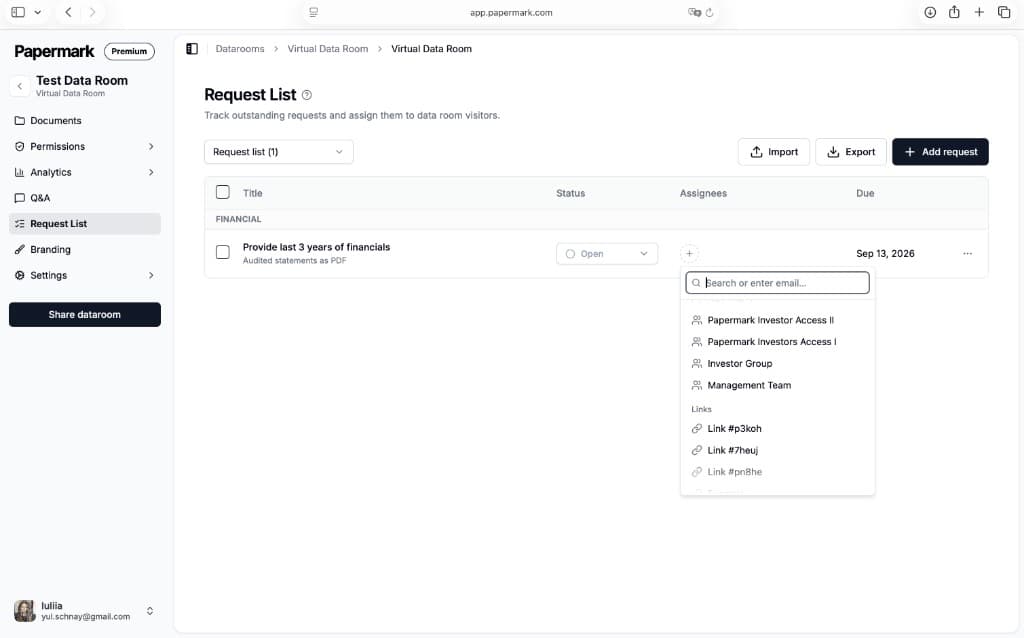
The request list tracks every diligence item from open to completed.
Page-by-page analytics show which buyer read which document and for how long, a useful signal when you decide who to take to management meetings.

Papermark is our #1 VDR provider for M&A transactions right now. In two deals we used custom branding, dynamic watermarking, and granular permissions.
Tyler
The Data Rooms plan is $99/month with a 7-day free trial, and includes 3 team members, unlimited data room visitors, unlimited data rooms and documents, a custom domain, dynamic watermarking, NDA agreements, granular file-level permissions and the request list. Q&A is on Data Rooms Plus, and AI redaction is on Data Rooms Premium and above.
No credit card required.
How to sell a company in 2026: 10 steps from valuation to closing, with timelines, broker fees, asset vs stock sale tax, and when to open a data room.
Entrepreneurship through acquisition in 2026: four search models, SBA financing up to $5M, an 8-step process, and the data room for an ETA acquisition.

Letter of intent acquisition guide for 2026: the 9 terms that decide the deal, which clauses bind, the no-shop trap, and the data room for the LOI stage.