




mergers-and-acquisitions
Sell-side due diligence in 2026: how to stop buyers retrading the price
Sell-side due diligence in 2026: the 6-step process, what a sell-side QoE costs, the retrade it prevents, and the data room for sell-side due diligence.
A sell-side M&A process is the structured way a founder sells a company: you prepare the numbers and documents, contact several buyers at once, collect bids in rounds, pick one letter of intent, and close after confirmatory diligence. For a first-time founder it typically runs 6 to 9 months, and a secure data room such as Papermark holds the documents from week one.
Most founders sell a company once. The buyers across the table, whether a corporate development team or a private equity fund, run acquisitions every quarter. That asymmetry is the whole reason a sell-side M&A process exists: it replaces one-on-one negotiation with a calendar, a set of rules and competing bids, so the experienced party cannot dictate the pace.
This playbook follows the process week by week, with the outcome of each phase and the founder's job in it. It also covers the part founder guides usually skip: how to configure the data room so documents go to the right bidder at the right time.
A sell-side M&A process is a sale that the seller organizes and controls. "Sell-side" simply means you, the founder and your advisors, are on the selling side of the table. The opposite is buy-side, where an acquirer runs its own search and diligence.
The practical difference between a process and an offer is competition. Many founders first think about selling when an inbound email arrives from a strategic acquirer. That is an offer, not a process. With one bidder, the buyer controls the timetable, the information it asks for, and the moment it moves the price. With four or five bidders working to the same deadlines, those levers move back to the seller.
A run process does not need to be a formal auction with dozens of buyers. For a founder-led software or services company, a targeted process of 20 to 60 contacted buyers, 8 to 15 signed NDAs and 3 to 6 indications of interest is common. What matters is that several credible buyers see the same information at the same time and bid against the same deadline.
There is also a sequencing logic. A buyer's leverage peaks after the letter of intent, once you have granted exclusivity and stopped talking to others. Everything in a sell-side M&A process is designed to make the company as well understood as possible before that moment, so confirmatory diligence confirms rather than discovers. Our guide to sell-side due diligence covers the pre-launch review in depth.
| Situation | Who sets the timetable | Price tension | Typical outcome |
|---|---|---|---|
| Single inbound offer | The buyer | None, unless you create it | Faster, but price and terms set by one party |
| Targeted process (3 to 6 bidders) | Seller and advisor | Moderate to strong | Common for founder-led companies |
| Broad auction (10+ bidders) | Seller and advisor | Strongest | Larger assets with many logical buyers |
The sell-side M&A process below is a well-run, founder-led sale counted from kickoff. The weeks are market convention for a company with a few million to a few tens of millions of revenue, and they compress on smaller deals. The order rarely changes, because each phase produces the information the next one needs.
| Weeks | Phase | What happens | Founder's job | Data room action |
|---|---|---|---|---|
| 1 to 6 | Preparation | Financial clean-up, metrics pack, teaser, CIM, buyer list | Approve the story, gather documents | Scaffold folders, upload tier-1 files |
| 5 to 10 | Outreach and NDAs | Teaser goes out, NDAs signed, CIM released | Intro calls with interested buyers | NDA gating on, one link per bidder |
| 9 to 12 | Indications of interest | Process letter, written IOIs with value ranges | Review IOIs with your advisor | Read per-bidder engagement |
| 12 to 16 | Management meetings and LOIs | Presentations, site visits, final LOIs | Present the business, answer questions | Open tier-2 folders to finalists |
| 16 to 28 | Confirmatory diligence | Buyer advisors review, purchase agreement drafted | Answer questions, keep running the company | Request list and Q&A for the winner |
| 28 to 36 | Signing and closing | Final negotiation, signing, funds flow | Tell the team, plan the transition | Freeze and archive the room |
Preparation turns your company into something a stranger can evaluate in an afternoon. That means monthly financials for the last 24 to 36 months on a consistent basis, a normalized EBITDA or a clean ARR bridge, a list of the documents buyers will request, and a story about why the business is worth more in someone else's hands. Your advisor drafts the teaser and the CIM; you supply the facts.
Outcome: a buyer list, a teaser, a CIM draft and a data room with the first tier of documents uploaded. Founder's job: decide the story and the walk-away terms, then gather documents without telling the wider team.
The advisor contacts buyers with a no-names teaser. Interested parties sign an NDA and receive the CIM. Run outreach in parallel, not sequentially: contacting buyers one at a time hands the first one a head start and removes any deadline pressure.
Outcome: 8 to 15 signed NDAs and buyers reading the CIM. Founder's job: short intro calls and nothing more. Detailed numbers wait for the next round.
A process letter asks every buyer for a written indication of interest (IOI) by the same date. An IOI gives a valuation range, the proposed structure, funding sources and what diligence the buyer still needs. You and your advisor rank them on value, certainty and fit, then invite three to five buyers forward.
Outcome: a shortlist. Founder's job: read every IOI with the advisor and decide who gets management time.
Shortlisted buyers meet the management team, see a deeper level of data and submit a final letter of intent. The LOI names a price, a structure and an exclusivity period. Our guide to the letter of intent in an acquisition explains which clauses bind.
Outcome: one signed LOI with a hard exclusivity end date. Founder's job: present well, compare LOIs on net proceeds rather than headline price, and hold back exclusivity until the terms are right.
The winning buyer's accountants, lawyers and specialists now confirm what they were told. This is the longest phase and the one where retrades happen. Our guide to how long due diligence takes breaks the period down by workstream.
Outcome: a negotiated purchase agreement and disclosure schedules. Founder's job: answer questions fast and keep revenue on plan, because a missed quarter during diligence is the most common trigger for a price cut.
Signing and closing can be simultaneous or separated by regulatory approvals or third-party consents. Funds flow, escrow is set up, and the announcement goes out.
Outcome: a closed deal and an archived record of what was disclosed. Founder's job: communicate with employees, customers and investors on a plan agreed with the buyer.
A first-time founder needs three advisors on almost every sale and a fourth on most. Hiring them early is cheaper than hiring them late, because each one shapes decisions made in the first six weeks.
The sell-side advisor or investment banker runs the calendar: builds the buyer list, drafts the teaser and CIM, manages outreach, collects bids and negotiates. Success fees typically run 2 to 5 percent of transaction value, often on a Lehman-style declining scale, sometimes with a monthly retainer and a minimum fee. Our guide to corporate finance advisory breaks down how those fees stack.
M&A counsel negotiates the LOI, the purchase agreement and the disclosure schedules. Use a lawyer who does M&A every week, not your general company counsel, because the purchase agreement is where indemnities, escrow and caps are decided.
A CPA or quality of earnings provider tests your EBITDA, add-backs and working capital before buyers do. A sell-side quality of earnings report typically costs $15,000 to $25,000 below $3M of EBITDA, more above it. A fractional CFO is worth considering when there is no finance lead who can answer diligence questions without the founder.
On smaller deals, a banker's minimum fee can consume a large share of proceeds, and some founders sell without one, usually to a buyer they already know or through a business broker. If you do, you inherit the banker's job: a written buyer list, a common bid deadline, an NDA before any data leaves, and a data room you control. You still need M&A counsel. The guide to tools to sell a business lists the software stack for a founder-run sale.
Buyers expect four sets of materials in a sell-side M&A process, and each is released at a different stage. Getting the order right is as important as getting the content right, because what a buyer sees early sets the anchor for its price.
The teaser is a one or two page anonymous summary: sector, size, growth, margins and why the business is for sale. It goes to every contacted buyer and contains nothing that identifies the company to a competitor.
The confidential information memorandum (CIM) is the 30 to 60 page document a buyer receives after signing an NDA. It covers the market, product, customers, team, financial history and the projections. See how to share a confidential information memorandum and control who reads it, and the guide to CIM distribution for sending it to several buyers.
The financial model and metrics pack supports the CIM. For a software company that means ARR and MRR bridges, cohort retention, churn, CAC and payback, and gross margin by product. For a services company it means revenue by customer, utilization and backlog.
The data room index is the structure of the documents buyers will review in diligence, organized by workstream: corporate and legal, financial, tax, commercial, HR, IP and technology. A buyer-ready index from week one shortens diligence later. Our data room index template gives a numbered structure, and the due diligence request list shows what buyers will ask for.
| Material | Length | Released to | Stage |
|---|---|---|---|
| Teaser | 1 to 2 pages | Every contacted buyer | Weeks 5 to 10, before NDA |
| CIM | 30 to 60 pages | Buyers who signed the NDA | Weeks 6 to 10 |
| Model and metrics pack | Spreadsheet plus summary | Buyers preparing IOIs | Weeks 8 to 12 |
| Data room tier 1 | Summary financials, corporate docs | Shortlisted bidders | Weeks 12 to 16 |
| Data room tier 2 | Contracts, payroll, customer data | LOI winner | Weeks 16 to 28 |
Buyer tension is what turns several interested parties into a better price. It comes from three things: parallel timing, common deadlines and visible competition.
Parallel timing means every buyer receives the teaser in the same week and the CIM in the same window. A buyer who knows it is early and alone will slow down. Common deadlines mean the process letter sets one date for IOIs and one date for LOIs, and your advisor holds to them. Visible competition means buyers know, without being told names, that others are at the same stage.
The data room adds a fourth signal that founders rarely use: engagement. When each bidder has its own link, page-level analytics show which buyer read the CIM twice, which spent an hour in the customer cohort analysis, and which has not opened anything in ten days. That is the difference between a buyer preparing a serious bid and one collecting market intelligence. Our guide to tracking buyer engagement on deal documents shows what to read in the data.
The competitive mechanics, including how many rounds to run and how to score bids, are covered in the guide to the competitive bidding process.
First-time founders rarely lose leverage on price. They lose it on sequence and terms, usually in the four weeks around the LOI. These are the five most common ways, all avoidable.
Granting exclusivity too early. Exclusivity stops you talking to other buyers. Granting it on an IOI, or with no hard end date, turns a competitive process into a single-buyer negotiation. Keep it to 45 to 60 days with dated milestones.
Opening the full data room before the LOI. A buyer who has seen every contract and payroll file before signing an LOI has nothing left to learn and every reason to bid low. Release summary data before the LOI and the detail after. The guide to sharing financials with potential buyers gives a stage-by-stage release plan.
Letting a buyer set the timetable. "We need another three weeks" from one bidder is a request; agreeing to it for that bidder alone tells the others the deadline was soft.
Ignoring the working capital peg and escrow. Two LOIs with the same headline price can differ by 10 percent of net proceeds once peg, escrow and earnout are modeled. See the working capital adjustment guide.
Telling the team too early. A leak to employees before the LOI creates attrition risk that buyers will price in. Most founders tell a small inner circle under NDA and the wider team at or just before signing.
A founder does not sell alone. Investors, option holders and key employees all have a stake in a sell-side M&A process, and handling them in the wrong order can stall a deal late.
Board and investor consent. Check your shareholder agreement for drag-along rights, protective provisions and liquidation preferences before outreach. Preferred investors often have a vote on a sale, and a 1x preference changes how proceeds split at lower prices. Bring the lead investors in at kickoff; surprises in week 28 are expensive.
Option holders. Reconcile the option ledger against board approvals before diligence starts. Unapproved grants and missing exercise records are among the most common legal findings in startup diligence, and fixing them takes weeks.
Key employees. Buyers will ask who is critical and whether they stay. Retention packages are usually negotiated with the buyer after the LOI, but you should know your list in week one.
When to tell the team. Most founders tell a small group, often the CFO, the head of product and one or two others, under a confidentiality agreement during preparation. The wider team hears at or near signing, with a plan from the buyer.
Northbeam Analytics is a hypothetical B2B SaaS company with 40 employees, $6.2M of ARR growing 35 percent and positive EBITDA. Its founder, Lena, receives an unsolicited approach from a larger competitor in January. Instead of negotiating alone, she hires a boutique sell-side advisor and an M&A lawyer.
In weeks 1 to 6, the CFO rebuilds 36 months of monthly financials on an accrual basis, a CPA runs a light quality of earnings, and the advisor drafts the teaser and a 42-page CIM. Lena creates a Papermark data room on day three, with seven workstream folders, and uploads the corporate documents and summary financials first. By week six the room holds 180 documents.
In weeks 5 to 10, the advisor contacts 38 buyers. Eleven sign the NDA, and each receives its own link to the CIM. Page analytics show four buyers reading the cohort analysis in depth, and two who never open the CIM. In week 11, five IOIs arrive, ranging from 5.5x to 8x ARR.
Four buyers attend management presentations in weeks 12 to 14 and get access to tier-1 folders. Three submit LOIs in week 16. The highest headline price comes with a 30 percent earnout and 90 days of exclusivity. Lena signs the second-highest, mostly cash, with 50 days of exclusivity and a hard end date.
During confirmatory diligence, the buyer's teams work through a request list of 214 items. The room grows to 412 documents. Customer contracts and payroll stay view-only and watermarked. The deal signs in week 27 and closes in week 30. Lena freezes the room and keeps the archive as the disclosure record.
Worked scenario. Confirmatory diligence and closing took more time than everything before the LOI combined.
A data room for your sell-side process is the secure workspace where every buyer reads the CIM, the financials and, later, the full diligence file. It replaces email attachments and shared drives because a sell-side process needs different access for different bidders at different stages, plus a record of who saw what.
Papermark is a secure, fully customizable, and developer-friendly data room built for modern dealmakers, with page-by-page analytics, dynamic watermarking, unlimited data room visitors and transparent pricing. It also offers a public API, CLI and MCP server for teams that automate room setup, and is open source.
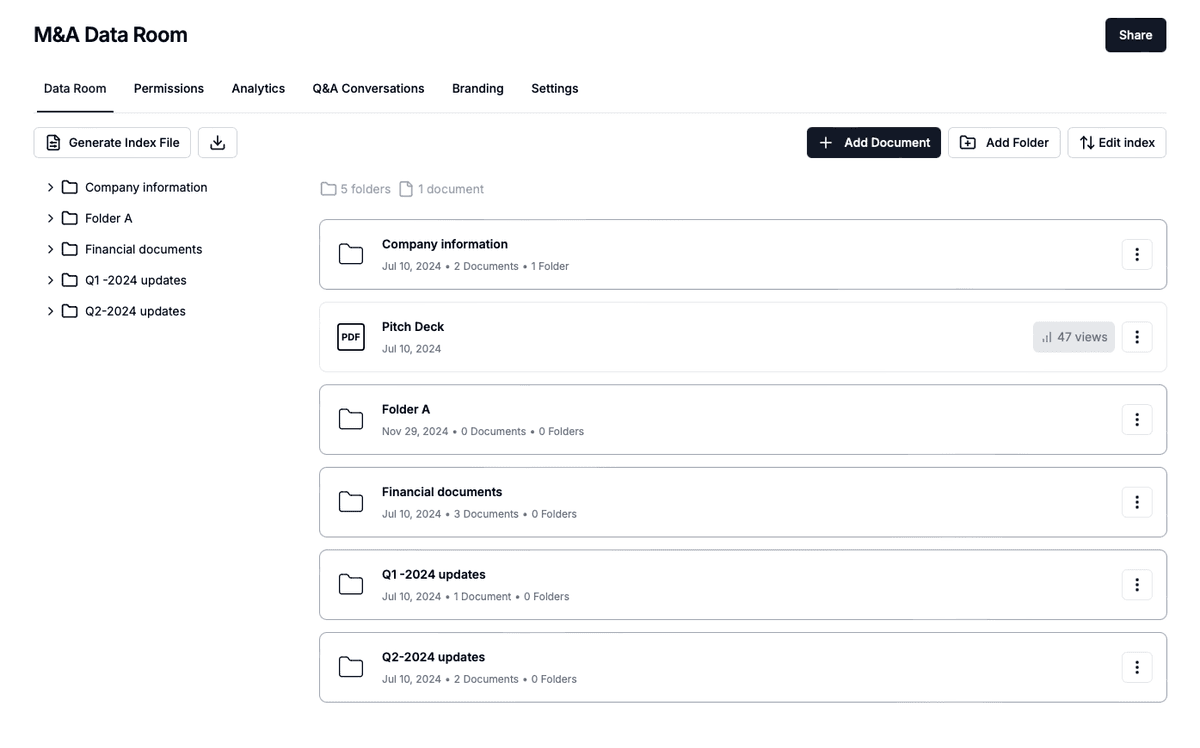
A sell-side room scaffolded in week one, with folders that mirror the buyer's diligence workstreams.
The first reason is staging. A sell-side M&A process releases information in tiers: teaser, then CIM, then summary financials, then the full diligence file to one buyer. A shared drive offers one permission set, so founders end up emailing attachments that cannot be tracked or revoked.
The second is evidence of interest. Per-bidder analytics tell you which buyers are doing real work before you choose who gets management time. The third is the disclosure record: what you showed the buyer limits what they can later claim under the warranties, and an audit log is the proof. If you are still comparing platforms, see our review of the best virtual data rooms.
Create one room for the transaction, with a top-level folder per workstream: corporate and legal, financial, tax, commercial, HR, IP and technology, and operations. Automatic file indexing numbers documents as they arrive, so "document 3.2.4" means the same thing in week 4 and week 24. Use the data room index template as a starting structure.
Split folders into what a shortlisted bidder sees before the LOI (summary financials, corporate documents, product overview) and what only the LOI winner sees (full customer contracts, payroll, detailed IP). Granular permissions let you set this per folder and per file, then open tier 2 with a single change when the LOI is signed.
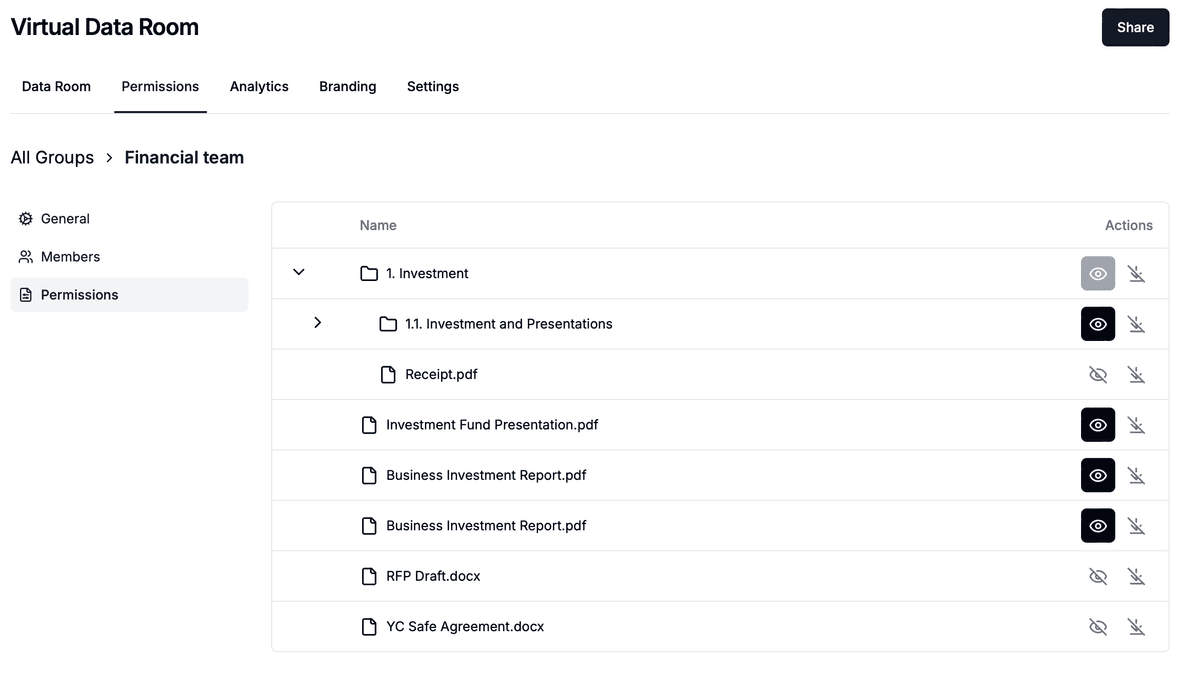
Permissions decide which tier each bidder sees, without duplicating files.
Give each buyer its own link or visitor group, with an email allowlist and an NDA that must be accepted before any document opens. Visitors do not need an account, which matters when a buyer's corporate development team forwards the link to its own advisors.
Turn on dynamic watermarking for financials, customer lists and contracts, so every page shows the viewer's email and a timestamp. Set the most sensitive folders to view-only. A watermark does not stop a leak, but it makes every leaked page traceable to a named reader.

Dynamic watermarks put the viewer's identity on every page of the financials.
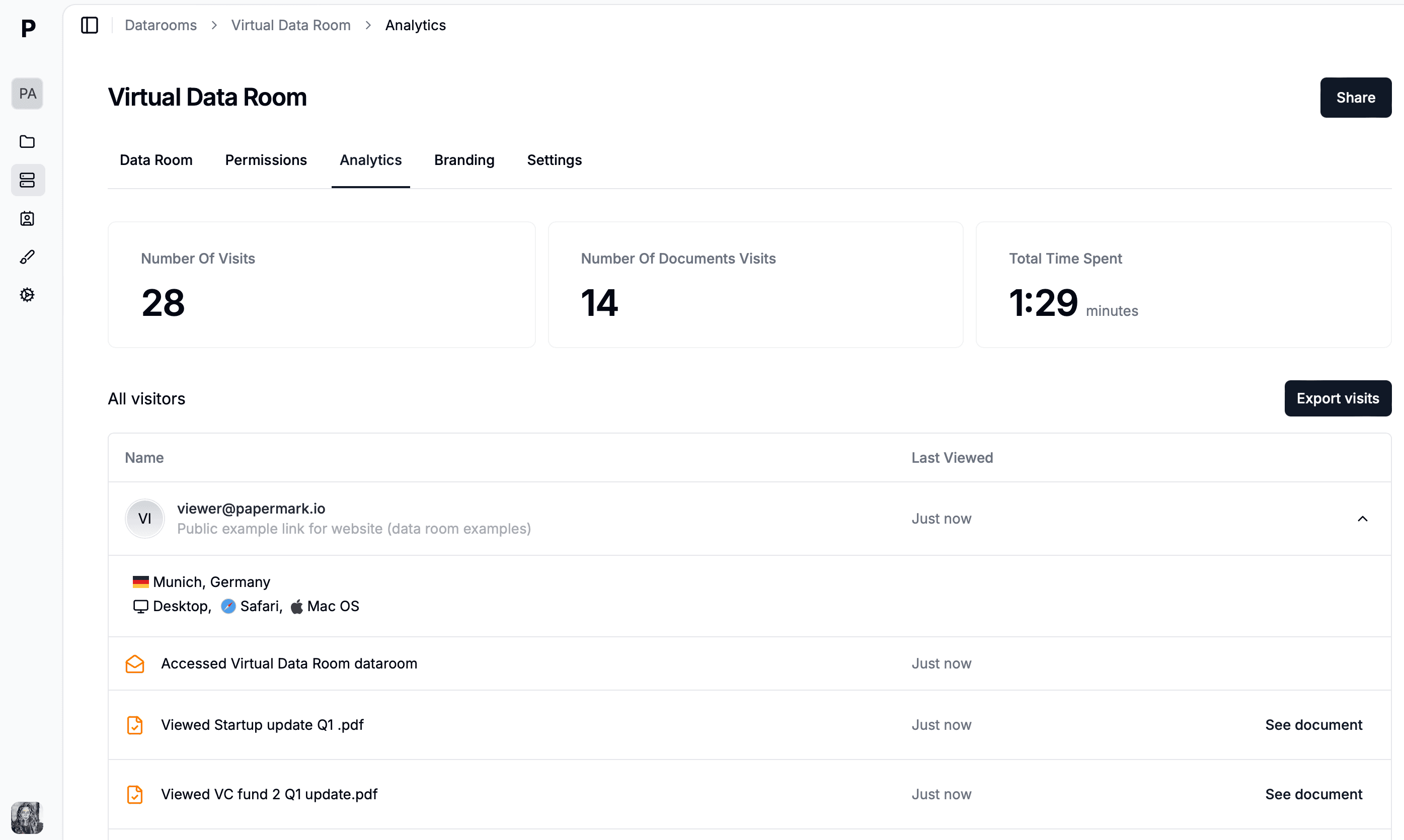
Page-by-page analytics show which bidder read what and for how long, which is a signal to weigh alongside the IOI. In diligence, load the buyer's checklist into the request list so both sides see what is open, submitted and complete. Teams that want buyer questions handled inside the room can use the Q&A module on Data Rooms Plus. At close, data room freeze makes the room read-only and archives it as your disclosure record.
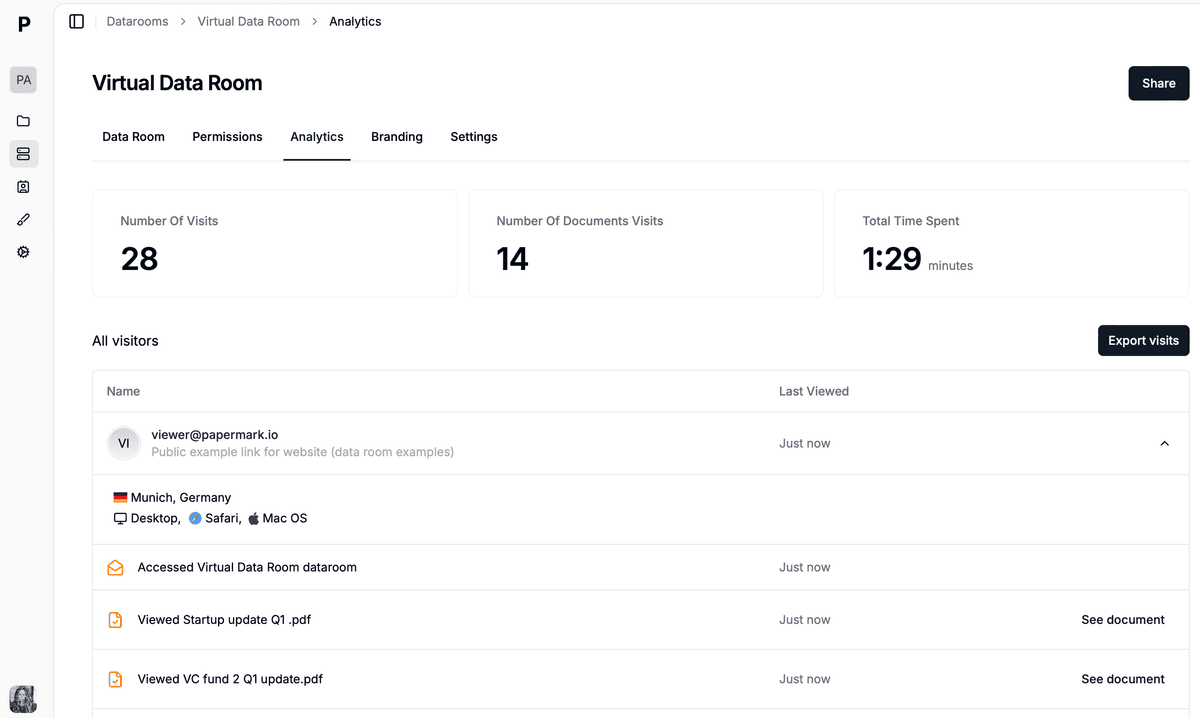
Per-bidder analytics show who is doing real work before you shortlist.

Papermark is our #1 VDR provider for M&A transactions right now. In two deals we used custom branding, dynamic watermarking, and granular permissions.
Tyler
The Data Rooms plan is $99/month with a 7-day free trial, and includes 3 team members, unlimited data room visitors, unlimited data rooms and documents, a custom domain, dynamic watermarking, NDA agreements, granular file-level permissions and the request list. The Q&A module is on Data Rooms Plus, and AI redaction is on Data Rooms Premium and above. Papermark is SOC 2 Type II certified.
No credit card required.
Sell-side due diligence in 2026: the 6-step process, what a sell-side QoE costs, the retrade it prevents, and the data room for sell-side due diligence.
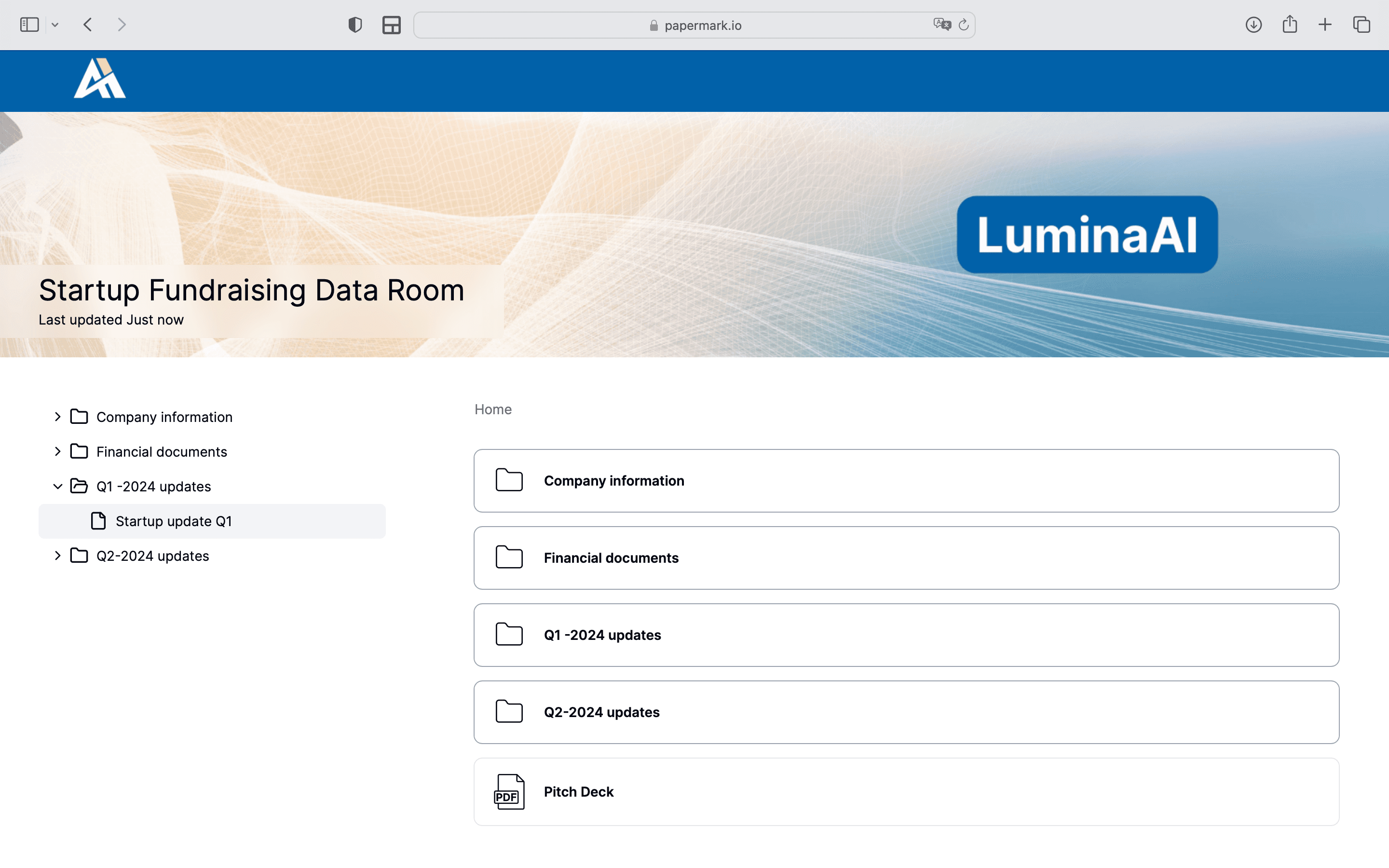
The M&A due diligence process in 2026: how long it takes (30-90 days), a week-by-week timeline, what buyers ask for by workstream, and the data room setup.
Competitive bidding process for selling a business in 2026: the 4 auction types, 5 rounds, process letter, bid scoring matrix and data room setup per bidder.