



mergers-and-acquisitions
Buy-side due diligence in 2026: what it really costs before you sign
Buy-side due diligence in 2026: the 7 workstreams, the LOI to signing timeline, real fee ranges, and how to run a data room for buy-side due diligence.
Before signing a letter of intent, a seller should have diligence-ready financial and legal records, know their walk-away price and acceptable deal structure, negotiate exclusivity length and diligence scope, decide what information the buyer gets and when, and have M&A counsel and a CPA review the draft. A secure data room such as Papermark holds the documents from day one.
Most sellers treat the LOI as a formality before the real contract. It is not. The LOI fixes the price range, the structure and, above all, the exclusivity period. Once you sign it, you stop talking to other buyers, and every question the buyer raises in diligence becomes a negotiation you enter without alternatives.
That is why the work happens before the signature. This checklist covers the five things a seller should have ready: documents, numbers, terms, an access plan and advisors.
The most useful thing a seller can do before signing an LOI is assemble the documents the buyer will request in diligence. Once exclusivity starts, the clock runs on your side: a 45-day exclusivity period spent hunting for a signed lease or a missing board consent is 45 days of leverage spent on admin.
A buyer that receives organized, complete documents in week one also reads it as a signal. Prepared sellers get fewer follow-up questions and fewer surprises, and surprises are what lead to a retrade. Our due diligence request list shows the full set buyers ask for; the items below are the ones to have ready before the LOI.
Before you read an LOI, know the lowest price you will accept and the structure you can live with. A letter of intent to purchase a business rarely offers only a price; it offers a combination of cash at close, deferred payments and conditions, and two offers with similar headlines can be very different deals.
The headline price is enterprise value. What you take home is that number minus debt, transaction fees, taxes, escrow and any working capital shortfall, plus cash in the business if the deal is cash-free and debt-free. Ask your CPA for a net proceeds estimate on each offer, including the after-tax difference between an asset sale and a stock sale.
Cash at close is certain. A seller note is a loan you make to the buyer, paid over time and subordinated to its bank. An earnout pays only if future targets are met, often under the buyer's control. Rollover equity means you keep a stake in the combined business, which can be valuable with a private equity buyer but is not cash.
Escrow sets aside part of the price, often 5 to 15 percent, for 12 to 24 months to cover indemnity claims. Representations and warranties insurance can reduce it. See our guide to representations and warranties insurance.
| Term | Offer A: $5.0M | Offer B: $4.5M |
|---|---|---|
| Cash at close | $3.0M | $4.05M |
| Earnout | $1.0M over 3 years, revenue target | None |
| Seller note | $1.0M over 4 years | None |
| Escrow | 10 percent for 18 months | 10 percent for 12 months |
| Exclusivity | 90 days | 45 days |
| Expected cash in hand at close | About $2.5M after escrow | About $3.6M after escrow |
The table is illustrative, but the pattern is common: the higher headline offer often carries less cash at close, more risk and a longer lock-up. Many sellers prefer Offer B once the earnout is discounted for the chance it does not pay.
The working capital peg is the normal level of net working capital (receivables plus inventory minus payables and accrued liabilities) the business must deliver at closing. If actual working capital at close is below the peg, the price drops by the difference, dollar for dollar.
Sellers often leave the peg as "to be agreed in the definitive agreement." That defers the fight to a point where the buyer has exclusivity. Instead, propose the method in the LOI: usually a trailing 12-month average, adjusted for seasonality.
A simple example: a business with average monthly net working capital of $800,000 signs an LOI with a peg of $1.0M because the buyer used a peak month. At close, working capital is $820,000, and the seller loses $180,000 that a properly set peg would have kept. Our guide to the working capital adjustment covers the calculation.
Cash and debt treatment matters as much. Most deals are cash-free and debt-free, which means you keep the cash and pay off the debt. Agree in the LOI what counts as debt: deferred revenue, unpaid taxes, accrued bonuses and capital leases are often argued about later.
Exclusivity is the clause that most changes the balance of power. It commits you to stop negotiating with other buyers for a period, typically 30 to 90 days, with 45 to 60 days most common in the middle market. It is usually binding.
Negotiate three things. First, a hard end date, with no automatic renewal. Second, dated milestones (diligence complete, first draft of the purchase agreement, financing commitment) that let exclusivity lapse if the buyer slips. Third, a definition of what "satisfactory diligence" means, because an unlimited diligence condition is a free option for the buyer.
Diligence scope and timing belong in the LOI too. Agree which workstreams the buyer will run (financial, legal, tax, commercial, IT), whether third-party reports such as a quality of earnings are required, and when the request list will arrive. Our guide to how long due diligence takes gives typical durations per workstream.
The access plan answers a simple question: what does each buyer see, and when? Without one, sellers either share too little (and slow the process) or too much (and give a buyer, or a competitor posing as one, everything before they have committed).
Put an NDA in place before any data leaves the company. Before the LOI, buyers need enough to price the business: the confidential information memorandum, summary financials, a customer concentration overview with names removed, and the cap table summary. Share these view-only and watermarked. See how to share a confidential information memorandum.
After the LOI, the winning buyer gets the full diligence file: customer contracts, employee records, detailed financials and IP documentation. Opening this tier only to the LOI winner protects you if the deal fails.
If the buyer is a competitor, customer pricing, margins by customer and employee compensation should go to a clean team of outside advisors who report only aggregated findings. The guide to sharing financials with potential buyers gives a stage-by-stage release table.
| Stage | What the buyer sees | Controls |
|---|---|---|
| Before NDA | Anonymous teaser | No company name, no data room access |
| NDA to LOI | CIM, summary financials, anonymized customer data | NDA gate, view-only, dynamic watermark |
| After LOI | Full contracts, payroll, detailed financials, IP | LOI winner only, per-folder permissions |
| Competitor buyer | Pricing and employee detail | Clean team folder, named advisors only |
Also write "access to information" into the LOI. Define who on the buyer side gets access, when management interviews may happen, and that the buyer may not contact customers, suppliers or employees without your consent.
Almost every LOI says it is non-binding, and almost every LOI has a few clauses that are binding from signature. Know which ones before you sign, because those are the ones you cannot renegotiate later. Our full guide to the letter of intent in an acquisition covers each term.
| Clause | Usually binding? | Seller watch-out |
|---|---|---|
| Price and structure | Still sets the anchor for everything that follows | |
| Working capital mechanism | Agree the method now, not after exclusivity | |
| Exclusivity or no-shop | Hard end date, no automatic renewal | |
| Confidentiality | Check it covers the buyer's advisors and lenders | |
| Expenses | Each side usually pays its own costs | |
| Governing law | Matches the jurisdiction of the purchase agreement | |
| Conditions to closing | Avoid open-ended diligence satisfaction clauses |
A clause can also become binding by accident if the language is loose. Ask counsel to check that the LOI states clearly which sections bind and that the rest does not.
You need at least two advisors before the draft LOI arrives, and often a third. Each one reviews a different part of the document.
An M&A attorney reviews the binding clauses, exclusivity, conditions to closing, the indemnity framework and anything that will carry into the purchase agreement. Use a lawyer who negotiates acquisitions regularly. A CPA or tax advisor models net proceeds after tax, compares asset and stock sale treatment, and checks the working capital and debt definitions. A banker or business broker, if you have one, compares the LOI against the other bids and the market, and decides how to use the competing offers.
If you are running the sale without a banker, our guide to the sell-side M&A process shows how to keep several buyers moving to the same deadline, and the guide to corporate finance advisory explains typical fees.
A commercial real estate LOI works the same way but asks for different documents and terms. Before signing, a seller should have the rent roll, trailing 12-month operating statements (the T-12), copies of all leases with amendments, tenant estoppel status, service contracts, recent capital expenditure records, environmental reports and the title policy.
Watch three terms in a property LOI. The due diligence period (often 30 to 60 days) and whether the buyer can extend it. The earnest money deposit, how much it is and when it becomes non-refundable. And closing conditions such as financing contingencies. A data room helps here too: tenant files and leases are confidential and need the same staged access as an operating company.
Harbor Field Services is a hypothetical HVAC services company with $14M of revenue and $2.3M of adjusted EBITDA. Its owner, Dan, has two interested buyers: a private equity platform and a regional competitor. Both want to submit an LOI within a month.
In week one, Dan hires an M&A attorney and asks his CPA for a net proceeds model. The CPA reconciles three years of financials to the tax returns and documents $310,000 of add-backs, dropping a $90,000 item that would not survive a buyer's quality of earnings.
In week two, Dan creates a Papermark data room with two tiers. Tier 1 holds the CIM, summary financials and an anonymized customer concentration table. Tier 2 holds 38 customer service contracts, payroll and the lease. Both buyers get their own NDA-gated link to tier 1, view-only and watermarked.
In week three, the analytics show the competitor's team spending most of its time in the customer table, and the platform reading the financials and the lease. The LOIs arrive in week four: the competitor at $15.5M with a $3M earnout, the platform at $14.8M with $13.3M cash at close and 45 days of exclusivity. The CPA's model shows the platform delivering $0.8M more cash at close, before even discounting the competitor's earnout for the chance it never pays.
Dan signs with the platform, with a working capital peg based on a seasonally adjusted 12-month average written into the LOI. Tier 2 opens to the platform's advisors the same day, and diligence closes in 52 days.
Worked scenario. Most documents were ready before the LOI, but the sensitive tier opened only to the winning buyer.
Use this list in the two to six weeks before you expect LOIs. Each item is something that is far harder to do after exclusivity starts.
Documents
Terms
Access
Advisors
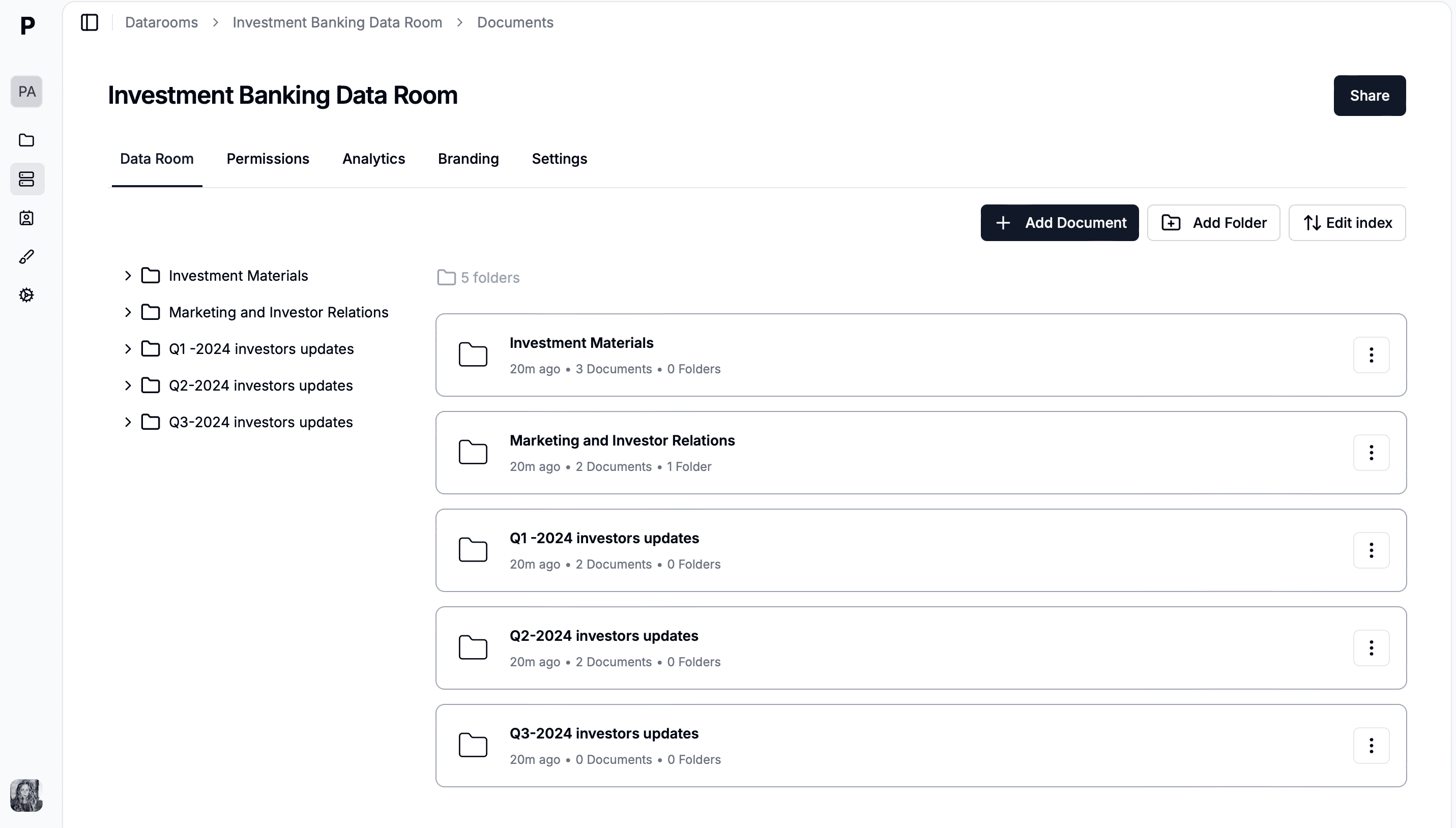
A data room for the LOI stage is a secure, permissioned workspace where buyers read what they need to price the business before the LOI, and where the winning buyer gets the full diligence file after it. It replaces email attachments, which cannot be revoked or tracked once sent.
Papermark is a secure, fully customizable, and developer-friendly data room built for modern dealmakers, with page-by-page analytics, dynamic watermarking, unlimited data room visitors and transparent pricing. Teams that automate setup can use its public API, CLI and MCP server. It is also open source.
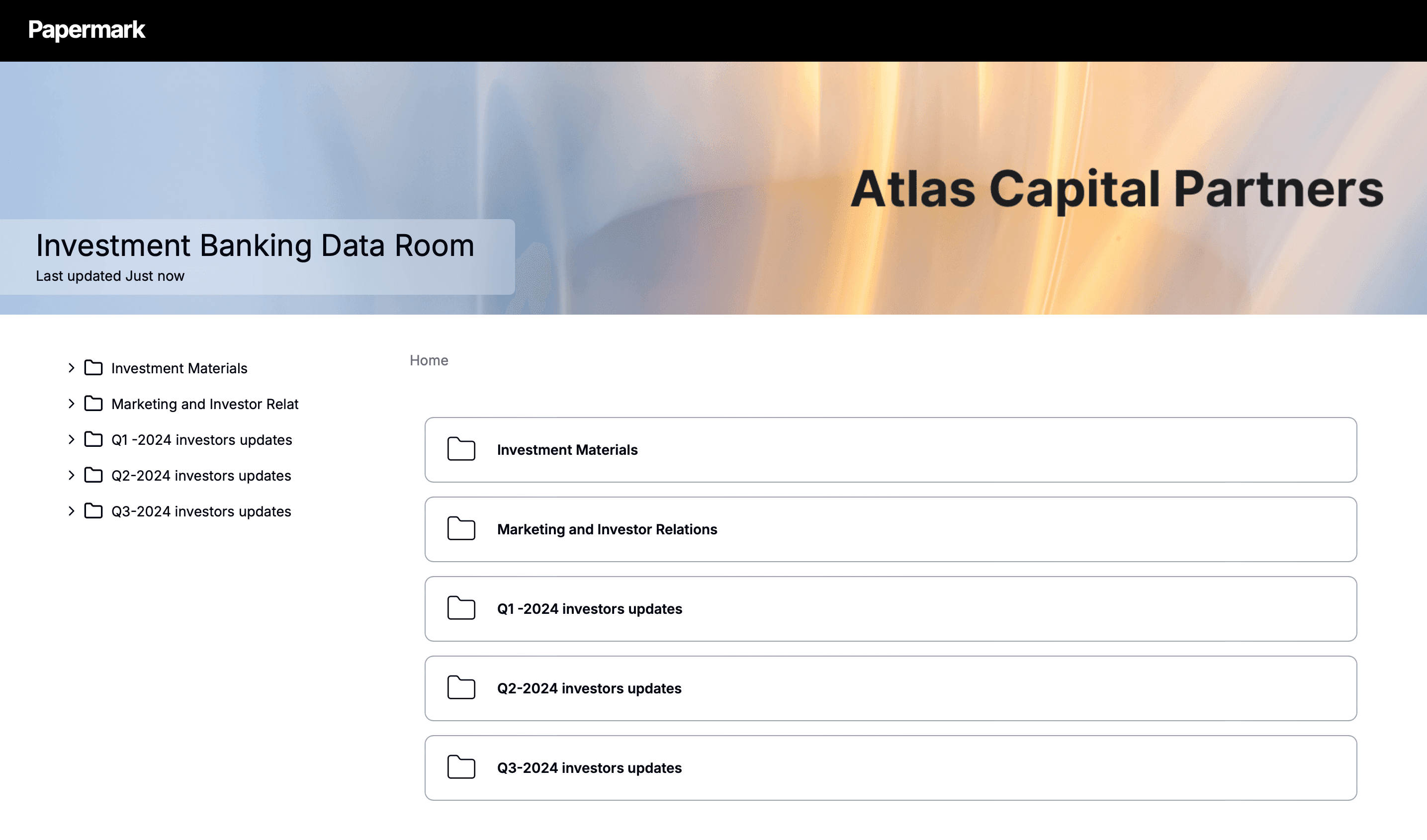
One room, two tiers: what buyers see before the LOI and what the winner sees after.
Set up the room before you sign, so diligence starts the day exclusivity starts. Every day you spend assembling documents after signing is a day of exclusivity used up. A room built in advance also lets you compare buyers on how they engage, not just on what they say. For a comparison of providers, see the best virtual data rooms.
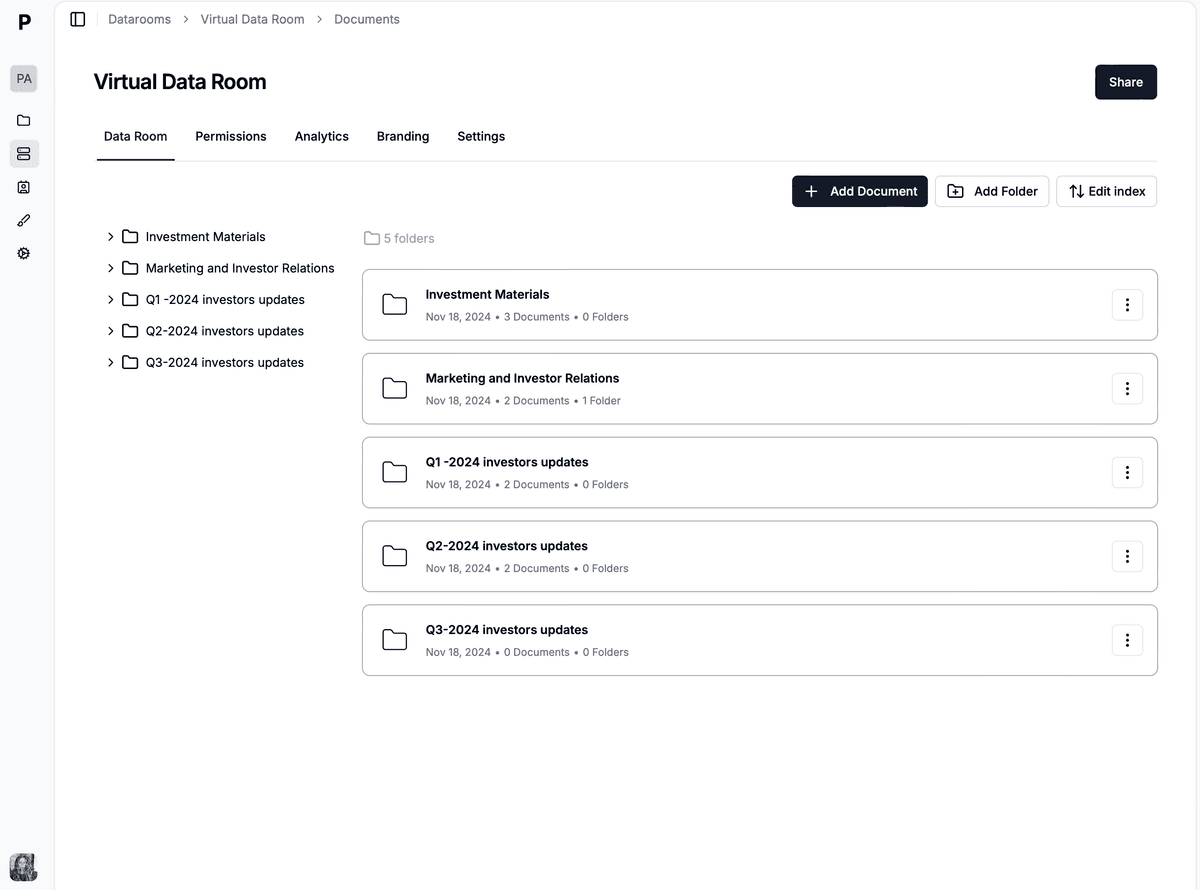
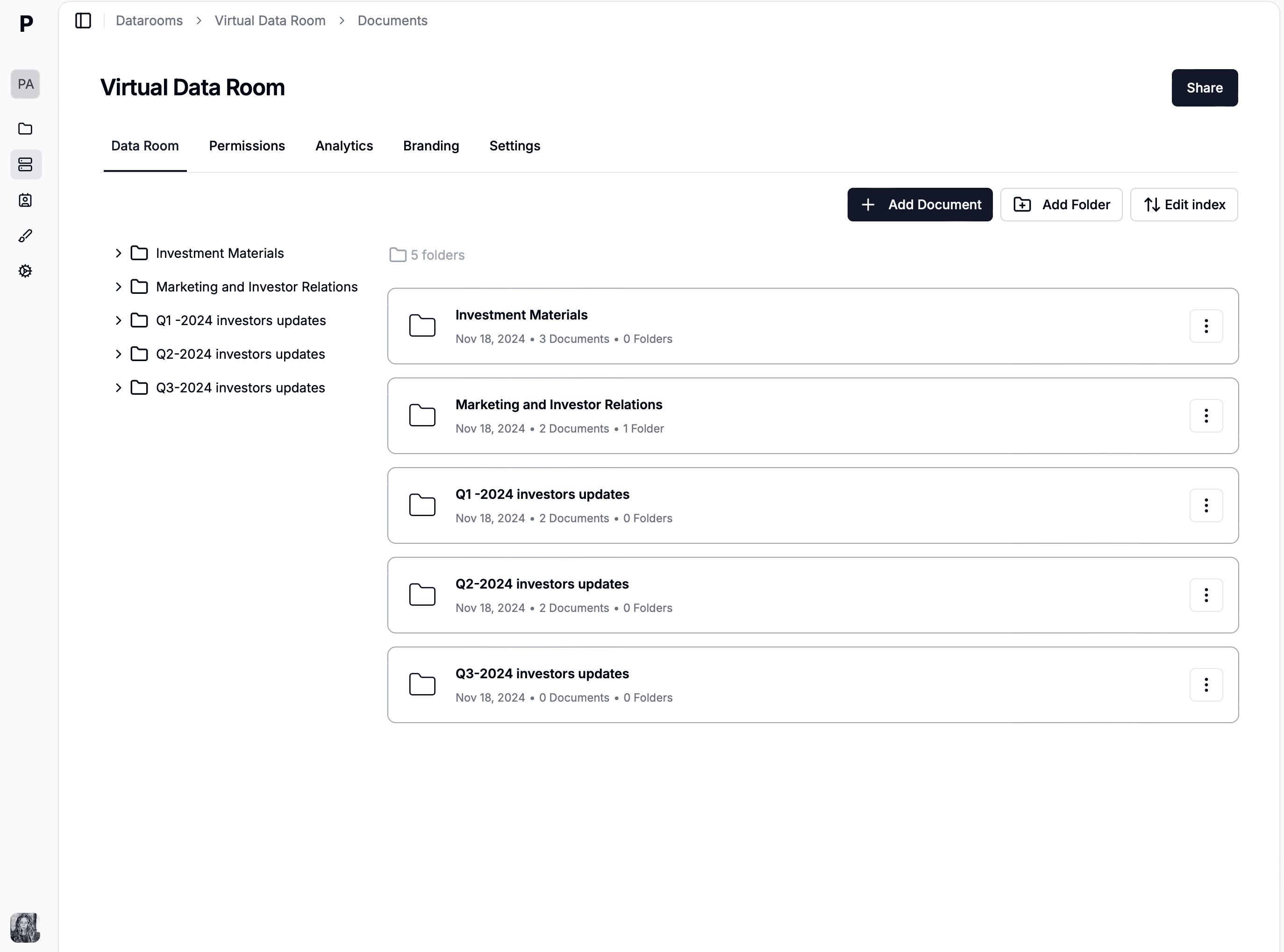
Create folders for the pre-LOI tier (CIM, summary financials, anonymized customer data) and the post-LOI tier (contracts, payroll, detailed financials, IP). Granular permissions control which tier each buyer sees, so you never duplicate files.
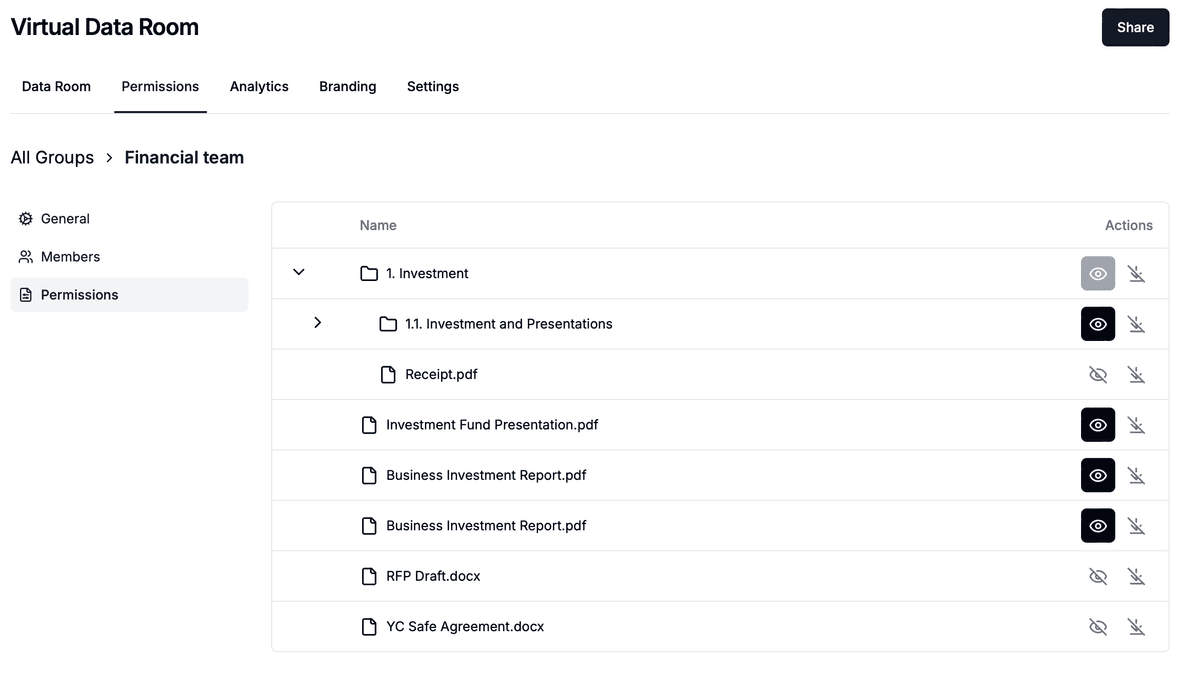
Pre-LOI and post-LOI tiers are a permissions setting, not two separate rooms.
Give each buyer its own link with an email allowlist and an NDA that must be accepted before any document opens. Buyers do not need an account to view.
Turn on dynamic watermarking so every page shows the viewer's email and a timestamp, and set financials and customer data to view-only.

Every page carries the viewer's identity, so a leaked page is traceable.
Page-by-page analytics show which buyer read which document and for how long. A buyer who has read the financials closely is preparing a real bid; one who has opened nothing is not.
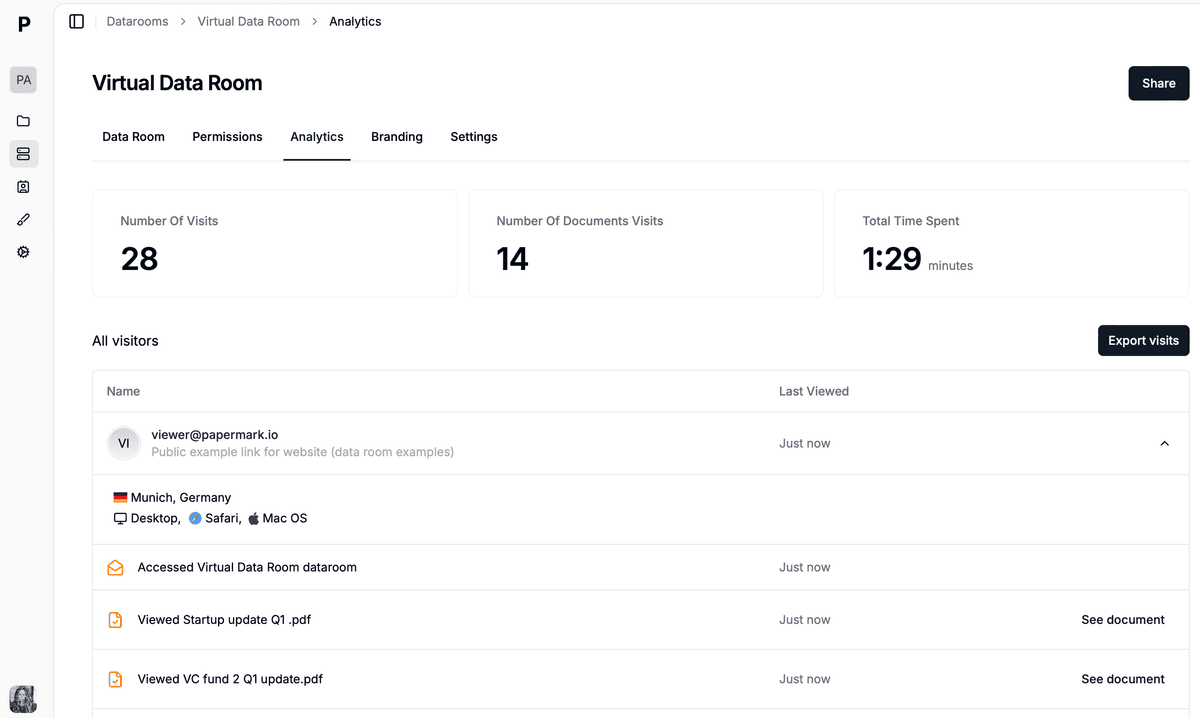
Engagement data is one more input when you choose which LOI to sign.
When the LOI is signed, give the winning buyer access to tier 2 with one permission change, and load its checklist into the request list, so both sides see what is open and what is delivered. Teams that want buyer questions handled inside the room can use the Q&A module on Data Rooms Plus.

Papermark is our #1 VDR provider for M&A transactions right now. In two deals we used custom branding, dynamic watermarking, and granular permissions.
Tyler
The Data Rooms plan is $99/month with a 7-day free trial, and includes 3 team members, unlimited data room visitors, unlimited data rooms and documents, a custom domain, dynamic watermarking, NDA agreements, granular file-level permissions and the request list. Q&A is on Data Rooms Plus, and AI redaction is on Data Rooms Premium and above.
No credit card required.
Buy-side due diligence in 2026: the 7 workstreams, the LOI to signing timeline, real fee ranges, and how to run a data room for buy-side due diligence.
A ready-to-use due diligence template for 2026 with a 150-point checklist covering financial, legal, commercial, operational, and technology diligence.
How to prepare a company for acquisition in 2026: a 24-month exit planning roadmap, a 30-item readiness checklist, asset vs stock sale and the data room.